
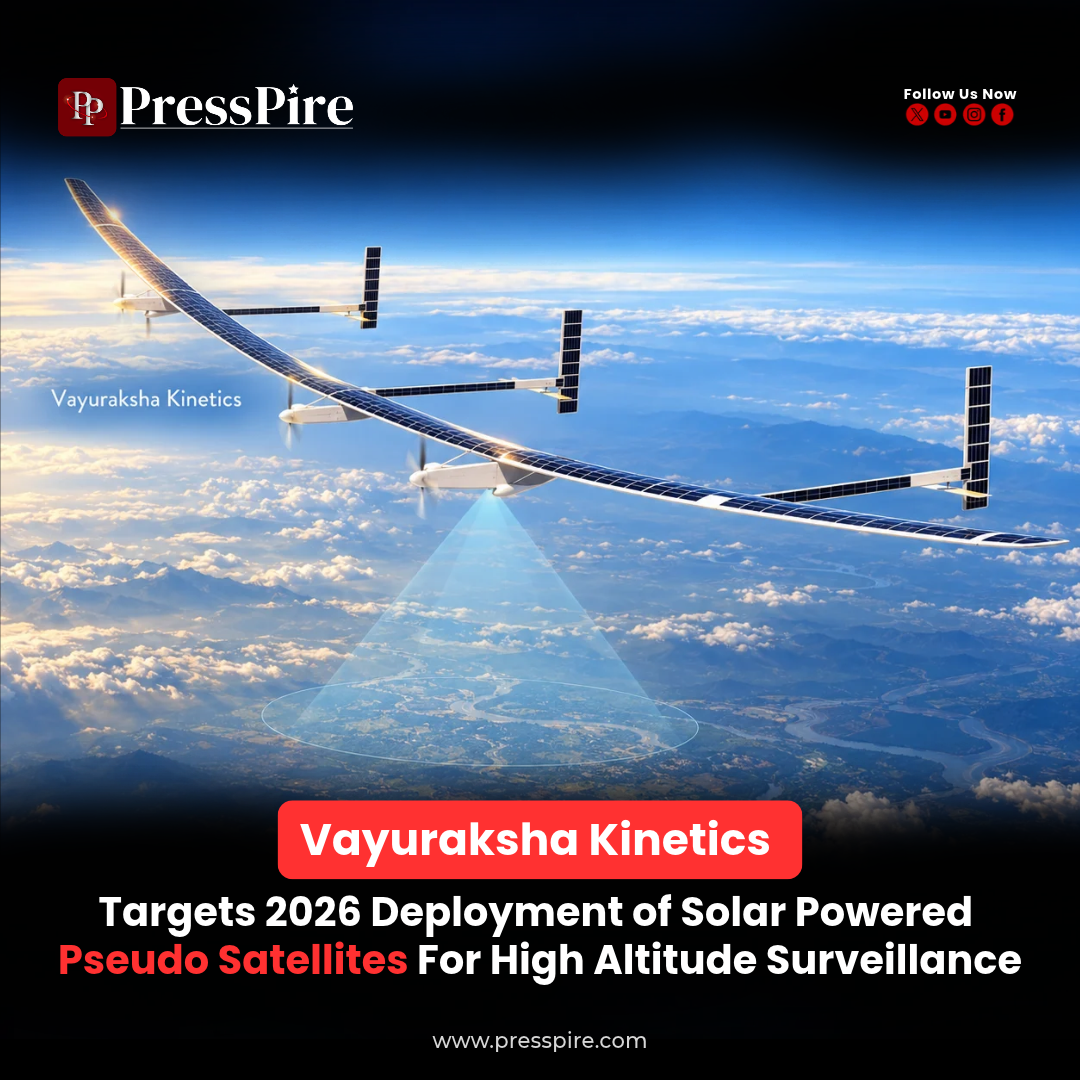
Vayuraksha Kinetics Reportedly Targets 2026 Deployment of Solar-Powered Pseudo-Satellites
The Odisha-registered startup’s reported plans draw attention to high-altitude aircraft designed for prolonged observation and communications.
Vayuraksha Kinetics is reportedly targeting 2026 deployment of solar-powered high-altitude pseudo-satellites, according to an Indian Defence News report published on 14 October. The proposed platforms would support surveillance and monitoring from the stratosphere.
The report places the startup in a technically demanding field that combines aircraft design, solar energy, batteries and communications systems. These platforms aim to remain above an area for extended periods while carrying equipment that observes the ground or relays information.
However, the material reviewed does not establish that Vayuraksha Kinetics has completed an operational deployment. The reported timeline remains a target, with company-specific flight results and customer acceptance still requiring confirmation.
What Is Known About Vayuraksha Kinetics?
Public corporate-information listings identify Vayuraksha Kinetics Private Limited as a company incorporated on 7 April 2026, with a registered office in Bhubaneswar, Odisha.
Its participation in India’s startup ecosystem has independent documentation. The Indian National Academy of Engineering, or INAE, named Vayuraksha Kinetics among the Best Startup Award winners at its Technology Conclave 2026, alongside FxUAV Technologies and IRA.
That recognition establishes a public milestone for the venture. It does not, by itself, verify the specifications or deployment status of a high-altitude aircraft.
For an aerospace startup, the next stage involves demonstrating that a proposed system can perform reliably in its intended environment and deliver useful results for customers.
What Are High-Altitude Pseudo-Satellites?
High-altitude pseudo-satellites, commonly called HAPS, are airborne platforms designed to provide services such as observation or communications from the stratosphere.
They operate within Earth’s atmosphere. The word “pseudo-satellite” refers to the satellite-like services they can provide, including monitoring a region or carrying communications equipment.
HAPS can take several forms, including aircraft, balloons and airships. Solar-powered fixed-wing designs use electricity to sustain flight and operate their onboard equipment.
Their appeal is persistence: a platform can be designed to remain near an area of interest rather than make only a brief observation. A fixed-wing aircraft achieves this through controlled flight and station-keeping, rather than remaining motionless in the air.
The European Space Agency has examined HAPS as a way to complement satellite and ground-based services, particularly where sustained regional coverage would be useful.
How Solar-Powered Aircraft Stay Aloft
Solar-powered HAPS depend on a carefully balanced energy system.
During daylight, solar cells generate electricity for propulsion, onboard electronics and the equipment carried by the aircraft. Batteries store energy that can support operations after sunset.
This approach is documented in established programmes such as AALTO’s Zephyr, whose batteries recharge during the day to power the aircraft and its payload at night.
The engineering challenge is to collect and store sufficient energy while keeping the aircraft light. Larger batteries can store more power, but their additional weight also affects flight performance.
Sensors and communications equipment introduce further demands. Their weight and electricity consumption must fit within the aircraft’s available capacity.
These principles explain how solar-powered HAPS work generally. Vayuraksha Kinetics’ detailed energy system, payload capacity and demonstrated endurance were not established in the material reviewed.
Why Persistent Observation Matters
The potential benefit of a high-altitude platform is the ability to observe changes over time.
For example, emergency teams responding to a flood may need repeated information about affected roads and settlements. Environmental agencies may need continuing observations of a developing situation rather than a single image.
The usefulness of such a service depends on more than altitude. It also requires suitable sensors, reliable communications and information that reaches users in time to support decisions.
Potential applications across the HAPS sector include:
| Application | Potential contribution |
|---|---|
| Surveillance and security | Repeated observation of a defined area |
| Disaster response | Monitoring affected locations and supporting emergency communications |
| Remote connectivity | Providing communications coverage where ground infrastructure is limited |
| Environmental monitoring | Collecting observations over extended periods |
| Maritime monitoring | Supporting awareness of activity across coastal or offshore areas |
These are applications of the technology category, rather than confirmed customer deployments by Vayuraksha Kinetics.
Could HAPS Improve Connectivity in Remote Areas?
Communications is another area of interest.
The International Telecommunication Union identifies high-altitude platforms as a potential means of delivering broadband access and providing links between mobile networks and their core infrastructure.
An airborne communications platform could be useful where geography makes ground infrastructure difficult to establish or where a disaster has interrupted existing services.
However, the aircraft is only part of the service. Communications equipment, ground connections and network integration must work together to deliver usable connectivity.
The commercial case therefore depends on the location, coverage requirements and available alternatives. HAPS may complement existing infrastructure in suitable circumstances; they do not automatically replace terrestrial networks or satellite services.
India’s Wider High-Altitude Aircraft Research
India already has research activity in this field through CSIR–National Aerospace Laboratories, or CSIR-NAL.
The laboratory’s published overview describes a one-third-scale high-altitude platform that flew for more than 10 hours at 25,000 feet, using solar and battery power.
Those results belong to CSIR-NAL’s programme. They provide context for India’s broader development efforts without establishing the performance of Vayuraksha Kinetics’ proposed platform.
The distinction is important because successful development requires evidence from the aircraft being evaluated. Results from another organisation cannot substitute for testing of a startup’s own design.
The Business Challenge Beyond Building an Aircraft
For a company entering this market, a successful flight is an important milestone. Building a dependable service requires further work.
A prospective customer will need to understand how long the platform can operate, what information it can collect or transmit, and how consistently it can support a mission.
Costs also extend beyond manufacturing. Ground operations, maintenance, communications equipment and support personnel contribute to the economics of a deployment.
From a business perspective, the opportunity depends on whether the complete system can meet a customer’s needs at a suitable cost. Broad claims about being cheaper than satellites cannot establish that case without a defined mission and a comparable service.
What Comes Next for Vayuraksha Kinetics?
The most useful next disclosures would be a company-confirmed development schedule, documented flight results and clear specifications for the proposed platform.
Evidence of sustained operation with a working payload would help readers and potential customers assess progress beyond the initial concept. Customer trials and delivery announcements would provide further commercial milestones.
Vayuraksha Kinetics’ reported plans bring attention to an emerging aerospace opportunity. Its progress will be measured by what its own aircraft demonstrates and the services it can reliably deliver.
For more insights navigate: PressPire | Stories That Shape the Future
Read previous article here : sarvam-ai-bulbul-v4-flash-text-to-speech/
Follow PressPire on Facebook | Instagram | LinkedIn | YouTube
PressPire | Stories That Shape the Future