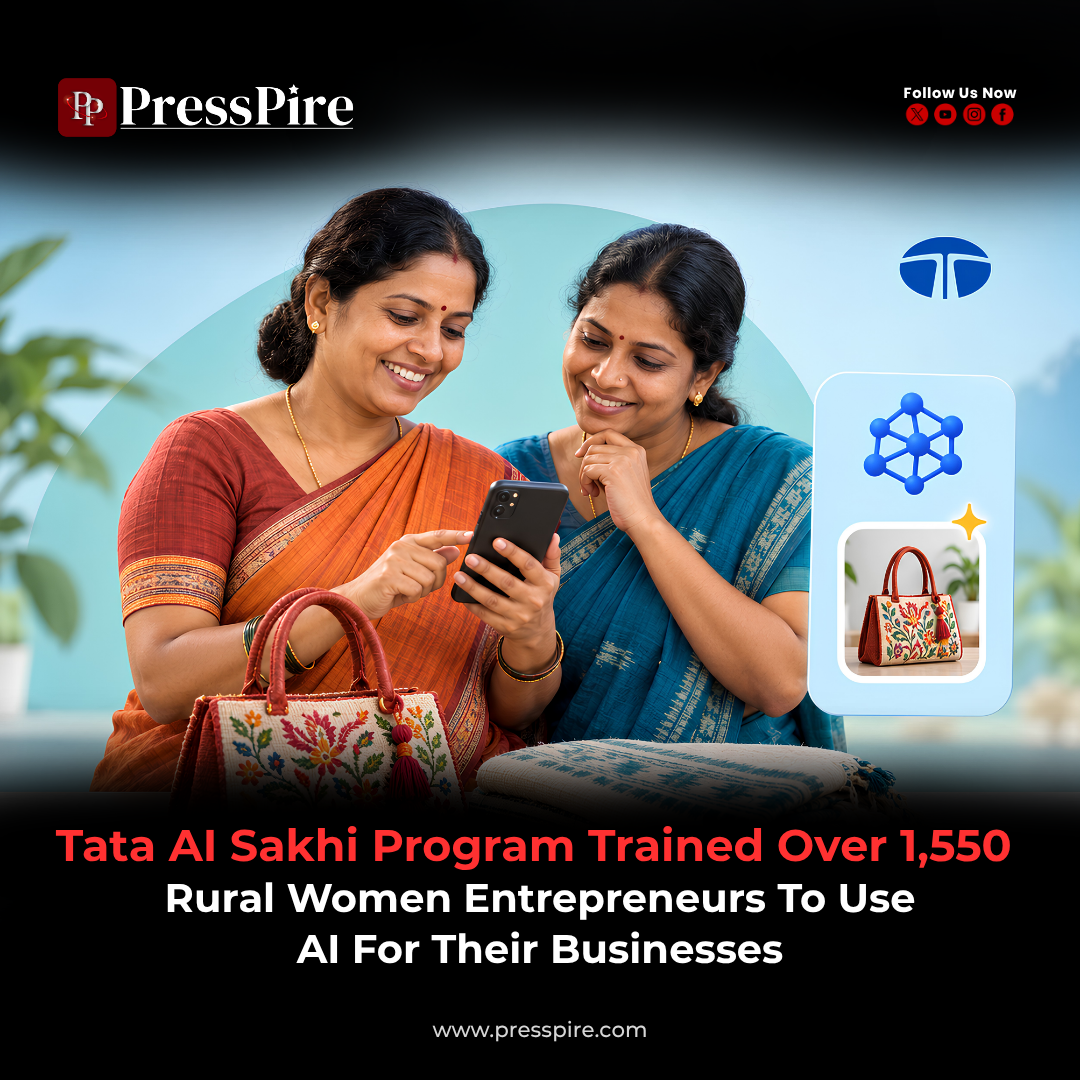
Tata AI Sakhi Program Trains 1,553 Rural Women to Use AI for Business
The Tata AI Sakhi Immersion Programme brought artificial intelligence directly to rural women entrepreneurs, artisans and self-help group leaders, showing how AI can be used for everyday business and livelihood activities.
Held at Bharat Mandapam in New Delhi during the India AI Impact Summit 2026, the programme brought together 1,553 women from rural India for a hands-on AI learning session. Over approximately 2.5 hours, participants completed 4,727 AI-powered tasks using their own smartphones.
The programme was designed around practical use rather than theoretical discussions. Participants explored AI for product design, marketing, business communication, translation, government schemes and other activities relevant to their daily work.
The initiative was organised by the Tata Group, with women mobilised through community and livelihood programmes run by TCS, Tata Steel, Tata Power and Tata Chemicals.
A Different Approach to AI Training
The Tata AI Sakhi programme was built around a simple idea: AI should be accessible to people who may not have a technical background.
Many of the participating women had little or no previous experience with AI. Instead of requiring computers, specialised software or technical training, the programme used the participants’ own smartphones.
The session also focused on making AI accessible through language. Tata’s detailed account says the immersion was conducted in Hindi, with voice input helping reduce literacy and technical barriers.
This allowed participants to interact with AI more like a digital assistant than a complex technical system.
The programme therefore focused on showing what women could actually accomplish with AI rather than simply explaining what artificial intelligence is.
1,553 Women Completed 4,727 AI Tasks
The scale of the session was one of its most notable features.
According to TCS, 1,553 women completed 4,727 AI-powered tasks in 2.5 hours
The participants were organised into three groups:
- Artisanal cohort
- Digitally Literate – Basic cohort
- Digitally Literate – Advanced cohort
The programme used a high-touch mentoring model, with approximately one mentor for every five participants. Around 400 trained mentors supported the women during the session.
This meant participants could work through the AI exercises with direct guidance rather than simply watching demonstrations.
What the Women Used AI For
The programme focused on practical tasks connected to entrepreneurship, crafts and community activities.
Participants used AI to:
- Explore new product and craft designs
- Create product photographs
- Develop marketing materials
- Draft business communications
- Translate documents
- Understand government schemes
- Prepare applications
- Identify objects using AI
- Explore ideas for business growth
The objective was to demonstrate how AI could become part of everyday work rather than remain a technology used only by large companies or highly trained professionals.
For small entrepreneurs, even relatively simple AI applications can reduce the time required for tasks such as preparing promotional material or writing business communication.
For artisans, AI can also provide a way to visualise potential designs before producing physical products.
Traditional Artisans Explored AI for Product Design
A significant part of the programme focused on traditional artisans.
According to TCS, 447 traditional artisans used AI to generate design ideas, product photographs and innovation concepts connected to crafts including Pattachitra, Madhubani and Dokra.
For artisans, the technology was demonstrated as a creative support tool.
Instead of producing multiple physical versions of an idea before deciding on a design, an artisan can use AI to explore visual concepts first.
The programme demonstrated how this could potentially help artisans think about new designs and promotional material while retaining their existing craft practices.
The programme did not claim that AI would replace traditional craftsmanship. Rather, the focus was on using AI as an additional tool available to the artisan.
Self-Help Group Women Used AI for Business Tasks
The programme also included women associated with self-help groups and grassroots entrepreneurship.
TCS reported that 940 women from self-help groups used AI for activities such as identifying objects, navigating government schemes, creating marketing materials and drafting business communications.
These are relatively practical applications of AI.
For a woman running a small enterprise, for example, preparing a promotional message or creating basic marketing material can take time and may require assistance.
The programme demonstrated that these tasks could be attempted directly through an AI tool on a smartphone.
The government-scheme component was another important part because AI was demonstrated as a way to help users understand documents and information that may otherwise be difficult to navigate.
Advanced Entrepreneurs Explored AI for Growth
The third group consisted of women who already had greater digital familiarity.
TCS said 166 advanced digital entrepreneurs, described as women already earning around ₹20,000 per month, explored AI for self-learning and business growth.
This cohort was able to move beyond introductory use cases and explore how AI could support their existing businesses.
The programme therefore did not treat all participants as having the same level of digital experience.
Instead, the three-cohort structure allowed the training to cover different starting points, from traditional artisans to women with more advanced digital skills.
AI Training Was Delivered Through Smartphones
One of the most important aspects of Tata AI Sakhi was the decision to use devices that participants already had.
The women worked on their own smartphones instead of being introduced to specialised computer systems.
This matters because smartphone access is much more common than access to dedicated computing equipment, particularly for people running small businesses in rural areas.
Tata’s account also highlights voice input as an important accessibility feature. Participants could interact with AI without relying entirely on typing, helping reduce the barrier created by literacy or unfamiliarity with English-language technology.
The approach effectively positioned the smartphone as the entry point to AI.
Mentors Played a Central Role
The programme was not simply a self-service AI workshop.
Around 400 trained mentors were present, with approximately one mentor supporting every five women.
The mentors helped participants work through tasks and solve problems in real time.
This high-touch approach was particularly relevant because many participants were first-time AI users.
The programme’s reported completion figures also show strong participation. TCS reported a 98% completion rate for the advanced cohort, while Tata’s detailed account reports 97% completion for the basic digital entrepreneur cohort and 98% for the advanced cohort.
The Programme Also Taught Responsible AI Use
The training did not focus only on what AI can do.
Participants were also reminded that AI systems can make mistakes and that sensitive personal information should not be shared with AI tools.
Tata specifically highlighted guidance around protecting information such as Aadhaar numbers and other personally identifiable information.
This was an important part of the programme because many first-time users may focus on the convenience of AI without immediately understanding its privacy implications.
The message was straightforward: AI can be useful for business and everyday tasks, but users still need to verify information and protect sensitive data.
A Real Example From the Programme
The impact of the training was illustrated through participants’ experiences.
Kumari Pradhan, a grassroots facilitator from Jharkhand, works with communities on digital services and government schemes.
She explained that AI allowed her to photograph a document and ask an AI application to explain it in simple Hindi. This helped her understand documents more quickly and assist other women without having to wait for additional help.
The example demonstrates a practical use of AI that does not require advanced technical knowledge.
Instead, the technology becomes a tool for interpreting information and supporting community-level work.
Tata AI Sakhi Was Built on Existing Community Programmes
The programme did not start from zero.
The women were mobilised through existing Tata Group community development and livelihood initiatives.
Tata says participants came through programmes associated with TCS, Tata Steel, Tata Power and Tata Chemicals, giving the initiative access to communities where women had already been involved in digital, livelihood or other development programmes.
The preparation also included a pilot.
Tata’s detailed account says the programme was first tested with 330 women across five states — Jharkhand, Maharashtra, Bihar, Rajasthan and Gujarat — before the larger session was conducted.
This pilot helped the organisers test the training format before scaling it to the larger group at the India AI Impact Summit.
Tata Group’s Broader AI Vision
The AI Sakhi programme was part of Tata Group’s broader presence at the India AI Impact Summit 2026.
Tata Sons Chairman N. Chandrasekaran has argued that AI should become accessible to every individual and citizen, including people at the grassroots level. He specifically referred to the experience of the rural women at the summit as an example of how people without computing backgrounds could begin using AI within a short period.
The Tata Group’s approach at the summit therefore extended beyond enterprise AI.
The AI Sakhi programme represented the group’s effort to demonstrate how AI could be introduced to communities that are not traditionally part of technology ecosystems.
The Programme Focused on Economic Independence
Tata positioned AI Sakhi around entrepreneurship, self-reliance and economic opportunity.
For women running small enterprises, AI can potentially support several activities that are normally difficult to manage alone, including marketing, communication, product presentation and information access.
However, the programme itself does not provide evidence that participants’ incomes increased as a direct result of the workshop.
The immediate measurable outcomes reported by Tata and TCS are the number of women participating, the number of AI tasks completed and the task-completion rates.
This distinction is important. The programme demonstrated practical AI use; longer-term business and income outcomes would require follow-up measurement.
Tata Plans to Expand the Initiative
The Tata AI Sakhi programme is not described as a one-off effort.
TCS’s FY2025-26 annual report says the initiative is intended to scale through broader regional outreach, expanded mentorship networks and deeper ecosystem partnerships, with the goal of empowering thousands of women as AI-enabled entrepreneurs and community change agents.
This suggests that the February 2026 immersion was intended as an early large-scale demonstration of a wider model.
The next stage will be whether the training can be taken beyond a large event and converted into sustained AI adoption among women in their own communities and businesses.
Why Tata AI Sakhi Matters for Rural Entrepreneurship
The significance of Tata AI Sakhi is not simply the number of women who attended.
The programme demonstrates a particular model for AI adoption: smartphone-first, language-accessible, mentor-supported and focused on practical tasks.
Instead of asking rural entrepreneurs to become technology experts, the programme introduced AI through activities they already understand — designing products, promoting businesses, communicating with customers and accessing information.
That approach could make AI easier to adopt among small entrepreneurs who have limited time, resources or technical training.
Tata AI Sakhi in Numbers
| Programme detail | Reported figure |
|---|---|
| Women participants | 1,553 |
| AI tasks completed | 4,727 |
| Duration | 2.5 hours |
| Traditional artisans | 447 |
| Women from self-help groups | 940 |
| Advanced digital entrepreneurs | 166 |
| Mentorship model | 1 mentor for about 5 participants |
| Advanced cohort completion | 98% |
| Venue | Bharat Mandapam, New Delhi |
| Event | India AI Impact Summit 2026 |
The figures above are based primarily on Tata Group and TCS’s published accounts of the programme.
What Comes Next
The immediate achievement of Tata AI Sakhi was demonstrating that rural women with limited previous exposure to AI could begin using the technology for practical activities within a short, structured session.
The longer-term objective is more ambitious.
TCS says the initiative is intended to expand through regional outreach, larger mentorship networks and partnerships.
If that expansion is sustained, the programme could move from a large-scale demonstration at an AI summit to a broader grassroots learning network.
For now, the most clearly documented result is already significant: 1,553 rural women completed thousands of practical AI tasks using smartphones in a single 2.5-hour immersion.
That makes Tata AI Sakhi an example of how AI education can be introduced outside traditional technology and corporate environments — directly into the businesses, crafts and community activities of rural women.
Tata AI Sakhi Brings AI to Rural Women Entrepreneurs
The Tata AI Sakhi Immersion Programme trained 1,553 rural women to explore practical applications of artificial intelligence for entrepreneurship, crafts and everyday activities.
The programme focused on real tasks rather than theoretical lessons, with participants completing 4,727 AI-powered tasks in 2.5 hours. Traditional artisans explored product designs and marketing, self-help group members worked on business communication and government schemes, while advanced entrepreneurs explored AI for self-learning and business growth.
The initiative also demonstrated the importance of accessibility. Participants used their own smartphones, received direct mentorship and worked with AI in a language-focused environment designed to reduce technical and literacy barriers.
TCS has said the initiative is intended to expand through wider regional outreach, stronger mentorship networks and ecosystem partnerships.
For more insights navigate: PressPire | Stories That Shape the Future
Read previous article here: takeme2space-ai-satellite-moi-1a/
Follow PressPire on Facebook | Instagram | LinkedIn | YouTube
PressPire | Stories That Shape the Future