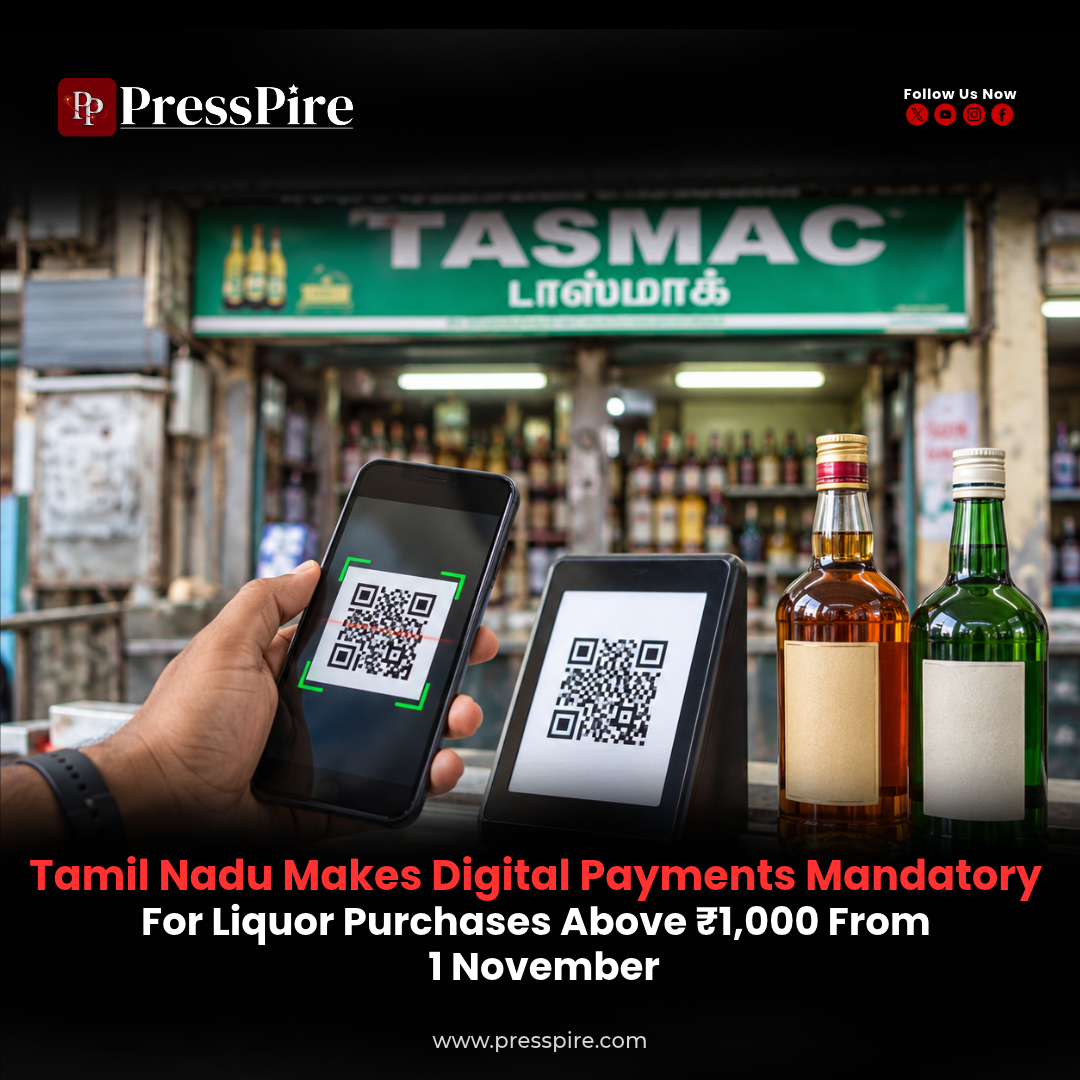
The requirement will apply to individual liquor purchases at TASMAC outlets, with the threshold falling to above ₹500 from January 2027.
TASMAC digital payments will become mandatory for liquor purchases exceeding ₹1,000 from 1 November 2026, as Tamil Nadu’s state-run retailer introduces a phased restriction on cash transactions.
The threshold will be lowered further on 1 January 2027, when purchases above ₹500 will require electronic payment.
The directive covers approximately 4,048 TASMAC retail outlets across Tamil Nadu. Customers making purchases above the applicable limit will need to pay through authorised UPI, debit-card or credit-card facilities.
According to reports quoting a circular issued by TASMAC managing director K. Nanthakumar, the move aims to reduce cash handling, improve accounting and address complaints of customers being charged above the maximum retail price.
TASMAC Digital Payments: Dates and Purchase Limits
The requirement will be introduced in two stages:
| Effective date | Single-purchase value requiring digital payment |
|---|---|
| 1 November 2026 | Above ₹1,000 |
| 1 January 2027 | Above ₹500 |
The threshold applies to the value of an individual transaction.
For example, a ₹1,200 bill would require digital payment under the November rule. An ₹800 bill would fall within the digital-payment requirement once the lower threshold takes effect in January.
The reported wording specifies purchases above the stated amounts. The measure is a restriction on cash payments for transactions exceeding those limits, rather than a complete withdrawal of cash payment at every purchase value.
Why TASMAC Is Changing Its Payment Rules
TASMAC has cited several operational concerns associated with handling large amounts of cash.
These include the security of sales proceeds, the burden of depositing collections in banks, counterfeit currency risks and differences between cash received and recorded sales.
The directive also responds to complaints about amounts being collected above the maximum retail price, or MRP.
Electronic payments can provide a transaction record showing the amount transferred. When that record is matched with a correctly issued bill and the outlet’s accounts, it can help managers investigate discrepancies.
The intended improvement is therefore broader than changing the payment method. It involves linking the payment, sales receipt and accounting entry so that each transaction can be checked.
Payments Must Go Through Official Accounts
A central part of the directive concerns where the money is received.
Employees have been prohibited from collecting sales proceeds through their personal UPI IDs, personal QR codes or personal bank accounts. Unauthorised payment accounts are also prohibited.
Payments must use TASMAC’s prescribed facilities connected to the corporation’s designated bank accounts.
This distinction matters because a payment can be digital without entering the retailer’s official accounting system. Routing transactions through approved facilities helps ensure that the amount paid is recorded as an outlet sale.
Reports state that employees violating these instructions could face disciplinary action.
Payment Terminals Must Be Available and Working
District managers have been instructed to ensure that outlets have functioning point-of-sale terminals, commonly called PoS machines, connected to the appropriate bank accounts.
The reported instructions also cover staff training in digital transactions and reconciliation—the process of checking that payment records match sales and accounts.
Faults involving payment terminals, internet connectivity or servers must be reported promptly. Officials have also been told to record the time and duration of disruptions.
These requirements will be important during implementation. A mandatory payment method needs dependable equipment and a clear process for resolving technical problems.
Customers’ experience will depend on whether those arrangements work consistently across outlets.
A Bill Must Be Issued for Every Sale
The circular reiterates that every sale must be accompanied by a bill.
According to the reported instructions, the amount collected must match the bill, and sales must be entered correctly in the accounts. Shops should not collect an additional amount beyond the billed sum.
A bill and an electronic payment record serve different purposes. The bill identifies the sale, while the payment record shows the transfer of money. Keeping both can make it easier to explain a disputed transaction.
The effectiveness of the policy will depend on correct billing alongside the shift to digital payment.
Notices, Complaints and Monitoring
Outlets have been directed to display notices explaining the payment requirements and complaint arrangements.
Published reports identify 1800 889 2015 as the toll-free complaint number for reporting overcharging and other irregularities.
Supervisors are expected to inform district managers about complaints and violations. The circular also calls for inspections and regular monitoring reports to assess implementation.
These measures place responsibility on both shop-level employees and the officials overseeing outlets. Displaying the rules clearly should also help customers distinguish an authorised requirement from an informal demand at the counter.
What Changes for Customers?
The immediate change is the payment method required when a single purchase exceeds the relevant threshold.
The instructions identify UPI, debit cards and credit cards as accepted electronic options. Customers should also receive a bill and should be directed to the outlet’s official payment facility.
The reported order concerns TASMAC retail shops. Its scope should not automatically be extended to every hotel, restaurant, bar or other licensed establishment in Tamil Nadu.
The two-stage schedule also matters: the ₹500 threshold begins in January 2027, while the November change applies to purchases above ₹1,000.
Implementation Will Determine the Outcome
The Times of India reported that earlier efforts to encourage digital payments and prevent overcharging had faced inconsistent implementation.
The latest directive adds transaction-value thresholds to the requirements for official payment accounts, working terminals and receipts.
Its practical impact will depend on whether customers can use the prescribed facilities, receive accurate bills and have complaints addressed. Those everyday outcomes will determine how effectively TASMAC’s digital-payment rules improve accountability across its retail network.
For more insights navigate: PressPire | Stories That Shape the Future
Read previous article here : tata-communications-ai-super-highway-2/
Follow PressPire on Facebook | Instagram | LinkedIn | YouTube
PressPire | Stories That Shape the Future