
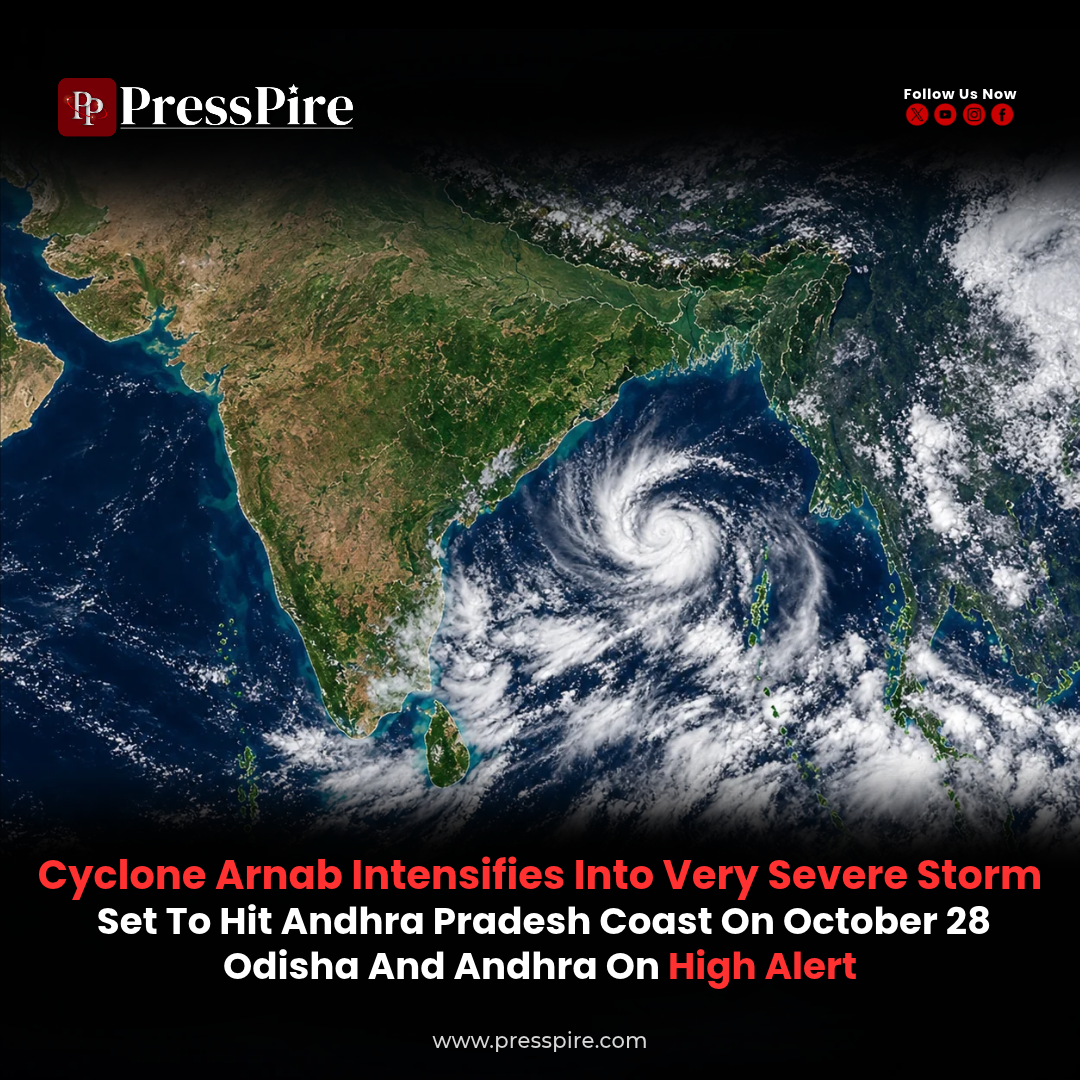
Cyclone Arnab Becomes Very Severe Storm; Andhra Pradesh Landfall Forecast for October 28
Heavy rainfall, damaging winds and coastal flooding threaten parts of Andhra Pradesh and Odisha as authorities prepare shelters and emergency response teams.
Forecast reference: IMD assessment at 02:30 IST on 27 October 2026
Cyclone Arnab has intensified into a very severe cyclonic storm over the west-central Bay of Bengal, prompting warnings for Andhra Pradesh and adjoining southern Odisha.
The India Meteorological Department expects the storm to cross the Andhra Pradesh and Yanam coasts between Bapatla and Visakhapatnam, close to Yanam, by the forenoon of October 28, 2026.
The forecast has placed coastal communities and emergency agencies on alert, with heavy rainfall, strong winds and rising coastal water levels among the principal threats.
Cyclone Arnab’s Position and Landfall Forecast
At 02:30 IST on October 27, Arnab was approximately 300 kilometres southeast of Visakhapatnam and 360 kilometres east-southeast of Kakinada.
Its maximum sustained winds were estimated at 125–135 kmph, gusting to 150 kmph.
IMD forecast a west-northwestward movement until the evening of October 27, followed by a northwestward turn towards the coast. At landfall, maximum sustained winds are forecast at 115–125 kmph, with gusts reaching 140 kmph.
These figures refer to different stages of the storm. The stronger offshore winds recorded or forecast before landfall should not be presented as the expected wind speed at every coastal location.
The predicted crossing point and timing may change as further observations become available.
Heavy Rainfall Warning for Andhra Pradesh and Odisha
Coastal Andhra Pradesh is forecast to receive heavy to very heavy rainfall at a few places on October 27 and 28, with isolated extremely heavy rainfall.
In the bulletin, extremely heavy rainfall refers to amounts of 21 centimetres or more. This is a warning for isolated locations, rather than a forecast of that amount across the entire state.
Southern Odisha also faces heavy to very heavy rainfall, with isolated extremely heavy rainfall possible on October 28. Heavy rain could continue in parts of the region after the storm crosses the coast.
The concern extends beyond the immediate landfall area. Prolonged rainfall can affect inland communities, drainage systems and access roads even where winds are less intense.
Storm Surge Threat Near Kakinada and Yanam
IMD has forecast a storm surge of approximately 1–1.5 metres above the astronomical tide around landfall, with the highest surge expected near Kakinada and Yanam.
This could inundate low-lying coastal areas. The surge estimate describes an additional rise above the expected tide; it should not be read as a uniform flood depth for every nearby settlement.
Sea conditions are also expected to deteriorate sharply. Fishermen have been advised against venturing into the west-central Bay of Bengal and along and off the Andhra Pradesh and Odisha coasts from October 27 to 29.
Fishing communities should follow subsequent marine warnings before resuming operations.
Authorities Prepare Shelters and Rescue Teams
The National Crisis Management Committee reviewed cyclone preparedness on October 26 in a meeting chaired by Cabinet Secretary T. V. Somanathan.
According to the government’s account, state and local administrations reported that shelters and evacuation arrangements had been prepared. District control rooms were activated to monitor conditions and coordinate the response.
The National Disaster Response Force reported deploying teams, with additional personnel on standby. Rescue resources from the Army, Navy, Air Force and Indian Coast Guard were also kept ready.
Officials were directed to prioritise preventing loss of life, limiting infrastructure damage and restoring essential services quickly if disruption occurred.
Odisha Strengthens Local Preparedness
Odisha has mobilised disaster response personnel and directed officials to remain available for emergency duties.
Chief Minister Mohan Charan Majhi instructed authorities to prioritise evacuation and public safety, despite the forecast placing landfall in neighbouring Andhra Pradesh.
Reported measures include cancelling leave for officials in critical offices and deploying disaster response and fire-service teams to vulnerable areas.
In Andhra Pradesh, the health department has also been placed on alert, with instructions to maintain emergency medical services during the cyclone period.
What Residents Should Do Before Conditions Worsen
NDMA’s cyclone guidance emphasises early preparation and following official evacuation instructions.
Residents in areas covered by warnings should:
- Leave when instructed: Move to the designated shelter or safe location using the route advised by local authorities.
- Prepare essential supplies: Keep drinking water, ready-to-eat food, necessary medicines, a torch and important documents accessible.
- Keep phones charged: Preserve battery power and keep emergency contact details available.
- Avoid floodwater: Do not walk or drive through flooded roads, and stay away from fallen electricity lines.
- Use official updates: Check IMD forecasts and district administration announcements before making travel decisions.
- Wait for the all-clear: A temporary reduction in wind does not necessarily mean the cyclone has passed.
People living in unsafe structures should seek shelter early, before strong winds make movement dangerous.
Further Updates Will Determine Local Action
The most useful updates will concern changes to the forecast track, district rainfall warnings, evacuation instructions and transport advisories.
School closures, service cancellations and restrictions should be checked against announcements from the relevant local authority or operator.
This report reflects the forecast reference stated above. Residents should follow subsequent IMD bulletins and district instructions as conditions develop.
For more insights navigate: PressPire | Stories That Shape the Future
Read previous article here : tasmac-digital-payments-1000-rule-november-2026/
Follow PressPire on Facebook | Instagram | LinkedIn | YouTube
PressPire | Stories That Shape the Future