
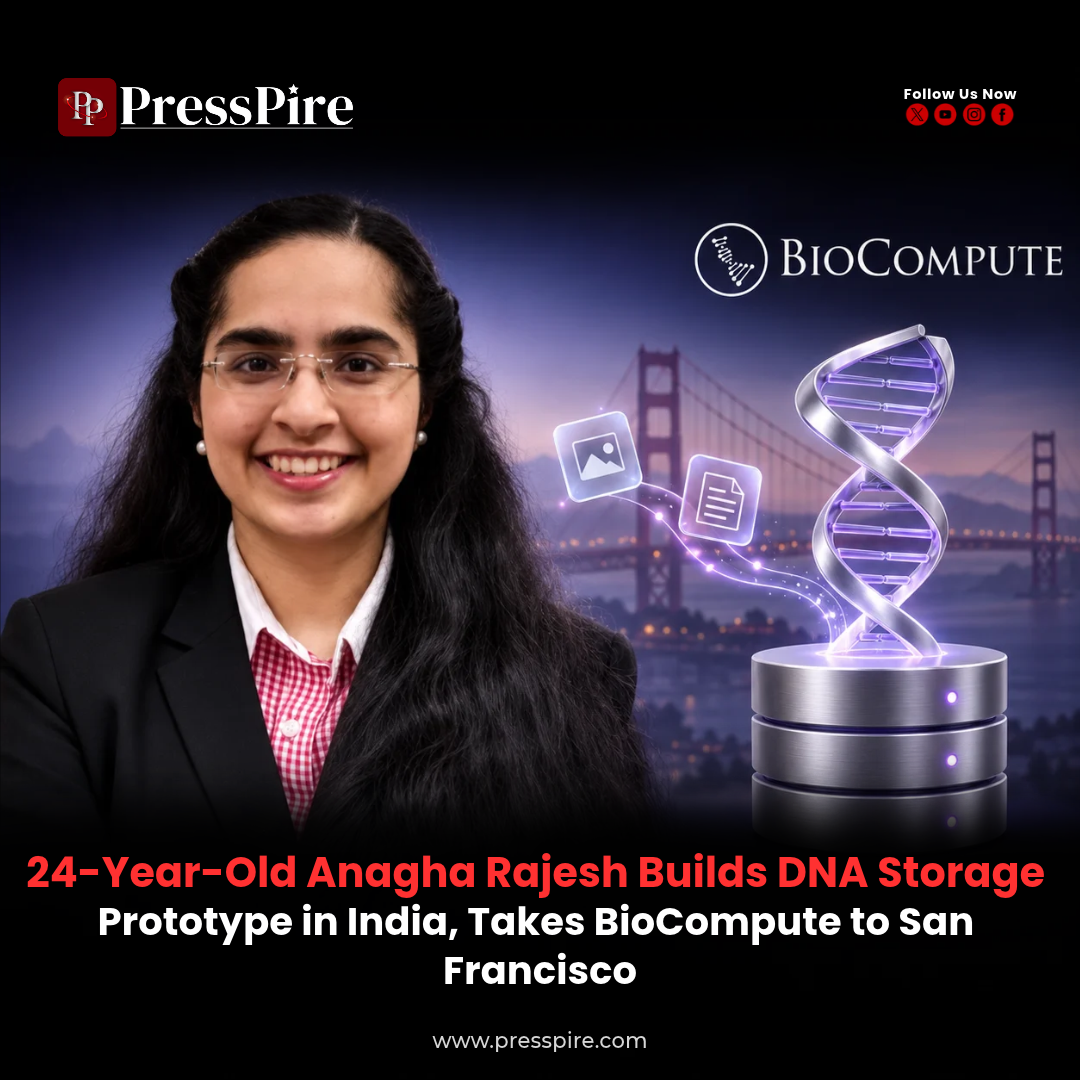
24-Year-Old Anagha Rajesh Builds DNA Storage Prototype in India, Takes BioCompute to San Francisco
The BioCompute founder developed a prototype with her Bengaluru team and moved the startup to the US as it worked towards bringing DNA-based storage hardware to customers.
Anagha Rajesh, the 24-year-old founder of BioCompute, is building a company around an unusual approach to digital infrastructure: storing information in DNA.
After developing a prototype with her team in Bengaluru, she took the startup to San Francisco. The move, announced in June 2026, marked a transition towards further product development and commercialisation.
Her story connects laboratory research, early funding and the difficult decisions involved in taking an experimental technology to market.
Who Is Anagha Rajesh?
Anagha Rajesh is a 2024 graduate of BITS Pilani’s K K Birla Goa Campus. Her university’s alumni newsletter identifies her as the founder who took BioCompute to San Francisco after developing its technology in India.
In her early writing about the company, Rajesh described reading research on storing information in DNA and investigating why the technology had not become widely usable.
Those questions led her towards the practical problems of cost and integration: how to make DNA storage affordable and connect its different operations within a usable system.
She also explored entrepreneurship while studying. In her account of BioCompute’s beginnings, she described applying to gradCapital’s Atomic Fellowship and securing an Emergent Ventures grant in December 2023.
The business grew from an interest in the science into an effort to build the equipment, software and organisation needed to use it.
How BioCompute Developed Its Prototype in India
BioCompute’s published timeline records its establishment in January 2024.
The company says it began incubation at Bengaluru’s Centre for Cellular and Molecular Platforms, or C-CAMP, in July that year. It subsequently operated a home laboratory before establishing its own workspace in Koramangala.
A key milestone came in April 2025, when the company says it successfully wrote data into DNA and retrieved it.
| Milestone | Company-reported timing |
|---|---|
| BioCompute established | January 2024 |
| Incubation at C-CAMP | July 2024 |
| Successful write-and-read proof of concept | April 2025 |
| Own laboratory established in Koramangala | July 2025 |
| Laboratory automation milestone | October 2025 |
| San Francisco relocation announced | June 2026 |
These milestones show the progression from an initial idea to a working demonstration. Building a dependable product requires that process to work repeatedly, with predictable cost and performance.
What Is DNA Data Storage?
DNA is best known for carrying biological information. Its four chemical bases are represented by the letters A, T, C and G. Researchers are also investigating how the molecule can represent digital information.
Computers encode files as binary data: combinations of zeros and ones. In DNA storage, software translates digital information into a molecular representation that can be written, preserved and read back.
The attraction is the possibility of storing large amounts of information in very little physical space. Research programmes, including work by Microsoft and the University of Washington, have explored DNA as a medium for long-term archives.
An archive has different requirements from a frequently accessed computer file. A film collection or historical research dataset may need to remain recoverable for decades, even if it is rarely opened.
The practical challenge is making the entire process reliable and economical, including writing the information, preserving it and recovering it correctly.
How BioCompute Describes Its Technology
BioCompute’s product page outlines a system with four broad stages:
- Encode: Convert encrypted digital files into a representation compatible with DNA.
- Write: Use an enzymatic process to edit information onto existing DNA templates.
- Store: Preserve the encoded material in sealed containers.
- Read: Use a proposed solid-state nanopore system to recover electrical signals and reconstruct the digital information.
A nanopore is an extremely small opening through which a DNA strand can pass. In the company’s described design, measurements associated with that passage are used to read the stored information.
These are the company’s descriptions of its approach. Its website’s performance claims should be distinguished from independently verified results at commercial scale.
Funding Helped Support the Early Development
The Economic Times reported in June 2026 that BioCompute had raised more than ₹5 crore, with backers including WTFund, gradCapital and 1517 Fund.
The startup also won the ₹31.4 lakh Big Pi grant at SusCrunch 2024, associated with the Sustainability Mafia and BITS Pilani.
This backing forms part of the story of how the company developed in India. Laboratory equipment, specialist staff and repeated experiments require resources well before a hardware product reaches regular production.
Why Anagha Rajesh Took BioCompute to San Francisco
In a blog post dated 21 June 2026, Anagha Rajesh said the next stage required access to capital, specialised talent and customers willing to try an unfamiliar technology.
Anagha Rajesh described San Francisco as a place where those resources could help the company move towards its first storage chips and customer deployments.
The decision also had a personal cost. Anagha Rajesh wrote about parting with the Bengaluru team that had helped develop the prototype, describing the conversations as among the hardest parts of the transition.
Anagha Rajesh account reflects a specific founder’s assessment of what her company needed. BioCompute had already received support in India; the relocation concerned the environment Anagha Rajesh believed would best support its next stage.
A First Customer Revealed a Difficult Business Choice
An earlier company update offers another view of the commercial challenge.
In January 2026, Rajesh wrote that BioCompute had served its first paying customer. However, she said providing that service drew heavily on the same team responsible for research and product development.
The experience prompted her to question how much attention the company should give to services while building its hardware.
For an early scientific business, a customer can provide revenue and useful feedback while also creating work that competes with development priorities. BioCompute’s account illustrates that tension without establishing a large or repeatable commercial business.
Its current website invites applications for early-access pilots, indicating that customer evaluation remains part of its public offering.
What Comes After the Prototype?
BioCompute’s stated target markets include long-term storage for cloud providers, financial institutions, media businesses, researchers and public-sector organisations.
To serve those customers, a storage system must do more than demonstrate that information can be encoded in DNA. Buyers need evidence about recovery accuracy, retrieval time, usable capacity and the complete cost of operation.
Integration also matters. Organisations need to understand how files enter the system, how access is controlled and how information can be recovered when required.
For Anagha Rajesh, the next measure of progress will be turning the laboratory work into hardware and services that customers can evaluate and trust. The prototype established an initial capability; sustained commercial use will require dependable performance beyond the laboratory.
For more insights navigate: PressPire | Stories That Shape the Future
Read previous article here : chemvolt-global-battery-plant-madhya-pradesh/
Follow PressPire on Facebook | Instagram | LinkedIn | YouTube
PressPire | Stories That Shape the Future