
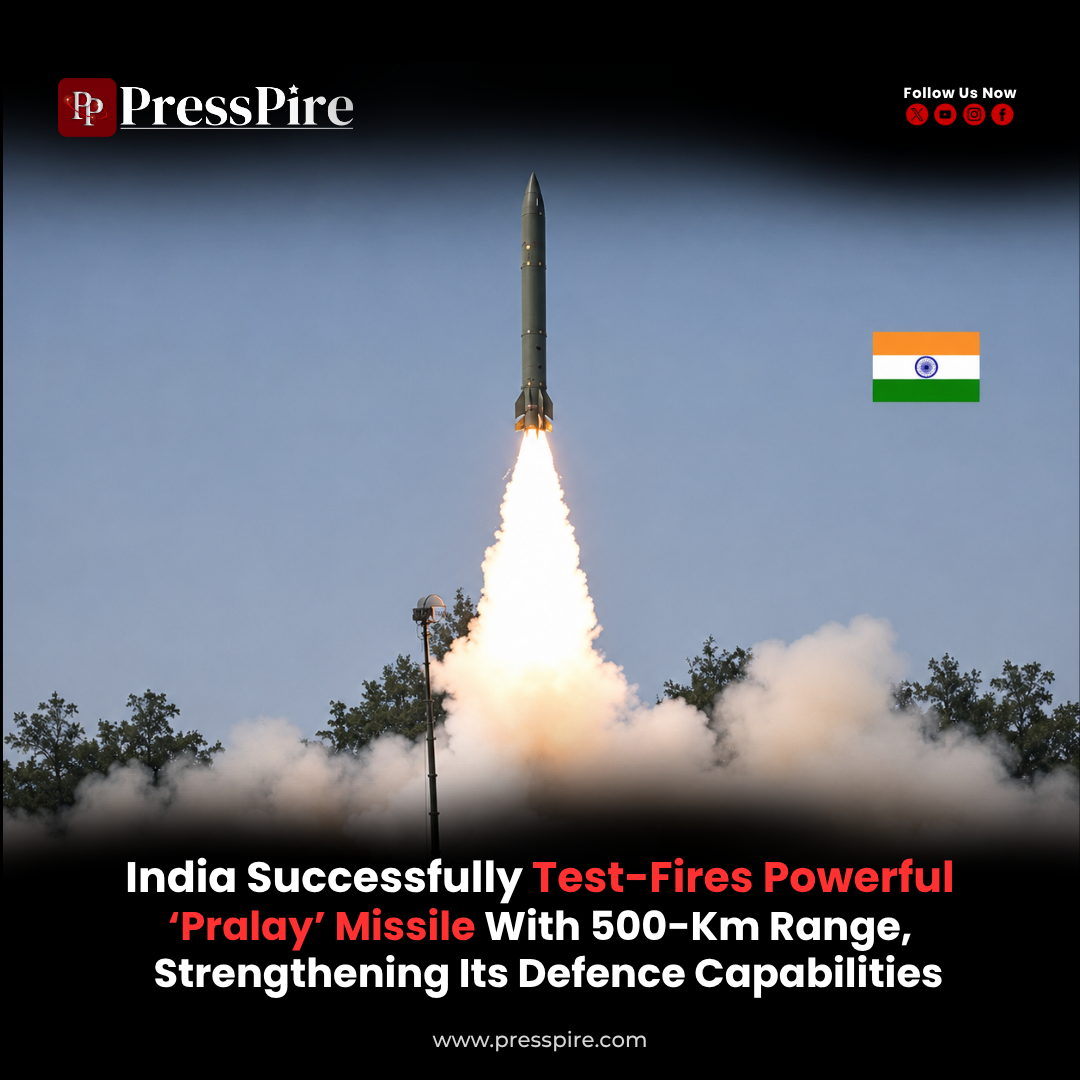
India Tests Pralay Missile With 500-Km Range to Strengthen Its Defence Readiness
The successful user evaluation trial marks another step towards the induction of India’s indigenously developed Pralay missile system.
India successfully flight-tested the Pralay missile from Dr APJ Abdul Kalam Island off the Odisha coast on 5 November 2026, advancing the indigenous weapon system’s evaluation programme.
The Defence Research and Development Organisation, or DRDO, conducted the trial at approximately 11:10 am. According to the Ministry of Defence, instruments operated by the Integrated Test Range at Chandipur confirmed that the mission achieved all its objectives.
Pralay missile has a previously announced range of 150 to 500 kilometres. The latest announcement concerns a successful user evaluation trial; it does not specify the distance covered during this particular flight.
Pralay Missile Test: Key Details
| Feature | Confirmed information |
|---|---|
| Latest test date | 5 November 2026 |
| Launch location | Dr APJ Abdul Kalam Island, off Odisha |
| Development organisation | DRDO |
| Missile category | Surface-to-surface, quasi-ballistic missile |
| Previously announced range | 150–500 kilometres |
| Propulsion | Solid propellant |
| Latest trial stage | User evaluation |
| Test outcome | All stated mission objectives achieved |
What the Pralay Missile’s 500-Km Range Means
The Ministry of Defence disclosed Pralay’s 150–500 km range when announcing its maiden flight test in December 2021. That announcement also confirmed that the system could be launched from a mobile launcher.
The published range describes the missile system’s capability. It should be distinguished from the distance selected for an individual test, which depends on what that trial is intended to evaluate.
Official descriptions identify Pralay missile as a surface-to-surface missile powered by solid propellant, incorporating navigation, guidance and integrated avionics. These systems work together to support controlled flight and accurate delivery.
For readers following the programme, the significance of the latest trial therefore extends beyond its headline range. Consistent performance across successive evaluations is central to assessing a weapon system’s readiness for service.
A Programme Built Through Successive Trials
The November test follows several publicly announced milestones in Pralay’s development and evaluation.
Its maiden flight test took place on 22 December 2021. During that flight, the missile followed its intended trajectory and reached the designated target, according to the government’s announcement.
On 28 and 29 July 2025, DRDO conducted two further successful tests to validate the system’s maximum and minimum range capabilities. The Ministry of Defence said the missiles met their flight objectives and that the subsystems performed as expected. Tracking instruments, including equipment positioned near the designated impact area, supplied the supporting data.
A subsequent milestone came on 31 December 2025, when two Pralay missiles were launched in quick succession from the same launcher. That exercise formed part of user evaluation trials and demonstrated another aspect of the system’s performance.
The ministry reported that both missiles followed their intended trajectories and met the flight objectives.
Taken together, these announcements show a programme progressing through different evaluation requirements over time.
Indian Research and Industry Behind Pralay
Pralay missile has been developed through cooperation between DRDO laboratories and Indian industry.
The programme is led by Research Centre Imarat in Hyderabad, with contributions from laboratories working across missile development, materials, armaments, engineering and testing.
Earlier official announcements identified Bharat Dynamics Limited and Bharat Electronics Limited as development and production partners. They also recognised the involvement of other Indian companies and micro, small and medium enterprises.
The December 2025 announcement stated that the two production partners integrated the systems used in those trials. Representatives from the Indian Army, Indian Air Force and industry witnessed the tests alongside DRDO scientists.
This cooperation illustrates the breadth of work required to develop a defence system. Research must be translated into equipment that industry can manufacture, integrate and support consistently.
Why User Evaluation Trials Matter
A successful development flight establishes that a system can demonstrate particular capabilities. User evaluation adds evidence about its suitability for the requirements of the armed forces.
This makes repeated testing an essential part of the transition from development towards service. A single launch cannot establish every aspect of a system’s performance.
The July 2025 range trials and the December 2025 launches in quick succession examined different requirements. The latest flight adds to that evaluation record.
From a programme perspective, the important measure is whether the accumulated results support the intended military requirements and the next stage of acceptance.
What the Test Means for India’s Defence Capabilities
Pralay’s development is relevant to India’s effort to build domestic expertise in missile technology and defence manufacturing.
An indigenous programme can support capabilities across research laboratories, production companies and specialist suppliers. Its longer-term value includes the knowledge required to manufacture, maintain and improve the system.
The practical defence benefit will depend on the progression from successful evaluation to service introduction, training and sustained support. Those steps determine how demonstrated technology becomes an operational capability.
Following the November trial, the Ministry of Defence described induction as imminent. However, its announcement did not provide a specific induction date or confirm that operational deployment had already taken place.
The successful Pralay missile test therefore marks further progress towards service readiness, with formal induction remaining the next significant milestone to watch.
For more insights navigate: PressPire | Stories That Shape the Future
Read previous article here : tata-motors-iveco-deal/
Follow PressPire on Facebook | Instagram | LinkedIn | YouTube
PressPire | Stories That Shape the Future