
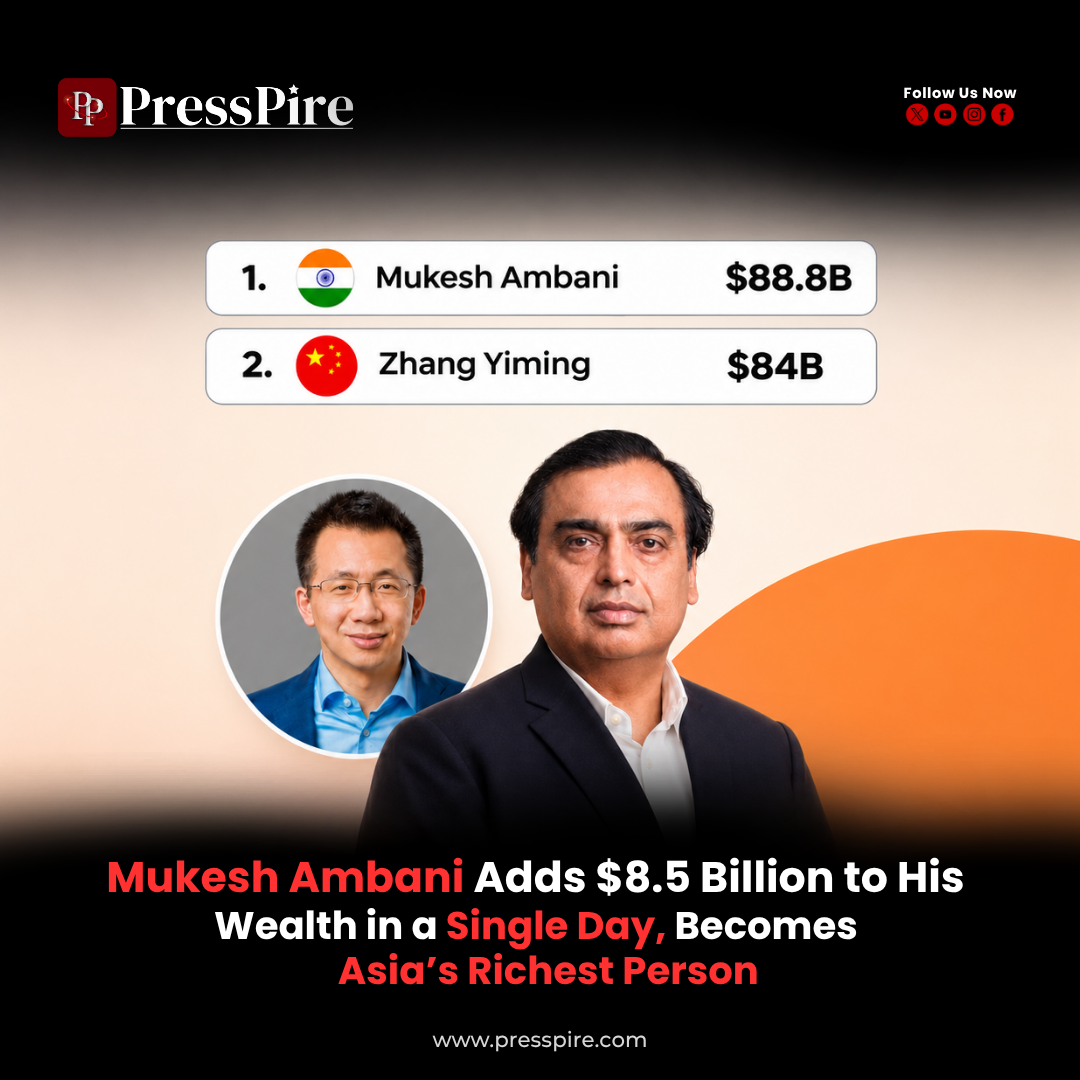
A sharp rally in Reliance Industries shares lifted Mukesh Ambani’s estimated wealth to $88.8 billion, returning him to the top of Asia’s billionaire rankings.
Mukesh Ambani added an estimated $8.5 billion to his wealth on 2 November 2026, becoming Asia’s richest person in the Forbes Real-Time Billionaires ranking reported that day.
The increase followed a strong trading session for Reliance Industries, whose shares climbed 11.64% to ₹1,299 on the BSE after its quarterly earnings announcement.
The development highlights how closely the fortunes of major business owners are connected to stock-market valuations. For Ambani, a substantial rise in the value of his business holdings translated into a multibillion-dollar increase in estimated net worth.
Mukesh Ambani’s Wealth Jump: The Key Figures
According to Forbes’ reporting, the increase took Ambani’s estimated fortune to $88.8 billion, placing him 23rd globally at that point.
He moved ahead of ByteDance co-founder Zhang Yiming, whose wealth was estimated at approximately $84 billion in the same reporting.
| Reported development | Detail |
|---|---|
| Date of the wealth increase | 2 November 2026 |
| Estimated single-day gain | $8.5 billion |
| Estimated wealth after the gain | $88.8 billion |
| Position in Asia | Richest person in the reported Forbes ranking |
| Global position | 23rd |
| Reliance share-price increase | 11.64% on the BSE |
| Reliance closing share price | ₹1,299 |
These figures describe the ranking and market movement on that date. Billionaire wealth estimates change as share prices, exchange rates and asset valuations move.
Why Reliance Industries Shares Rose Sharply
The immediate backdrop was Reliance’s financial performance for the quarter ended 30 September 2026, with results released on 30 October.
The company reported stronger earnings, supported particularly by its oil-to-chemicals operations and continued growth in digital services.
Reliance’s official disclosures showed:
| Financial measure | September-quarter result | Year-on-year growth |
|---|---|---|
| Gross revenue | ₹3,62,268 crore | 27.8% |
| EBITDA | ₹62,409 crore | 23.9% |
| Profit attributable to owners of the company | ₹25,548 crore | Approximately 40.6% |
EBITDA measures earnings before interest, tax, depreciation and amortisation. It provides a view of earnings before those expenses, while profit attributable to shareholders reflects the portion of the group’s final profit belonging to the parent company’s owners.
The distinction between revenue and profit matters here. ₹25,548 crore was profit attributable to Reliance’s shareholders, while the company reported a substantially larger gross-revenue figure.
The market’s response suggests that investors viewed the earnings announcement positively. A share-price increase reflects both the reported results and expectations about future performance.
Oil-to-Chemicals Earnings Led the Improvement
Reliance’s oil-to-chemicals business, which includes refining and petrochemicals, was a major contributor to the quarter’s earnings growth.
The segment reported EBITDA of ₹25,203 crore, an increase of 67.9% year on year. The company attributed the improvement to stronger transportation-fuel margins and better margins in downstream chemicals.
For a refining business, profitability depends partly on the relationship between feedstock costs and the prices received for finished products. Changes in those margins can have a substantial effect on earnings.
The results show why Reliance’s established energy operations remain important to its overall financial performance, even as its consumer and digital businesses attract considerable attention.
However, energy-market conditions can change. A strong quarter does not establish that the same margins will continue indefinitely.
Jio Strengthened the Digital Business Story
Reliance’s digital operations provided another source of growth.
Jio Platforms reported quarterly profit of ₹8,387 crore, up 13.7% year on year, while its customer base reached 542.4 million at the end of September.
The company said revenue growth benefited from subscriber additions, higher average revenue per user and growth in digital services.
These measures help explain the business beyond subscriber numbers alone. Adding customers can expand revenue, while higher spending per customer and operating efficiency influence how much of that revenue becomes profit.
The earnings announcement also followed Jio Platforms’ stock-market listing on 28 October 2026. The listing gave investors a separate market valuation for the digital business, adding another development to consider when assessing the wider Reliance group.
How a Share Rally Adds Billions to Personal Wealth
The reported $8.5 billion increase represents a change in estimated wealth.
For business owners with substantial equity holdings, rising share prices increase the market value of those holdings. That change can be reflected in a billionaire ranking even when the owner has not sold shares.
Consider a simplified example: if an investor owns shares worth $10 billion and their value rises by 10%, the holding becomes worth approximately $11 billion, assuming the ownership remains unchanged.
The investor’s estimated wealth has increased by $1 billion. Receiving cash would require a separate event, such as selling shares or receiving a dividend.
Ambani’s reported gain follows this broad relationship between business ownership and market value. His total estimated fortune can also be affected by other assets, liabilities, valuation assumptions and currency movements.
Why the Ranking Needs a Date and a Source
The description “Asia’s richest person” refers here to the Forbes ranking associated with the 2 November market movement.
Wealth rankings are estimates assembled using available information. Publicly traded shares have observable market prices, while private-company holdings and other assets may require valuation assumptions.
Different publishers can therefore produce different estimates, particularly when they use different methods or update their figures at different times.
For readers, the useful information is the combination of the person’s estimated wealth, the source and the date. Together, those details make the headline meaningful without presenting a changing ranking as a permanent position.
What Could Shape Reliance’s Performance Next?
The earnings improvement was not uniform across every business.
Reliance’s retail business reported profit, including its share of associates and joint ventures, of ₹2,611 crore, down 24.3% year on year. The company’s disclosures pointed to factors including investment in digital commerce, cost pressures and a shift in the festive calendar.
That contrast matters when assessing the wider group. Stronger refining and telecom performance can support consolidated earnings while other operations remain under pressure.
Several developments will help determine how the business progresses:
- Whether oil-to-chemicals margins remain strong.
- Whether Jio sustains customer growth and improves revenue per user.
- Whether retail investment translates into stronger profitability.
- How new-energy projects progress towards commercial operations.
- How capital expenditure affects future cash generation.
These are business-performance questions that extend beyond a single trading session.
The Business Story Behind the Wealth Headline
Ambani’s wealth increase drew attention because of its scale, but the underlying development was a reassessment of Reliance following its earnings release.
The quarter demonstrated the continuing importance of the group’s energy operations alongside its digital businesses. It also showed that a diversified company can experience strong overall growth while individual divisions face different conditions.
Future results will provide a clearer test of whether the earnings improvement can be sustained—and whether the expectations reflected in the share-price rally are supported by continued business progress.
For more insights navigate: PressPire | Stories That Shape the Future
Read previous article here : tata-motors-iveco-deal/
Follow PressPire on Facebook | Instagram | LinkedIn | YouTube
PressPire | Stories That Shape the Future