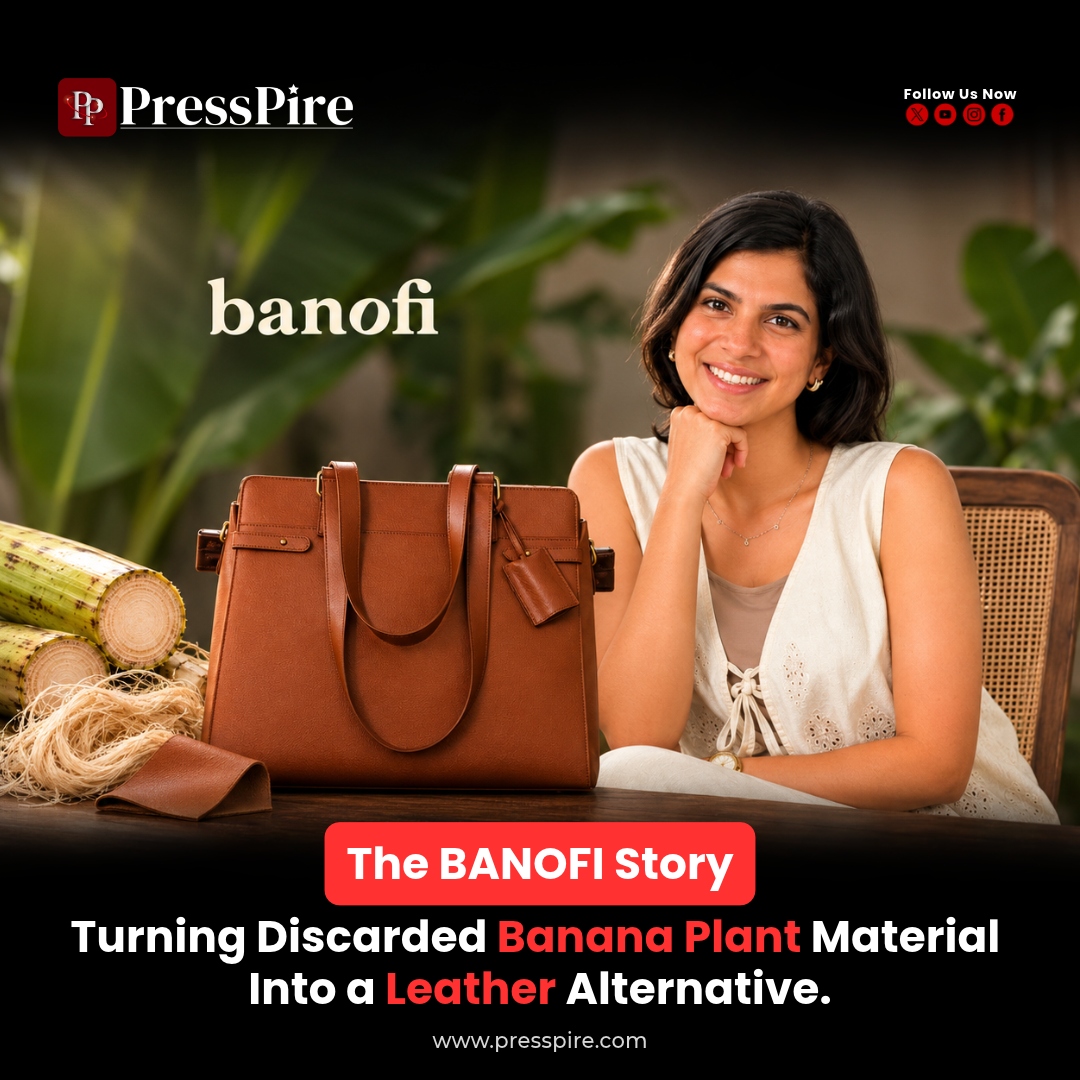
Banofi: Turning Banana Plant Waste Into a Leather Alternative for Modern Fashion
An Indian materials startup is finding a new use for banana crop residues, combining fibre research, farmer partnerships and product development to serve fashion brands.
Banofi is developing a leather alternative from agricultural residues, turning material left after the banana harvest into an input for design and manufacturing. Founded by Jinali Mody, the business began with banana crop waste and has since expanded its research to other cellulose-based ingredients.
The idea connects two commercial needs: finding useful applications for farm residues and giving brands more choices in the materials they use.
That opportunity extends beyond creating a convincing sample. A material supplier must deliver consistent quality, support product development and provide evidence for its environmental claims.
The company’s progress offers a useful view of how a sustainable-materials startup moves from an early experiment towards a place in established supply chains.
How Banofi Began
Jinali Mody established the company in 2022 while studying at the Yale School of the Environment. Her background included biochemistry at St. Xavier’s College in Mumbai and experience at McKinsey & Company.
Yale’s account of the venture describes how university entrepreneurship programmes helped her develop the idea. In April 2022, she won the Sustainable Venture Prize at Startup Yale.
The team explored several plant-derived inputs, including residues from mangoes and wheat, before focusing on banana stems.
The founding proposition was to create a usable material from an overlooked agricultural resource. To become a business, that material would also need the appearance, handling qualities and performance that designers expect.
Why Banana Crop Residues Became the Starting Point
Banana cultivation leaves substantial plant material after the fruit is harvested. The fruiting stem produces one bunch and is then normally cut, leaving residues that can become an input for other processes.
The relevant material is the fibrous stem structure, often called the pseudostem. It is different from the peel discarded after eating the fruit.
For Banofi, these residues offered a starting point for extracting useful plant fibres and developing a leather-like surface.
The business also creates a possible market for material that participating farmers previously discarded. That opportunity depends on practical arrangements for collection, transport and processing.
An abundant crop residue does not automatically become a dependable industrial input. Manufacturers still need material of suitable quality, delivered when production requires it.
From Plant Material to a Finished Sheet
The company’s published process identifies cellulose isolation as an important step. Its finished material combines a composite layer with adhesives, a backing and a protective surface.
This layered construction performs several functions:
- Plant-derived ingredients contribute to the main material.
- Binders and adhesives help hold the components together.
- Backing fabric provides support during handling and product construction.
- Surface finishing influences appearance, texture and resistance to everyday wear.
Its published panel size is 39 by 27 inches. Designers can evaluate the material’s handling, surface and dimensions before developing finished goods.
For a designer, the result must work beyond a display sample. It needs to respond predictably when cut, folded, stitched or combined with other components.
That is where material development meets the practical requirements of manufacturing.
Understanding the Current Material
Banofi says its development now incorporates a wider range of cellulose-based inputs, extending beyond its original banana-waste formulation.
Its published ingredient description includes plant fibres, rubber, seaweed-derived polymers and mineral fillers. It also identifies a polyurethane topcoat and cotton backing.
These details matter when describing the product. A material can have a high share of bio-based ingredients while still containing a synthetic component.
Similarly, plant-derived content alone does not establish that a finished product is biodegradable or suitable for composting. The complete formulation and disposal conditions need to be considered.
The business is therefore best understood as developing a plant-based composite leather alternative. Its current formulation reflects continuing work on both material performance and the ingredients needed to achieve it.
Building a Business Around Brand Customers
Banofi describes its business as supplying materials to other businesses, including fashion brands.
Its website provides sample requests and options for discussing colour, texture, finish and product requirements. These services support an important part of the buying process: establishing whether a material suits a particular application.
A bag designer may prioritise surface appearance and the way a panel holds its shape. A footwear developer may need a different combination of flexibility, abrasion resistance and construction compatibility.
These are examples of how customer requirements can vary; suitability must be demonstrated for the intended product.
From a commercial perspective, the task is to turn material evaluations into repeat orders. Buyers need confidence that later batches will match the sample they approved.
This places customer support, production consistency and delivery planning alongside the scientific work.
Testing Performance Beyond Appearance
The company says its testing covers properties including tensile strength, tear resistance, repeated flexing, abrasion, water resistance and colourfastness.
Each property addresses a different aspect of use.
A surface that looks attractive in a sample book may still need further assessment for a frequently handled bag or an item exposed to moisture. Thickness, backing and finishing choices can also affect how a manufacturer works with the material.
Testing is therefore most useful when connected to a specific product and its expected conditions.
The startup’s challenge is to help customers understand both the material’s capabilities and the applications for which further development is needed.
Recognition and Early Commercial Progress
In 2023, Banofi won the $1 million Hult Prize, providing a significant milestone in its development.
Jinali Mody subsequently became a 2025 Young Champion of the Earth, an award from the United Nations Environment Programme.
A September 2025 Yale report also said the company had conducted pilots with more than 150 brands across fashion, lifestyle and automotive sectors.
| Milestone | Reported detail |
|---|---|
| Establishment | Founded in 2022 |
| Entrepreneurship award | Winner of the $1 million Hult Prize in 2023 |
| Product development activity | More than 150 brand pilots reported by Yale in September 2025 |
| Founder recognition | UNEP Young Champions of the Earth award in 2025 |
These milestones describe different forms of progress. Prize funding supports development, while pilots allow prospective customers to evaluate a material.
The pilot figure should not be read as a count of recurring commercial customers. Longer-term progress depends on converting evaluations into sustained demand and dependable production.
The Farming Communities Behind the Material
A 2025 UNEP profile described the company as working with around 100 smallholder banana farmers and having a workforce that was 60% women.
The sourcing model gives participating farmers an additional use for their crop residues. Selling stems can create an income opportunity alongside the fruit harvest.
For Banofi, these relationships also form part of its raw-material supply chain.
The practical value of that arrangement depends on predictable purchasing, manageable collection costs and clear expectations about material quality.
As production expands, maintaining those relationships becomes an operating requirement. The company needs to coordinate agricultural sourcing with the quantities and schedules required by its manufacturing customers.
Reading the Environmental Case Carefully
Banofi positions its material as a way to reduce the environmental burden associated with conventional leather production.
Using crop residues gives an existing agricultural by-product another application. However, the finished material also contains other ingredients, and their production contributes to its footprint.
An October 2025 life-cycle assessment commissioned by the company examined impacts from raw-material sourcing through to the factory gate. It excluded the customer-use stage and disposal at the end of a product’s life.
The report identified adhesives and backing materials as important contributors to environmental impacts. It also stated that independent review of its public comparative claims was pending at publication.
These boundaries matter when interpreting claims about lower emissions or water use. A manufacturing comparison does not describe every stage of a finished handbag, shoe or upholstered product.
The assessment provides a basis for further improvement, particularly in ingredient sourcing, production and transport.
The Challenges of Expanding Production
Moving from samples to larger orders requires repeatable manufacturing.
A brand may accept a promising prototype, but commercial production brings additional expectations. Colour, thickness, finish and delivery schedules need to remain consistent across orders.
Several operating priorities follow:
- Reliable sourcing: Securing suitable inputs in the quantities needed.
- Consistent batches: Keeping material characteristics within agreed specifications.
- Production efficiency: Managing processing time, rejected material and manufacturing costs.
- Customer qualification: Demonstrating suitability for each intended application.
- Clear documentation: Supporting composition, performance and environmental claims.
These are the commercial requirements of growing a materials business. They explain why recognition and product trials are meaningful steps, while repeat orders remain an important test of adoption.
The Next Stage for Banofi
The Banofi has connected an agricultural residue with a practical materials opportunity, supported by research, farmer relationships and interest from prospective brand customers.
Its next phase will depend on turning that interest into sustained use. That means matching product performance with consistent manufacturing and a supply chain that can support larger orders.
Continued research can also help improve the formulation and strengthen the evidence behind environmental claims.
The lasting opportunity is to make discarded plant material useful in products people choose for their design and performance, supported by a business capable of supplying it consistently.
For more insights navigate: PressPire | Stories That Shape the Future
Read previous article here : campa-cola-plant-reliance-vijayapura-karnataka/
Follow PressPire on Facebook | Instagram | LinkedIn | YouTube
PressPire | Stories That Shape the Future