
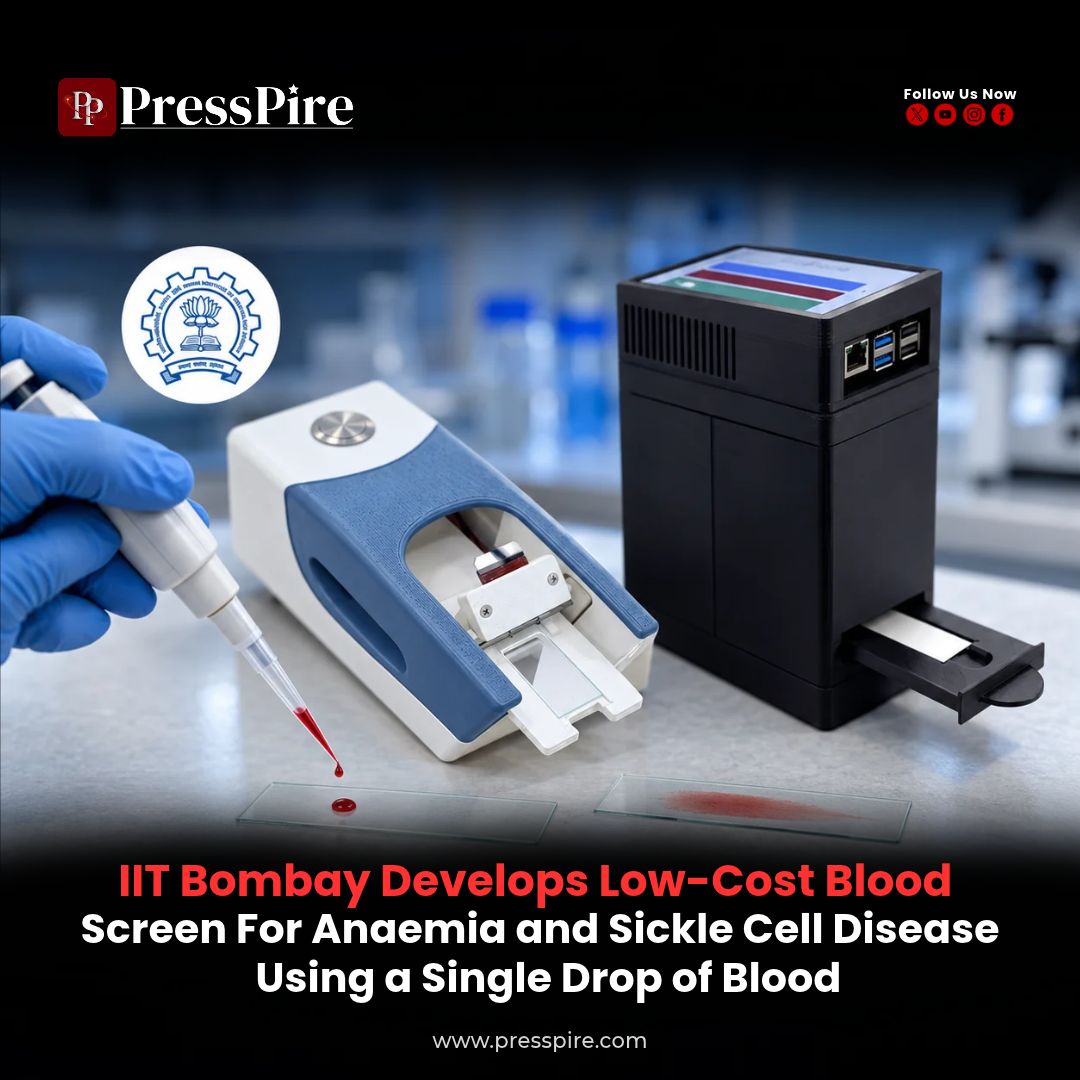
IIT Bombay Blood Test for Anaemia and Sickle Cell Screening
Researchers are using tiny blood samples and controlled glass-slide measurements to develop affordable screening tools for settings with limited laboratory access.
A low-cost IIT Bombay blood test could help screen for severe anaemia and sickle cell disease using tiny blood samples. The research applies fluid mechanics—the study of how liquids move—to a familiar laboratory technique: making a blood smear on a glass slide.
The aim is to support testing closer to patients, particularly where sophisticated laboratory equipment is difficult to access. While the approach requires very little blood, the sample is processed differently for the two screening applications.
The Researchers Behind the IIT Bombay Blood Test
The work comes from IIT Bombay’s Department of Chemical Engineering. Its authors are Mahrukh A. Mir, Professor Mahesh S. Tirumkudulu and Bhavesh Raicha of Valsad Raktdan Kendra.
Their paper, published in Lab on a Chip, examines how thin blood films can reveal information relevant to disease screening. The journal records its first online publication on 16 March 2026, while IIT Bombay highlighted the research on 23 October 2026.
The recent institutional announcement therefore describes published research progressing towards practical healthcare use.
How a Blood Smear Becomes a Screening Tool
A blood smear is a thin layer of blood spread over glass. In this approach, a compact automated device creates the smear under controlled conditions so that its length can be measured consistently.
The underlying principle involves viscosity, or resistance to flow. Under comparable conditions, blood that resists flowing more strongly produces a different smear length.
IIT Bombay’s technology description identifies a sample requirement of approximately 5–20 microlitres for the sickle-cell method. This explains the emphasis on testing with a very small quantity of blood.
The device controls how the smear is formed. A ruler or graduated measurement card can then help interpret its length. The result becomes useful when the physical measurement is related to a clinically relevant property of the blood.
What the Approach Measures in Anaemia
Anaemia involves insufficient red blood cells or haemoglobin to meet the body’s oxygen-carrying needs. It has several possible causes, including nutritional deficiencies, blood loss, infections, chronic illness and inherited conditions.
The research focuses on the relationship between the proportion of red blood cells and blood viscosity. Lower red-cell concentration can reduce viscosity, providing a signal associated with severe anaemia.
That signal does not establish why a person has anaemia. Identifying the underlying cause remains part of clinical assessment, and haemoglobin thresholds depend on factors including age and physiological status.
The distinction matters because a useful screening tool must connect people with appropriate follow-up assessment and care.
Why Sickle Cell Screening Uses a Different Procedure
Sickle cell disease is an inherited haemoglobin disorder. Affected red blood cells can become rigid and obstruct circulation, contributing to pain, anaemia and organ damage.
For this application, the researchers compare blood before and after oxygen is removed from the sample. A chemical treatment creates the low-oxygen condition outside the body.
Changes in smear length indicate changes in viscosity. The team uses this response to investigate differences between unaffected samples, sickle cell trait and sickle cell disease.
Sickle cell trait and disease have different clinical implications. Distinguishing them is therefore a more useful screening objective than simply identifying an unusual blood sample.
What the Reported Results Show
IIT Bombay’s research summary reports the following findings:
| Screening application | Participants | Reported performance |
|---|---|---|
| Severe anaemia | 516 | 95.1% sensitivity and 86% specificity |
| Sickle cell disease | 394 | Approximately 95% sensitivity and specificity |
Sensitivity describes how often a test identifies people who have the condition. Specificity describes how often it correctly identifies those who do not.
These figures relate to the studied groups and procedures. They should not be presented as one universal accuracy figure for every patient or application.
Potential for Testing and Treatment Monitoring
A compact system using small samples and inexpensive consumables could be useful in primary healthcare centres and outreach programmes. Its practical value would come from reliable results that help healthcare teams identify who needs further assessment.
The published study also explores treatment monitoring. Changes in viscosity among patients receiving therapy suggest a possible way to track biological responses over time. Establishing how that measurement should guide care requires clinical validation.
Rheoheme, the company developing the platform, describes haemoglobin measurement, viscosity analysis and sickle cell detection as its initial focus. Its stated development plans also include other blood-testing applications.
This approach could eventually allow healthcare facilities to perform several assessments using shared equipment, provided each application meets its own performance and regulatory requirements.
Regulatory Progress and Remaining Limitations
IIT Bombay says the technology is licensed to Rheoheme Private Limited. The team is working with the National Institute for Research in Tribal Health, Jabalpur, and AIIMS Nagpur towards regulatory approval.
The researchers note that viscosity thresholds can vary between populations. Conditions that disrupt the usual relationship between blood viscosity and haemoglobin could also affect screening results.
The research update does not provide a confirmed commercial price or nationwide rollout date. Further validation and regulatory progress will determine how the IIT Bombay blood test can move into routine healthcare use.
For more insights navigate: PressPire | Stories That Shape the Future
Read previous article here : iit-madras-6g-test-6-39-gbps/
Follow PressPire on Facebook | Instagram | LinkedIn | YouTube
PressPire | Stories That Shape the Future