
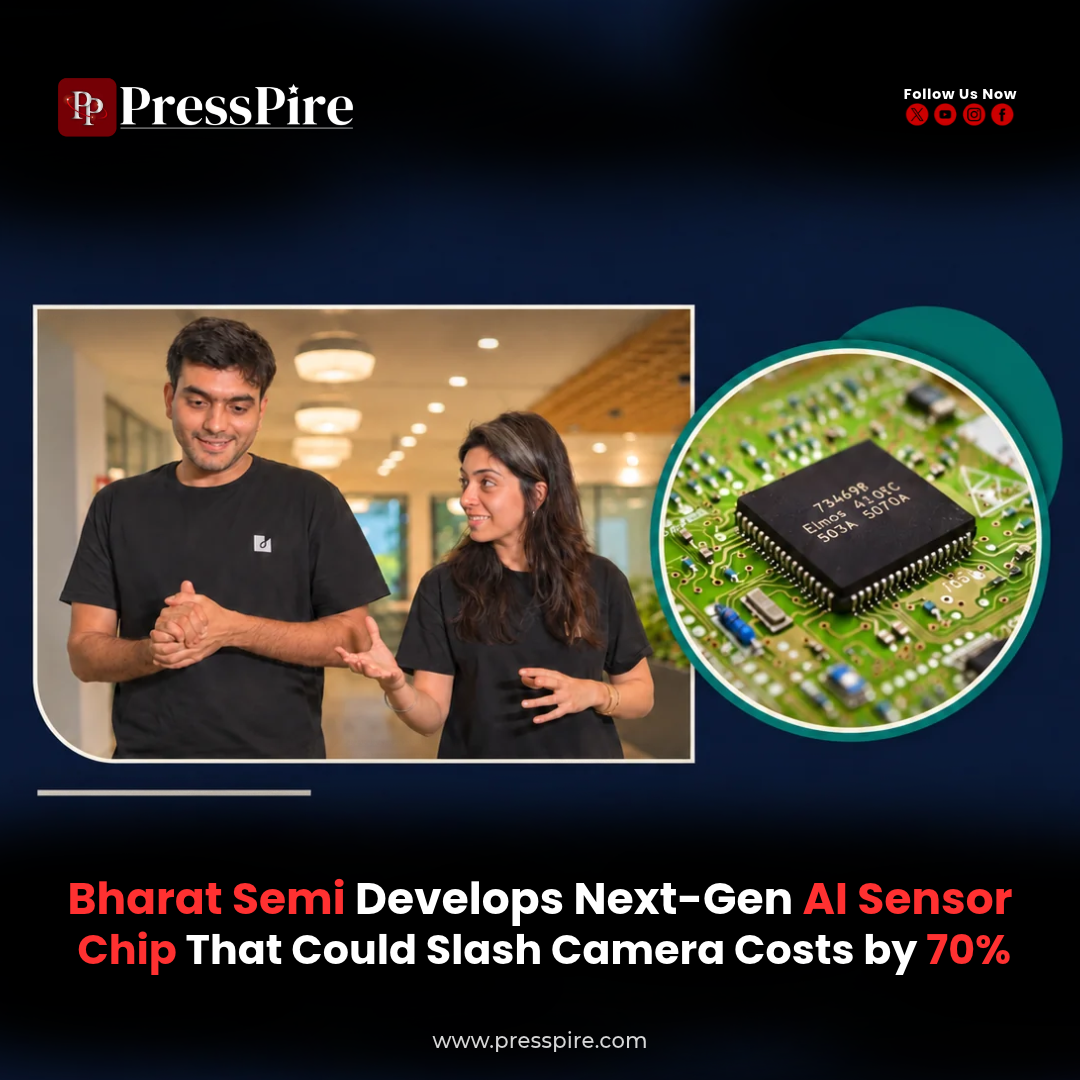
Bharat Semi Develops an AI Sensor Chip That Could Cut Camera System Costs by 70%
The semiconductor startup is developing programmable sensors that bring image capture, processing and AI together, with initial commercial production targeted for 2027.
Bharat Semi is developing an AI-enabled image sensor that could make intelligent camera systems more affordable by combining functions usually handled by separate components. Co-founder Vrinda Kapoor estimates that the approach could reduce imaging-system costs by at least 70%.
The startup has also raised $24 million in seed funding to advance product development and expand its engineering and commercial capabilities. Its ambition is to supply sensors for devices that need to interpret their surroundings, including cameras, drones, industrial equipment and smart appliances.
The technology remains under development. The projected savings concern the imaging system and should not be read as a guaranteed reduction in the retail price of a finished camera.
How Bharat Semi Is Bringing AI Into Image Sensors
An image sensor captures visual information. In a conventional camera configuration, an image signal processor helps turn that information into a usable image, while another processor may handle tasks such as object recognition.
The company is developing programmable sensors that bring image capture, processing and artificial intelligence together in one chip. The aim is to analyse information closer to where it is captured, reducing the need to pass everything through separate processing components.
This approach is relevant to “physical AI”: systems that use information about the real world to help devices respond to their surroundings.
A machine does not always need a complete picture for a person to view. It may need a simpler result, such as whether a space is occupied or an object is present. Processing that information near the sensor can help reduce the amount of data that must travel elsewhere.
Understanding the 70% Cost Estimate
For Bharat Semi, the cost argument centres on integration. Kapoor’s estimate compares the proposed approach with a setup using separate image-sensing, image-processing and system-on-chip components.
Combining functions could reduce the hardware needed for a particular imaging task. However, the final benefit will depend on the application, the performance required and the configuration being replaced.
A finished camera also includes items beyond its sensor and processing electronics, such as lenses, an enclosure and connectivity hardware. Manufacturers must also account for assembly, software and distribution.
The company’s estimate therefore describes a potential saving within a camera system. It does not establish that every camera using the technology would become 70% cheaper for consumers.
Potential Uses Across Cameras, Drones and Smart Devices
Bharat Semi is initially targeting consumer electronics and surveillance, with broader ambitions across automotive applications, robotics and connected devices.
Its proposed technology could serve several markets:
| Application | Potential role |
|---|---|
| Surveillance cameras | Analyse visual information closer to the point of capture. |
| Commercial drones | Support imaging for agricultural monitoring, mapping and inspections. |
| Industrial equipment | Supply visual information for machine-vision applications. |
| Smart appliances | Help devices respond to information about their surroundings. |
| Automotive systems | Support applications that depend on visual sensing. |
These are target applications, rather than evidence that finished products are already widely deployed.
Programmability is central to the strategy. Different devices need different kinds of visual information, so manufacturers need sensors that can be configured for their intended tasks.
The Founders and the $24 Million Funding Round
Founded in 2021 by Vrinda Kapoor and Vinayak Dalmia, Bharat Semi operates across India and the United States.
Its $24 million seed round was led by Info Edge Group, South Park Commons and Indus Bridge Ventures. Other participants included Micromax, Valour Capital and Gaingels, alongside angel investors.
The capital is intended to support product development, engineering expansion and efforts to work with global customers.
For Bharat Semi, that funding supports the transition from developing a technology to delivering products that manufacturers can incorporate into their own devices. Customer adoption will depend on the complete offering, including the chip, supporting software and assistance with integration.
The founders are pursuing an international market while building a semiconductor product business with roots in India.
From Prototypes to Planned Production
Bharat Semi is currently prototyping its first-generation sensors and targeting initial commercial production in 2027.
A second generation with more advanced AI capabilities is also planned. The company has indicated a mid-2027 prototype target, followed by intended customer availability towards the end of that year.
These dates represent its development roadmap. They should be treated as targets while the products progress through testing and preparation for commercial use.
The distinction matters for buyers and readers: a prototype demonstrates progress, while commercial production requires a product that can be manufactured and supplied consistently.
The next stage will show how the proposed integration performs in practical customer applications.
Competing in an Established Intelligent-Sensor Market
Bharat Semi is entering a field where major semiconductor companies have already developed sensors with AI capabilities.
Sony announced its IMX500 and IMX501 intelligent vision sensors in 2020, combining image sensing with AI processing. Their design illustrated how a sensor could produce useful information about an image without always transmitting the entire image for external analysis.
That history provides context for the startup’s opportunity. The competitive challenge involves delivering a combination of cost, performance, flexibility and software support that customers find valuable.
Potential advantages of processing closer to the sensor include reduced data transfer and faster responses. The actual gains depend on the device and workload.
The Next Test for the Business
Bharat Semi’s progress will ultimately be measured through working products and customer adoption.
Manufacturers evaluating the technology will need to assess image quality, processing performance, power requirements and total system cost together. A lower component bill matters most when the product also meets the application’s practical requirements.
The startup’s proposal connects two important developments: the expansion of AI into physical devices and the effort to build globally competitive semiconductor products from India.
If the technology delivers the expected savings while meeting customers’ performance needs, it could make intelligent imaging accessible to more device makers. The planned production milestones will be the next opportunity to assess that promise.
For more insights navigate: PressPire | Stories That Shape the Future
Read previous article here : dehaat-success-story-founders-funding-farmers/
Follow PressPire on Facebook | Instagram | LinkedIn | YouTube
PressPire | Stories That Shape the Future