Zoho One Takes On Microsoft, Google and Salesforce With a Unified Business Suite
India’s Zoho is expanding its challenge across CRM, workplace tools, finance and AI by connecting business applications within a broader software ecosystem.
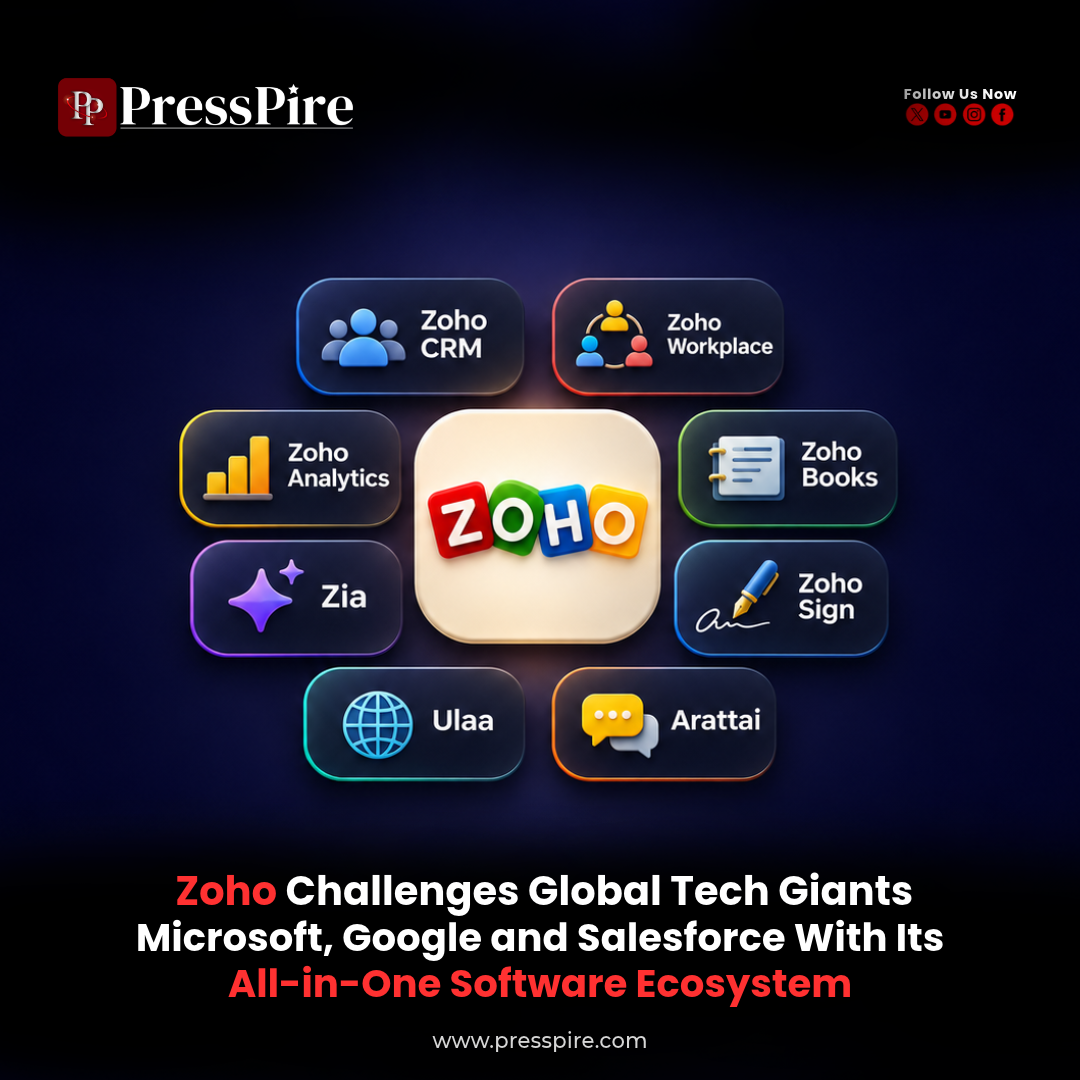
India’s Zoho is competing for a larger role in how companies run their daily operations. At the centre of that strategy is Zoho One, a suite that brings sales, marketing, finance, customer support, human resources and collaboration tools into a connected environment.
The Chennai-headquartered company competes with Microsoft, Google and Salesforce across overlapping software categories. Its pitch combines a broad application portfolio with shared administration, integrations and automation.
Recent announcements involving conversational AI, industry-specific applications and multichannel marketing show how the company is extending that approach.
What Zoho One Offers Businesses
The Standard edition is advertised with more than 50 business applications, alongside central administration and tools for customisation.
The suite addresses a familiar business problem: different departments often use separate systems to manage the same customers, projects and transactions.
Its application range includes:
| Business function | Examples of Zoho applications |
|---|---|
| Sales and customer relationships | CRM, Bigin and SalesIQ |
| Email and collaboration | Mail, Cliq, WorkDrive, Writer, Sheet and Show |
| Finance and operations | Books, Expense, Billing and Inventory |
| Customer support | Desk, Assist and Lens |
| Human resources and recruitment | People and Recruit |
| Marketing | Campaigns, Social and Marketing Automation |
| Projects and business intelligence | Projects, Sprints and Analytics |
Specific capabilities depend on the subscription, application edition and regional availability.
The broader proposition is to let a company introduce connected tools across departments while managing access and administration through a common platform.
Where It Competes With Microsoft, Google and Salesforce
Zoho One overlaps with different parts of each competitor’s portfolio. The comparison is most useful when organised around business functions.
| Competitor | Main areas of overlap |
|---|---|
| Microsoft | Office productivity and collaboration through Microsoft 365; CRM and enterprise operations through Dynamics 365; automation and custom applications through Power Platform |
| Business email, documents, spreadsheets, meetings and file collaboration through Google Workspace; custom applications through AppSheet | |
| Salesforce | Customer relationship management, sales, service, marketing, analytics and AI-supported customer workflows |
Each rival also offers integrations, automation and AI. Microsoft combines productivity software with business applications and automation. Google offers collaborative work tools and app-building capabilities. Salesforce connects customer-focused applications with data, analytics and its Agentforce platform.
Zoho’s competitive case therefore rests on the usefulness of its combined offering, the quality of individual applications and the cost of running them together.
Why Connected Workflows Matter
Zoho One’s appeal becomes clearer when viewed through a routine business process.
Consider an illustrative customer journey: a sales team records an opportunity in CRM, finance prepares an invoice in Books, support handles a request in Desk, and managers review performance in Analytics.
Connecting those stages can reduce repeated data entry and help teams work with more consistent information.
The company’s November 2025 platform update introduced features including Spaces, a central integration panel and consolidated dashboards. These were designed to make applications and relevant information easier to access.
Businesses still need to configure connections, permissions and workflows around their own processes. A shared software supplier provides a foundation for integration; effective implementation determines how useful that foundation becomes.
Zia Chat Adds a Conversational AI Interface
Zoho announced Zia Chat on September 23, 2026, extending its AI strategy across business applications.
The product is designed to help users retrieve information, analyse records, prepare content and initiate supported actions through conversation.
For example, an account manager could examine customer interactions alongside open support issues and overdue invoices, then prepare a follow-up. Zoho says the system respects existing application permissions and can connect with supported external systems.
The product’s current documentation describes early access. Bundling with Zoho One is planned, with licensing and pricing details to be announced at general availability.
That sits alongside existing Zia capabilities already offered within the suite, including contextual search and assistance. The newer chat product’s availability and commercial terms remain a separate consideration.
Expanding Into Industry-Specific Software
Zoho’s wider product strategy increasingly includes applications designed around particular industries.
Its September announcement covered retail, automotive, banking and financial services, healthcare, education, real estate and restaurants.
Examples included dealer management, loan origination, campus administration and restaurant point-of-sale applications.
These offerings extend the company’s reach into workflows that need more specialised processes than a general business application provides. Their capabilities and subscription arrangements should be assessed individually.
The company also announced an updated Zoho Campaigns on October 29, 2026, bringing email, SMS and native WhatsApp marketing into connected workflows, with support for compatible AI agents.
Together, these developments show an effort to cover both common departmental tasks and more specialised operational needs.
How the Subscription Model Shapes the Proposition
Zoho One offers both all-employee and flexible-user licensing approaches.
Under the all-employee model, the business commits to licensing everyone on its payroll. Flexible-user licensing allows it to purchase access for selected users.
This distinction affects the overall cost calculation. A company using several applications across most departments may evaluate the bundle differently from one that needs a single tool for a small team.
Implementation, migration, training, storage, support and additional product requirements also influence total expenditure.
The useful comparison is the cost of supporting the organisation’s actual workflows, with equivalent features and service requirements.
Indian Roots and a Long-Term Product Strategy
Behind Zoho One is a privately held technology company with a stated emphasis on building its own products.
Zoho Corporation was founded in 1996. The company says it has grown without external investor funding and prioritises product development and customer support.
Its published privacy position states that it does not display advertising inside its products or sell user information to third parties.
In its September 2026 announcement, Zoho also reported 47% year-on-year revenue growth in India during 2025. It identified IT services, manufacturing, financial services, professional services and retail among the contributing sectors.
What Will Determine Its Competitive Strength?
The long-term challenge for Zoho One is consistent execution across a broad product range.
Customers need dependable applications, useful integrations, responsive support and a manageable transition from existing systems. Large organisations may also require extensive customisation and connections to established infrastructure.
Businesses need sales, service, finance and employee information to work together. The practical test is whether the platform makes those everyday activities easier and delivers sufficient value to sustain long-term use.
Can Zoho One Replace Every Existing Business Application?
Its suitability depends on the organisation’s requirements. Some businesses may consolidate many functions within the suite, while others will retain specialist tools and connect them through supported integrations.
For more insights navigate: PressPire | Stories That Shape the Future
Read previous article here : dehaat-success-story-founders-funding-farmers/
Follow PressPire on Facebook | Instagram | LinkedIn | YouTube
PressPire | Stories That Shape the Future