
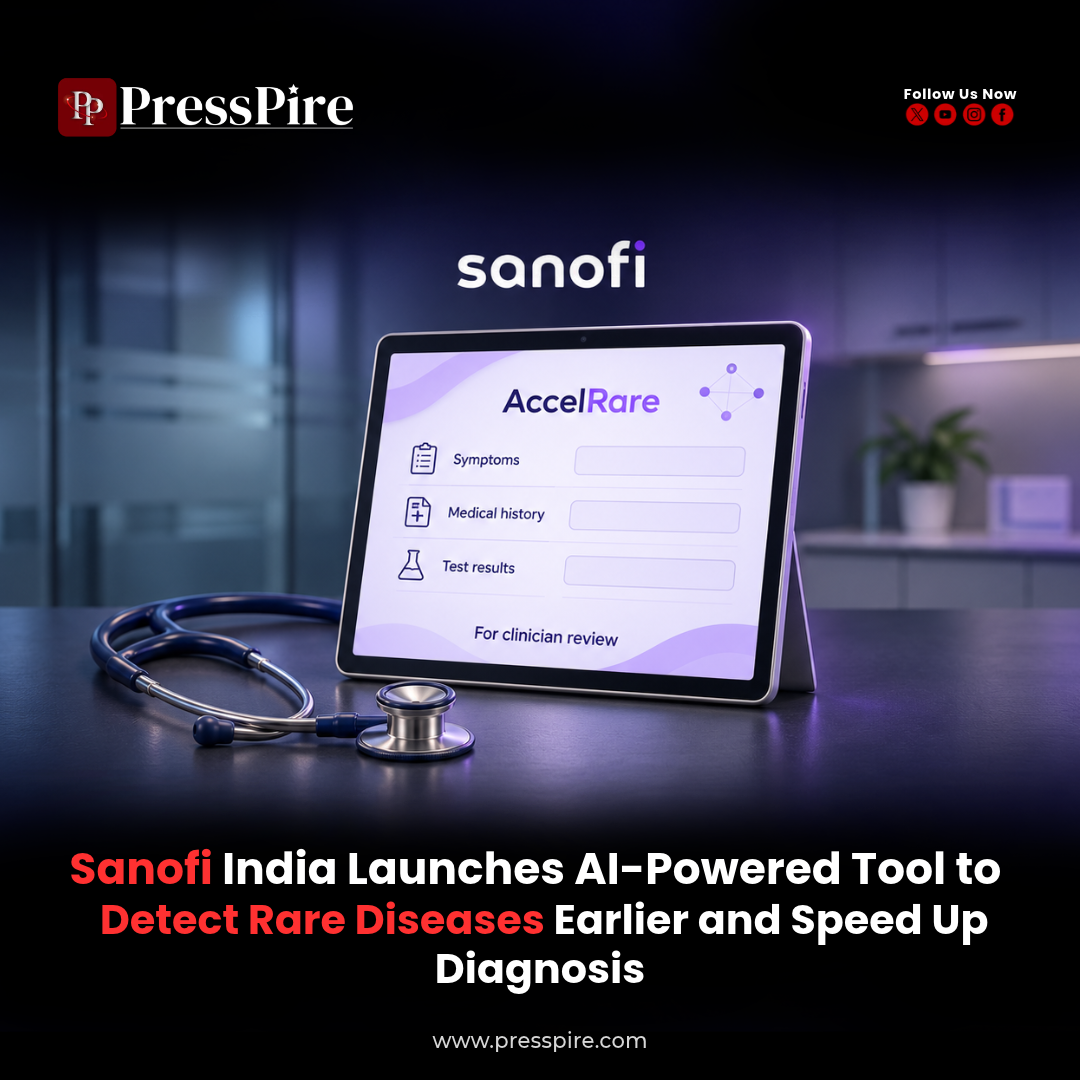
Sanofi India Launches AccelRare: AI Tool to Help Speed Up Rare Disease Diagnosis
The free platform helps healthcare professionals consider possible rare diseases, identify further investigations and connect patients with specialist care.
Sanofi India announced the launch of AccelRare on 14 May 2026, introducing an AI-powered pre-diagnosis tool intended to help doctors recognise rare diseases earlier.
The web-based platform supports clinicians by analysing information about symptoms, medical history and available test results. It generates a list of possible conditions for further investigation, helping doctors decide whether specialist assessment is needed.
The launch addresses a persistent problem in rare disease care: patients can spend years moving between consultations and tests before the underlying condition is identified. AccelRare aims to support an earlier, better-informed suspicion of a rare disease, while diagnosis remains the responsibility of healthcare professionals.
The Challenge of Recognising Rare Diseases
Rare diseases present a difficult clinical problem because each condition is uncommon, while its early symptoms may resemble those of more familiar illnesses.
India’s National Policy for Rare Diseases identifies limited awareness among primary care physicians and inadequate screening and diagnostic facilities as barriers to early diagnosis. Small patient populations also make it harder for doctors to develop experience with individual conditions.
Sanofi India’s initiative focuses on the point where a doctor needs help connecting clinical findings and considering less familiar explanations.
The potential benefit is a clearer direction for investigation. A structured list of possibilities may help a clinician decide which additional information to collect and when to involve a specialist.
How Sanofi India’s AccelRare Tool Works
AccelRare uses MedVir, a medical decision-support tool whose legal manufacturer is Medical Intelligence Service. Sanofi acts as the distributor.
The platform’s workflow moves through four stages:
- Patient profile: The healthcare professional enters relevant background information.
- Clinical information: Symptoms, medical history and examination or test results are recorded.
- Additional signs: Further questions help complete the clinical picture.
- Possible conditions: The tool presents suspected rare diseases for the doctor to assess.
This output is a differential diagnosis: a set of possible explanations that need to be evaluated.
Product documentation describes a knowledge-based symptom checker supported by scientific literature, rare disease databases and expert review. It is designed to organise clinical information and suggest possibilities that merit further attention.
Coverage Across More Than 300 Rare Diseases
Sanofi India described the version introduced at launch as covering 310 rare diseases. The company said the platform was developed and validated with input from 67 experts across 13 rare disease networks.
This breadth is relevant because doctors may encounter unexplained findings across different medical specialties. A tool covering multiple conditions can help them consider possibilities beyond their everyday clinical experience.
Coverage still has boundaries. A patient may have a condition that is absent from the platform, so its output cannot rule out every rare disease.
The tool also provides information about suspected conditions and suggests complementary investigations. Those suggestions help inform the next clinical step; they do not establish a diagnosis on their own.
Free Access for Healthcare Professionals
According to Sanofi India, AccelRare is available without a subscription charge or account registration. It is intended for healthcare professionals, including doctors working in primary care and paediatrics.
The website can be used on computers, tablets and smartphones. Its documentation describes an anonymous questionnaire and states that information is not saved after a pre-diagnosis session ends.
Doctors can export the questionnaire and results for inclusion in the patient’s medical record.
The platform’s advertised five-to-ten-minute duration refers to completing the assessment and obtaining possible diagnostic directions. Confirming a condition may require further clinical evaluation, laboratory testing or specialist consultation.
The Evidence Behind Clinical Decision Support
Sanofi India positions AccelRare as a way to strengthen doctors’ recognition of rare conditions. Published research provides useful context for that ambition.
A 2025 conference abstract described a randomised study involving 12 physicians and 108 clinical case descriptions. Doctors using the tool selected the correct leading diagnosis in 73% of assessments, compared with 47% without it. Appropriate specialist referrals also improved, from 59% to 81%.
These were simulated clinical exercises, rather than a large trial following patients through routine care in India.
A related university research summary reported that individual assessments took longer with the tool. This distinction matters: a more thorough consultation could potentially improve the overall route to diagnosis without making each consultation shorter.
The findings support further evaluation of how the system performs in everyday clinical practice.
Connecting Patients With Specialist Centres
Sanofi India says the platform can help doctors identify relevant government-recognised Centres of Excellence for referral.
That function connects the initial suspicion of a rare disease with institutions equipped to investigate it further. Identifying a possible condition is most useful when the patient can access the appropriate next stage of care.
India’s rare disease policy includes specialist centres, stronger diagnostic capacity and professional training. Digital decision-support tools may complement that framework by helping clinicians recognise when specialist assessment is warranted.
Their practical value will depend partly on what follows the recommendation: access to appointments, suitable tests and continuing clinical support.
Building on Existing Rare Disease Support
Sanofi India has an established presence in rare disease care. Its India Charitable Access Programme began in 1999, and the company says it has offered diagnostic support for selected lysosomal storage disorders since 2013.
Those disorders include Gaucher disease, Fabry disease, Pompe disease, mucopolysaccharidosis type I and acid sphingomyelinase deficiency.
AccelRare adds a digital component earlier in the care journey, when a clinician is still trying to understand a patient’s symptoms.
The opportunity lies in making structured rare disease knowledge available during ordinary consultations, alongside existing diagnostic and specialist services.
Measuring Progress Beyond the Launch
Sanofi India’s AccelRare rollout creates an opportunity to examine how digital support affects rare disease recognition in Indian healthcare settings.
Useful measures would include appropriate referrals, confirmed diagnoses, time taken to reach specialist care and whether clinicians continue using the platform. Those outcomes would provide a clearer picture of its contribution than usage figures alone.
For patients and families, the intended benefit is a shorter path from unexplained symptoms to an informed clinical assessment. Delivering that benefit will require the technology, healthcare professionals and diagnostic services to work together.
For more insights navigate: PressPire | Stories That Shape the Future
Read previous article here : bharat-semi-ai-sensor-chip-camera-costs/
Follow PressPire on Facebook | Instagram | LinkedIn | YouTube
PressPire | Stories That Shape the Future