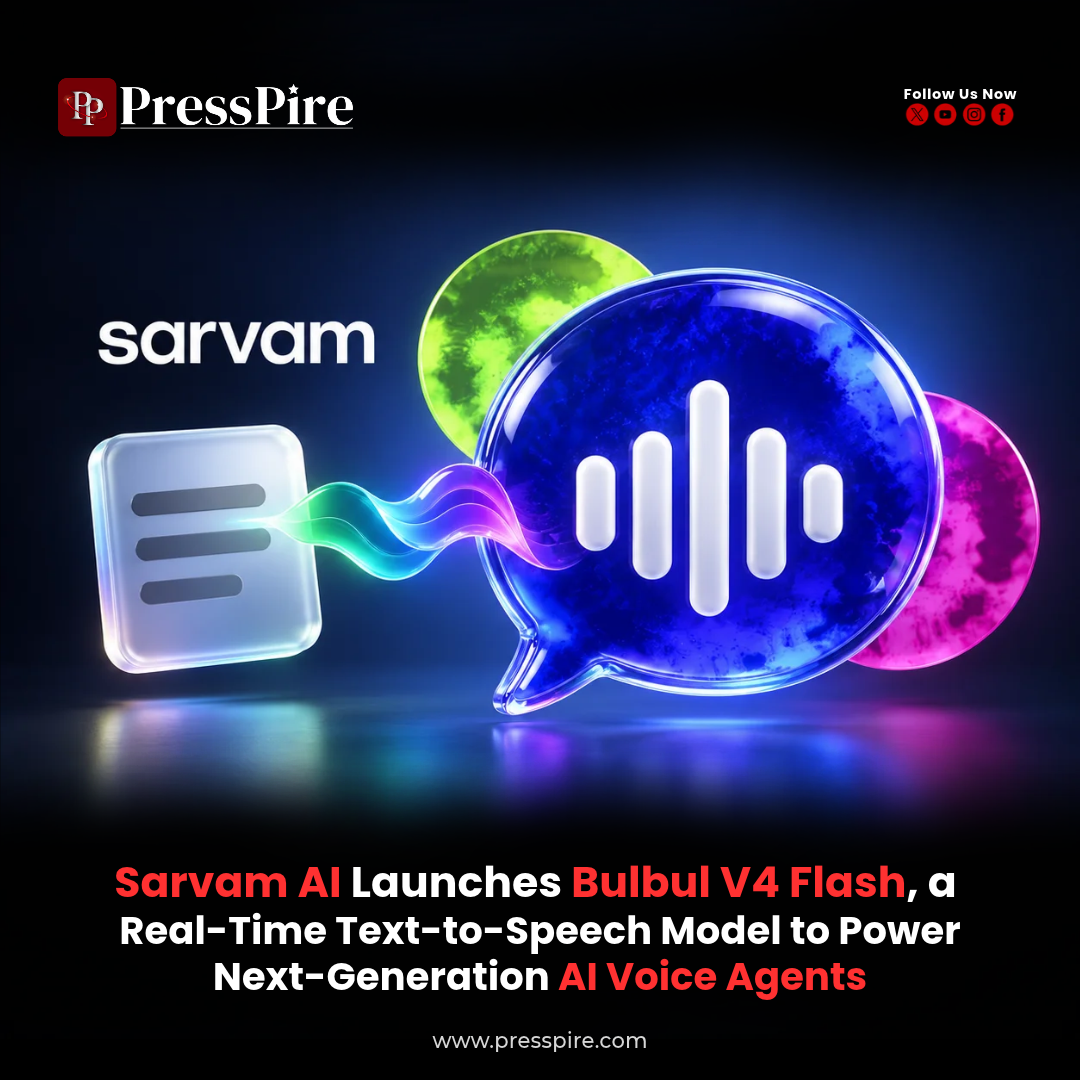
Sarvam AI Launches Bulbul V4 Flash for Real-Time AI Voice Agents
The Indian AI company’s new text-to-speech model focuses on faster speech generation, expressive voices and more natural delivery across Indian-language conversations.
Sarvam AI has launched Bulbul V4 Flash, a text-to-speech model designed to generate spoken responses for AI voice agents and other audio applications. Announced on 13 October 2026, the model strengthens the company’s offering for businesses building customer support systems, conversational assistants and multilingual content tools.
Sarvam says the release improves speech delivery, contextual pronunciation and processing efficiency. Its central performance claim is under 250 milliseconds to produce the first audio output, a measure intended to demonstrate how quickly the model can begin speaking.
The model is available through the Sarvam API, Playground and Content Studio.
What Is Bulbul V4 Flash?
Bulbul V4 Flash converts written text into spoken audio. A developer supplies the words an application needs to say, selects a supported voice and receives generated speech.
Within a conversational AI system, it provides the speaking capability. Other components handle tasks such as recognising the caller’s words, deciding how to respond and retrieving information from business systems.
For example, a customer service assistant might receive an order-status question, retrieve delivery information and prepare a response. The text-to-speech model then turns that response into audio.
This distinction matters when assessing the launch: a speech model can improve how an assistant sounds, while the complete application still depends on the accuracy and responsiveness of the systems around it.
What the Speed Claim Means for Voice Conversations
Sarvam reports that Bulbul V4 Flash delivers time-to-first-audio below 250 milliseconds in production.
This measures how quickly speech output begins. It does not mean an entire conversation turn, including understanding a question and finding the answer, finishes within that time.
In a working voice agent, the caller’s experience also depends on speech recognition, response generation, network conditions and any external services the application must contact.
Faster speech generation could reduce one part of that waiting period. For example, an assistant may need to check a booking database before answering. Even if its voice begins quickly once the response is ready, the database lookup still contributes to the overall delay.
The reported latency is a company performance claim; results in individual applications will depend on deployment conditions.
More Natural Speech for Indian Users
Sarvam positions the model around the details that make speech sound familiar to Indian listeners.
Its product materials emphasise Indian English, regional pronunciation and conversations that mix English with an Indian language. The company also highlights contextual handling of names, amounts, dates and abbreviations.
These details can affect practical usability. A payment amount must be understandable, a customer’s name should be pronounced clearly, and a reference number needs to be spoken in a form the listener can follow.
A voice that sounds expressive but reads important information incorrectly would still create difficulties for users. Businesses evaluating the model therefore need to assess both delivery and pronunciation.
Bulbul V4 Flash Voices and Language Availability
Sarvam’s launch materials advertise 83 voices and 224 voice-and-style combinations across 11 languages.
However, the developer documentation provides an important qualification: Malayalam and Odia voice personas are not yet available on V4 Flash. Its migration guide advises developers to continue using Bulbul V3 for those languages.
The current V4 model reference lists voice coverage for Hindi, English, Bengali, Gujarati, Kannada, Marathi, Punjabi, Tamil and Telugu, alongside English–Hindi mixed-language options.
Developers should therefore check the available voice catalogue for their intended language and application. The broader advertised language count should not be interpreted as confirmation that every language has a ready-to-use V4 voice.
Bulbul V4 Flash Pricing: Launch Rate and Current Listings Differ
Sarvam announced Bulbul V4 Flash at ₹20 per 10,000 characters, compared with ₹30 per 10,000 characters for Bulbul V3. On that launch comparison, the new model was approximately one-third cheaper.
However, a review of Sarvam’s public pages on 26 October 2026 found different listed rates:
| Official listing | Published rate |
|---|---|
| Launch announcement and text-to-speech product page | ₹20 per 10,000 characters |
| Dedicated API pricing table, pay-as-you-go tier | ₹1 per 1,000 characters, equivalent to ₹10 per 10,000 |
The dedicated pricing table lists the latter rate for its V4 Flash real-time, streaming and WebSocket entries.
Because the public pages differ, businesses should confirm the applicable billing rate before estimating production costs.
These figures cover text-to-speech usage. The total cost of a complete voice application can also include speech recognition, response generation, telephony and other services.
How Developers Can Use the Model
Bulbul V4 Flash supports standard requests that return generated audio, along with HTTP streaming and WebSocket connections.
Streaming allows an application to receive audio progressively, supporting interactive experiences where playback needs to begin before the full response has been generated.
For existing Bulbul users, Sarvam’s migration guide says the new model retains the same endpoints, authentication approach and request-and-response structure.
Developers need to select the bulbul:v4-flash model and use a compatible V4 voice identifier. Existing V3 short-form speaker names require updating.
The documentation also states that requests which omit the model selection continue to use V3. An existing integration therefore does not automatically move to Flash simply because the newer model has launched.
Potential Applications for Businesses and Creators
The model’s combination of speech generation and voice selection could support several applications:
| Application | Potential role for generated speech |
|---|---|
| Customer support | Speak answers, instructions and service updates |
| E-commerce | Deliver order information and product explanations |
| Financial services | Read reminders, amounts and account-related messages |
| Education | Provide spoken lessons and learning prompts |
| Content production | Generate narration and regional-language audio |
These are potential uses rather than evidence that every application has been deployed with V4 Flash.
For businesses, the value will depend on how well the chosen voice performs with their actual vocabulary, customer languages and operating conditions. A model that works well for a short demonstration may still need testing with unfamiliar names, long reference numbers or industry-specific terms.
What Will Determine Its Impact?
Sarvam’s launch expands the speech tools available to developers building applications for Indian users. The commercial opportunity lies in making spoken interactions easier to understand and more responsive.
Its published conversation demonstrations illustrate the model’s delivery, but Sarvam identifies them as scripted examples with generated audio for both speakers. They should be assessed as speech demonstrations, rather than proof of a fully autonomous customer interaction.
For production adoption, businesses will need to evaluate pronunciation, response timing, listener comprehension and total operating cost.
Bulbul V4 Flash addresses the speech-output component of that task. Its practical impact will depend on how consistently it performs when connected to the information, services and workflows that customers actually use.
For more insights navigate: PressPire | Stories That Shape the Future
Read previous article here : nvs-03-launch-isro-navic-positioning/
Follow PressPire on Facebook | Instagram | LinkedIn | YouTube
PressPire | Stories That Shape the Future