
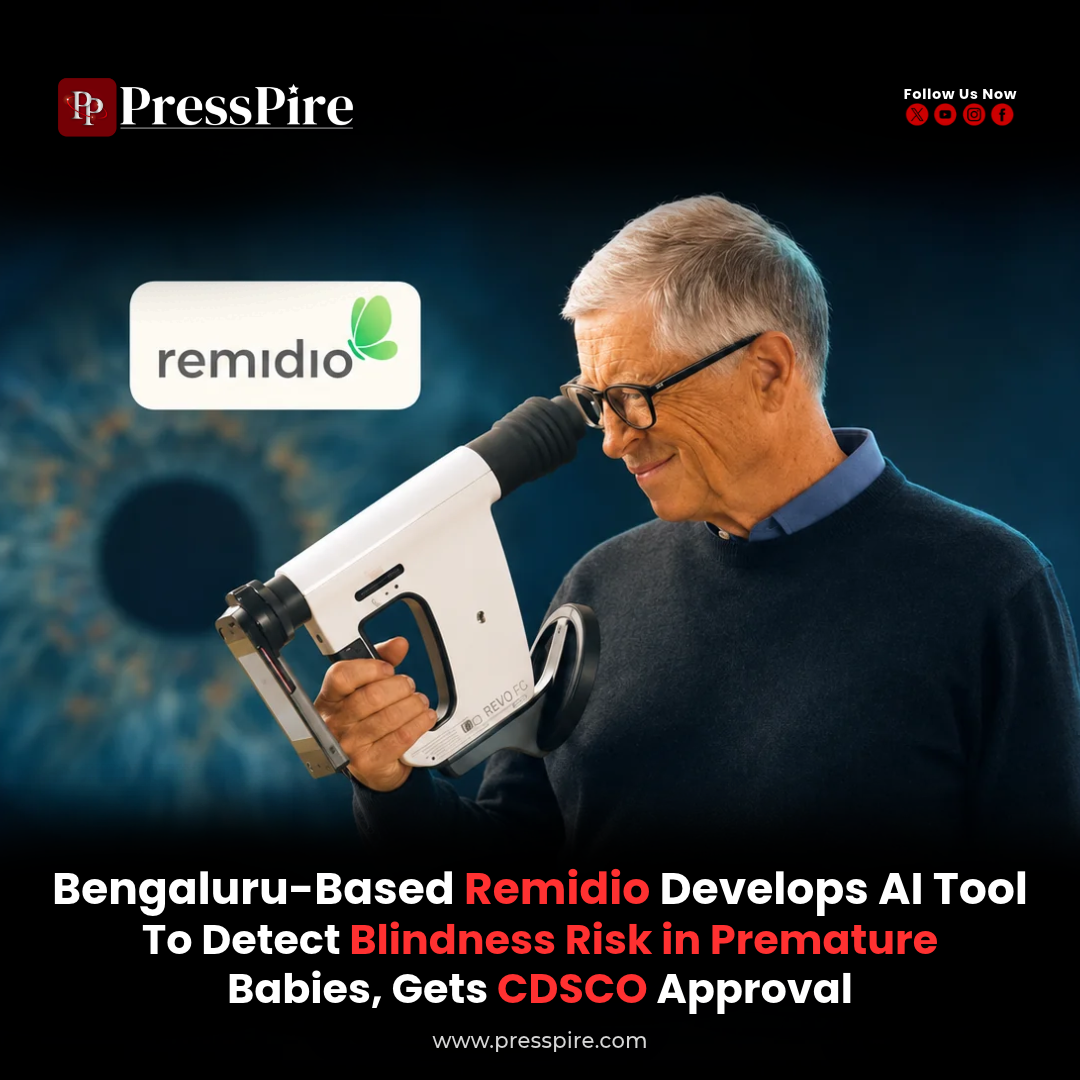
Remidio’s AI Tool Gets CDSCO Approval to Spot Blindness Risk in Premature Babies
Developed with KIDROP and supported by BIRAC, the system analyses retinal images offline to help identify premature babies who need specialist eye assessment.
Remidio, a Bengaluru-based medical technology company, has developed an AI tool for screening premature babies for retinopathy of prematurity, or ROP, that has received approval from the Central Drugs Standard Control Organisation (CDSCO), according to reporting on 17 November 2026.
The software examines images of the retina and flags findings that may require specialist review. Its purpose is to help healthcare teams identify babies needing further assessment and support timely referral.
The development was highlighted at an event organised by the Indian Retinopathy of Prematurity Society and Narayana Nethralaya in Bengaluru. It addresses a practical challenge in neonatal care: providing timely eye screening where specialist access is limited.
Early Screening Can Protect a Baby’s Vision
ROP affects the retina, the light-sensitive tissue at the back of the eye. In premature babies, the blood vessels supplying this tissue may not have completed normal development.
Abnormal vessel growth can lead to complications, including retinal detachment and permanent vision loss. Some mild cases improve without treatment, while more serious cases require intervention.
The condition may develop without visible early signs that parents can recognise. Scheduled examinations and follow-up are therefore important for babies identified as being at risk.
Remidio’s screening technology focuses on helping clinical teams recognise concerning retinal findings early enough to arrange the appropriate next step.
How Remidio’s AI Screening Tool Works
The company identifies its screening platform as MediosHI ROP AI. It combines retinal image analysis with a clinical workflow in which trained professionals capture images and ophthalmologists make medical decisions.
The process can be understood in four stages:
| Stage | Role in the screening process |
|---|---|
| Retinal imaging | Trained personnel capture images using a specialised retinal camera. |
| AI analysis | The software examines images for findings suggestive of ROP. |
| Specialist review | An ophthalmologist evaluates flagged findings and determines their clinical significance. |
| Further care | The clinical team plans additional examinations, referral or treatment as appropriate. |
The company’s announcement also describes support for flagging findings suggestive of plus disease, a feature associated with abnormal retinal blood vessel changes in ROP.
This is an assisted screening process, with the software helping organise attention around babies who may need further assessment.
Offline Analysis Supports Care in Areas With Limited Connectivity
According to Remidio, the system performs its AI analysis locally, without requiring an internet connection for that processing step.
This capability is relevant to neonatal units and outreach programmes where connectivity may be unreliable. Staff can obtain the software’s screening output where images are captured, rather than depending on an online analysis service.
Remote specialist consultation and image sharing remain separate parts of the wider care process.
The potential benefit is a more dependable initial screening workflow. Achieving that benefit still requires suitable imaging equipment, trained staff and a clear route for specialist review.
The company lists neonatal intensive care units, maternity centres and public health screening programmes among the settings its ROP platform is intended to serve.
The KIDROP Collaboration Brings Clinical Experience
Remidio developed the tool in collaboration with Karnataka Internet-Assisted Diagnosis of Retinopathy of Prematurity, known as KIDROP. The project received funding from the Biotechnology Industry Research Assistance Council, or BIRAC.
KIDROP is Narayana Nethralaya’s telemedicine programme for ROP care and operates through a partnership involving the Karnataka government.
Its screening model uses trained imaging teams to reach neonatal units, capture retinal photographs and connect babies with specialist assessment.
That experience matters for software development because a screening tool must fit the realities of neonatal care. These include handling images from small infants, recording findings accurately and ensuring babies return for follow-up.
The collaboration connects technology development with an established clinical screening network.
Research Behind the Screening Technology
Research involving Remidio and KIDROP predates the latest approval announcement.
A 2023 study published in Frontiers in Pediatrics evaluated an earlier AI model using images collected through the screening programme. The model classified images according to whether ROP was present or absent.
On an independent test set of 7,489 retinal images, the researchers reported sensitivity of 91.46% and specificity of 91.22%.
Sensitivity describes how often a test identifies the condition when it is present. Specificity describes how often it correctly identifies its absence.
These were results from an earlier research model and a particular image dataset. They should not be presented as the complete performance record of the newly approved product.
The study nevertheless documents part of the development work behind automated ROP screening and its potential use in clinical services.
Ophthalmologists Remain Central to Care
Remidio’s own announcement states that ophthalmologists retain responsibility for clinical decision-making.
An AI flag can help direct attention to an image or a baby requiring assessment. Decisions about disease severity, examination schedules and treatment remain part of specialist care.
Screening also needs to function as a continuing process. A baby may require repeat examinations as the retina develops, including appointments after discharge from the neonatal unit.
For families, the practical priority is following the screening and review schedule provided by their baby’s clinical team.
The technology’s value depends on how effectively its findings lead to appropriate care.
From Regulatory Approval to Wider Clinical Use
For Remidio, regulatory approval is an important step towards broader clinical adoption.
Successful use across hospitals will depend on more than installing software. Teams need reliable image capture, training, documentation and arrangements for reviewing suspected cases.
Hospitals evaluating such systems will also need to understand performance in their own patient populations and workflows. Poor-quality images, missed appointments and delays in referral can weaken an otherwise useful screening service.
Useful measures of impact would include screening coverage, completion of follow-up, time to specialist assessment and whether babies needing treatment receive it promptly.
These outcomes would show how the technology contributes to neonatal care in practice.
A Focused Application of AI in Neonatal Eye Care
Remidio’s development illustrates a specific role for AI in healthcare: assisting trained teams with a time-sensitive screening task.
Its combination of retinal imaging, offline analysis and specialist oversight could help extend screening to settings where access remains uneven.
The larger goal is to ensure that babies needing attention are identified and reach the right clinical service in time.
Connecting the software with dependable screening programmes, follow-up and treatment access will determine how much of that potential translates into better care.
For more insights navigate: PressPire | Stories That Shape the Future
Read previous article here : sanofi-india-accelrare-ai-rare-diseases/
Follow PressPire on Facebook | Instagram | LinkedIn | YouTube
PressPire | Stories That Shape the Future