
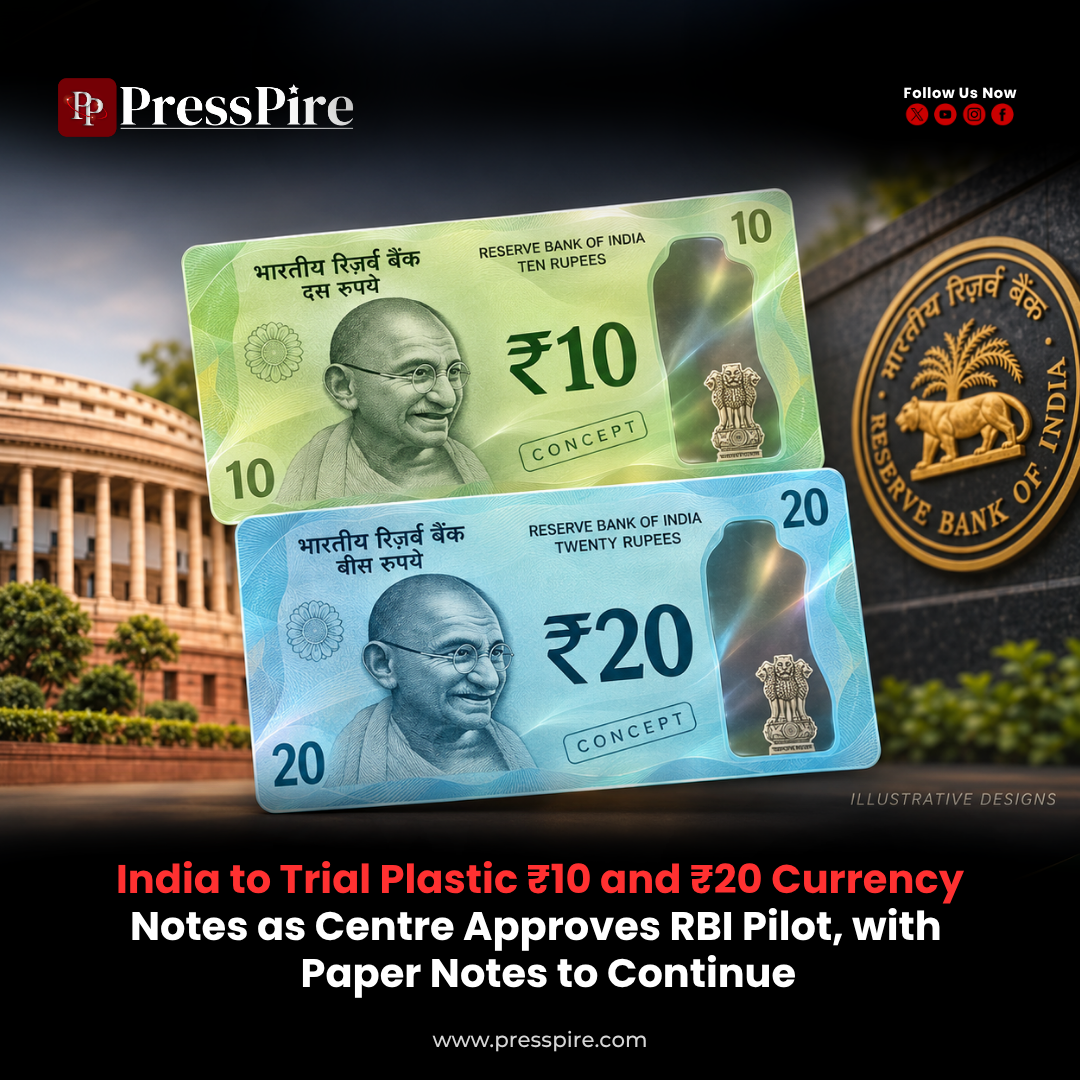
The approved RBI pilot covers 100 crore polymer notes of each denomination, with regular issuance dependent on successful field trials.
India has approved a proposal to conduct field trials of ₹10 and ₹20 plastic notes, taking another step towards evaluating more durable currency for everyday transactions.
The Finance Ministry confirmed the approval in a written reply to the Lok Sabha on 27 July 2026. The proposal covers one billion notes of each denomination, equivalent to 100 crore ₹10 notes and 100 crore ₹20 notes.
The government has also clarified that polymer notes would circulate alongside existing paper banknotes. The proposal does not seek to replace paper currency.
RBI subsequently indicated that it was targeting the beginning of the next financial year for circulation, provided preparations proceed as planned.
India’s Plastic Notes Trial: Key Details
| Detail | Confirmed Information |
|---|---|
| Denominations covered | ₹10 and ₹20 |
| Material being evaluated | Polymer, a flexible plastic substrate |
| Proposed ₹10 trial quantity | 100 crore notes |
| Proposed ₹20 trial quantity | 100 crore notes |
| Combined trial quantity | 200 crore notes |
| Parliamentary confirmation | 27 July 2026 |
| RBI’s stated timing target | Beginning of FY2027–28, subject to preparations |
| Existing paper currency | To continue alongside polymer notes |
| Regular issuance | Dependent on successful field trials |
The quantities refer to the number of banknotes proposed for the trial, rather than an announcement that these notes have already entered circulation.
What Are Plastic notes or Polymer Banknotes?
Polymer banknotes are printed on a thin, flexible plastic material designed for use as currency.
The material can support printed designs, protective coatings and security features. Although commonly called plastic notes, they are designed to be handled and folded during normal transactions.
India’s existing banknote paper is made using 100% cotton, according to RBI’s currency guidance. The proposed trial therefore involves testing a different base material for the notes.
Polymer currency is already used in countries including Australia, Canada, New Zealand and the United Kingdom. Their experience provides useful background, while India’s trial will assess performance under local conditions.
Why RBI Is Testing ₹10 and ₹20 Plastic Notes
The main reason is durability.
Lower-denomination notes pass frequently between consumers, retailers and other businesses. Repeated handling can shorten their usable life, creating a continuing need to replace worn currency.
At the 5 August 2026 post-monetary policy press conference, RBI Governor Sanjay Malhotra highlighted the relevance of polymer to these frequently used denominations.
He also identified additional production capacity as another objective as the economy’s currency requirements grow.
Longer-lasting notes could reduce replacement requirements over time. However, the actual benefit in India will depend on their performance during trials and the costs of producing and managing them.
When Could the New Plastic notes Enter Circulation?
Malhotra said RBI was targeting circulation at the beginning of the next financial year, subject to everything proceeding according to plan.
From the date of his August 2026 statement, that points to the start of FY2027–28 in April 2027.
Some subsequent reports have referred to 1 April 2027, the first day of that financial year. The governor’s statement, however, described a conditional target.
It should therefore be understood as the intended timeframe for the pilot, rather than an unconditional promise that the notes will become available nationwide on that date.
The timing of wider issuance will also depend on the outcome of the trials.
Paper ₹10 and ₹20 Notes Will Continue
The Finance Ministry’s parliamentary reply explicitly states that polymer notes are proposed to be issued alongside paper-based banknotes.
It also states that there is no proposal to replace paper currency with polymer currency under this initiative.
For consumers, the approval does not announce a withdrawal of existing paper ₹10 and ₹20 notes or introduce a deadline to exchange them.
The proposed change concerns the material used for a trial batch of currency. Existing paper notes remain part of the currency system.
Preparations Include Sourcing Polymer Material
Preparatory work includes obtaining the specialised material on which the notes would be printed.
Bharatiya Reserve Bank Note Mudran Private Limited, RBI’s banknote-printing subsidiary, published a global expression of interest on 17 July 2026 for the manufacture and supply of polymer substrate sheets with security features suitable for Indian banknotes.
The notice listed 18 August 2026 as its closing date.
This procurement process is one stage in preparing the pilot. It does not, by itself, establish that finished notes have been printed or distributed.
In his August remarks, the RBI governor explained that obtaining the substrate would be followed by testing and security-related procedures.
What Will the Field Trials Establish?
RBI has said it will examine how polymer notes perform under Indian climatic conditions and existing currency infrastructure before deciding how to expand their use.
That makes the trial important even though other countries already use the material.
A banknote needs to remain usable through repeated handling and work within the systems that print, distribute, collect and process currency.
The practical question is whether the proposed notes deliver sufficient improvements in durability and usability under Indian conditions.
RBI has indicated that the results will help determine whether the programme should be expanded in its existing form or with changes.
What About Security Features?
Polymer allows central banks to incorporate features such as transparent windows. The Bank of England, for example, uses clear sections as part of its banknote security design.
India’s precise features will need to be communicated by RBI.
When asked about the proposed notes in August, Malhotra said information about their security features would be provided at the appropriate stage.
Features used on another country’s polymer notes should therefore not be assumed to appear on India’s trial notes.
Will Plastic Notes Affect Digital Payments?
The Finance Ministry described banknotes and digital payment systems as complementary payment options.
Its parliamentary reply said any impact on digital payments could be assessed only after regular issuance of polymer notes.
The pilot focuses on the quality and durability of physical currency. It does not announce a change to the availability of digital payment services.
For the next stage, the key developments will be RBI’s operational announcements, the start of circulation under the pilot and evidence from the field trials. Those results will determine how the approved proposal develops into a wider currency programme.
For more insights navigate: PressPire | Stories That Shape the Future
Read previous article here :ahana-gautam-open-secret-success-story/
Follow PressPire on Facebook | Instagram | LinkedIn | YouTube
PressPire | Stories That Shape the Future