
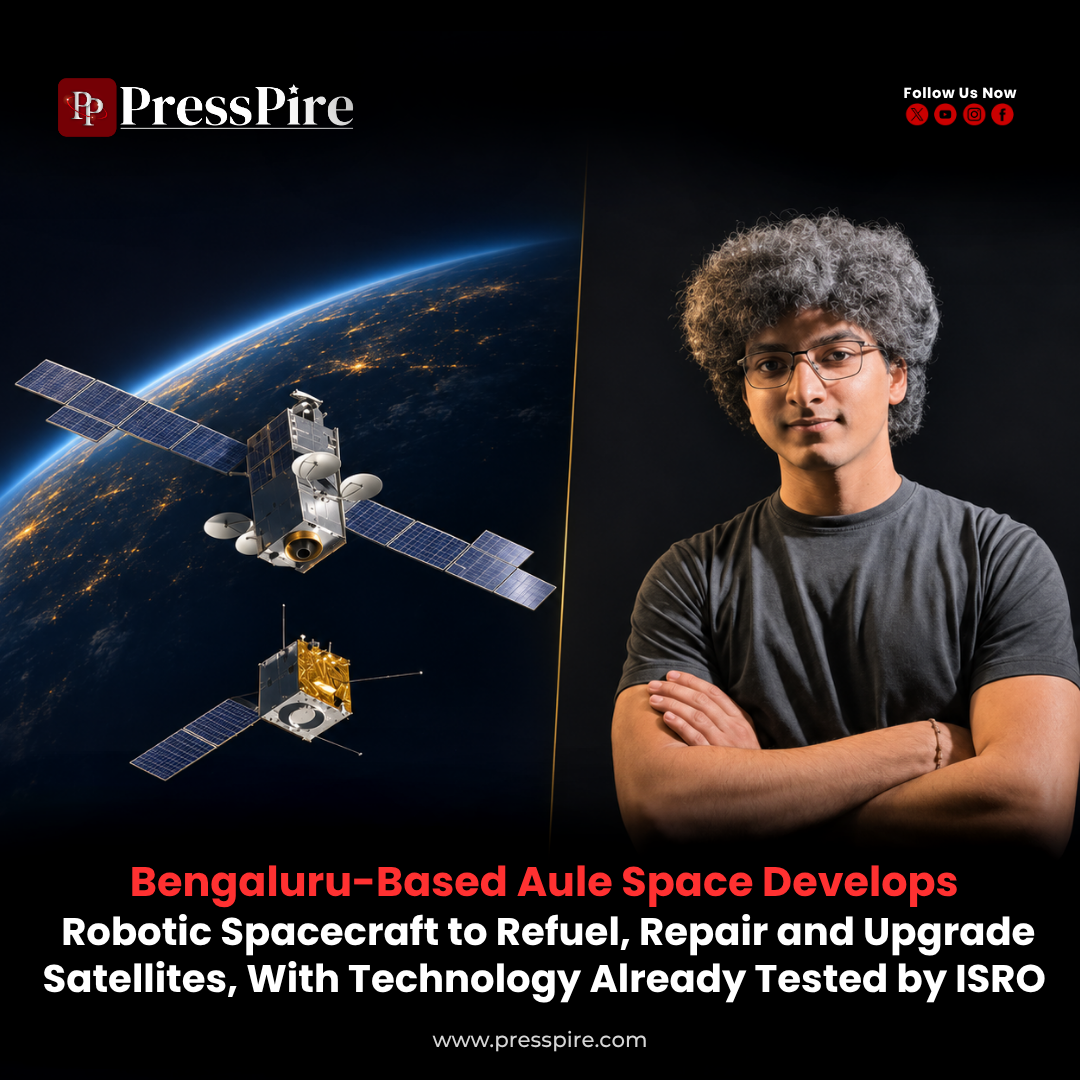
Aule Space Develops Satellite Jetpacks Following Navigation Tests at an ISRO Lab
The Bengaluru startup is developing autonomous spacecraft to extend satellite life, with a key navigation system tested on the ground at an ISRO facility.
Aule Space, a Bengaluru-based space technology startup, is developing robotic spacecraft that could attach to existing satellites and help them remain operational after their own propulsion fuel runs low.
The company reported in August 2026 that it had completed testing of its camera-based guidance, navigation and control technology at ISRO’s Rendezvous Simulation Laboratory, located within the Satellite Integration and Test Establishment.
According to Aule, the tests brought its relative guidance and control system to Technology Readiness Level 6, or TRL 6.
Its immediate focus is satellite life extension through attached propulsion. Refuelling, repairs and hardware upgrades form part of the broader possibilities that reliable docking could eventually support.
What Aule Space Is Developing
Aule describes its servicing spacecraft as satellite “jetpacks.”
The idea is to send a compact spacecraft to an existing satellite, dock with it and use the servicing vehicle’s propulsion system to help maintain the satellite’s position in orbit.
This could be useful when a satellite’s communications equipment remains functional but its remaining propellant limits how much longer it can operate.
The initial approach provides propulsion from an attached spacecraft. It does not require transferring fuel into the customer satellite’s tanks.
Aule is initially targeting geostationary communications satellites, where extending the useful life of an existing asset could have considerable commercial value.
Aule Space’s Plans and Progress
| Capability | Reported Status or Intended Role |
|---|---|
| Camera-based guidance and navigation | Ground-tested at ISRO’s Rendezvous Simulation Laboratory |
| Relative guidance and control system | Company reports achieving TRL 6 |
| Satellite life extension | Developing spacecraft that dock and provide propulsion |
| Close-range inspection | Planned application of proximity-operation capabilities |
| Debris mitigation | Potential application involving controlled movement of defunct spacecraft |
| Refuelling, repairs and upgrades | Longer-term possibilities enabled by servicing technology |
| In-orbit docking | Planned demonstration milestone |
The laboratory test concerns a key part of the navigation and control technology. It does not establish that Aule has already refuelled, repaired or upgraded a satellite in orbit.
What Was Tested at the ISRO Laboratory?
Aule says its test campaign covered the final 15 metres of approach towards a target spacecraft.
The laboratory uses robotic arms to reproduce the relative movement of two spacecraft and a solar simulator to create representative lighting conditions.
During the tests, cameras supplied images that the system used to estimate the target’s position and orientation. The guidance software then generated movement commands, creating a feedback loop between what the camera observed and how the simulated spacecraft moved.
According to the company, the system reached the final approach point within the required position, speed and alignment limits across different test conditions.
These were ground-based tests at an ISRO facility, supporting preparation for a future orbital mission.
What Does TRL 6 Mean?
Technology readiness levels describe how far a technology has progressed from an initial idea towards operational use.
NASA’s framework runs from TRL 1 to TRL 9. TRL 6 generally involves demonstrating a representative model or prototype under relevant conditions. Demonstration in space and successful operational use are later milestones.
For Aule, the reported TRL 6 achievement applies to its relative guidance, navigation and control technology.
The next challenge is to integrate the necessary systems into spacecraft and demonstrate their performance during an actual mission.
Why Docking With Existing Satellites Is Difficult
Many satellites already in orbit were built without dedicated interfaces for servicing.
Aule is working on non-cooperative docking: approaching and attaching to a target that does not provide a purpose-built docking interface or active assistance with the approach.
The servicing spacecraft must determine where the target is, understand its orientation and control its own movement precisely.
Aule has built its navigation approach around cameras. The company says this could help reduce the size, power requirements and cost of the sensing equipment.
The commercial appeal is access to satellites already in service, without requiring operators to wait for a future generation designed specifically for maintenance.
How Refuelling, Repairs and Upgrades Fit Into the Vision
Reliable docking provides a starting point for more advanced work in orbit.
Aule’s published plans describe potential applications including satellite refuelling, hardware upgrades and the assembly of larger structures in space. Its investor, pi Ventures, also identifies repair and other servicing activities as longer-term opportunities.
These activities require capabilities beyond reaching and attaching to a satellite. Their feasibility will depend on the servicing equipment and the design of the spacecraft being serviced.
For now, the clearest near-term application is life extension through propulsion support, alongside the development of docking and inspection capabilities.
Dawn Aerospace Will Supply Propulsion for the Demonstration
Aule’s preparations advanced further through a commercial agreement announced by Dawn Aerospace on 9 September 2026.
Under the agreement, Dawn will supply a customised SatDrive propulsion system for Aule’s planned rendezvous, proximity operations and docking demonstration.
Dawn described the mission as an attempt to autonomously approach and dock with a target satellite that does not provide a cooperative docking interface or active approach assistance.
The agreement moved the companies’ relationship from a memorandum of understanding to a hardware supply contract.
It is a concrete development step towards the demonstration, with the propulsion system intended to provide the precise manoeuvring needed near another spacecraft.
The Team and Funding Behind Aule Space
Founded in 2024, Aule Space is led by:
- Jay Panchal, Chief Executive Officer.
- Nithyaa Giri, Chief Technology Officer.
- Hrishit Tambi, Chief Operating Officer.
In January 2026, the company raised $2 million in a funding round led by pi Ventures.
The announced use of funds included expanding the engineering team, establishing ground infrastructure for docking trials and developing demonstration satellites.
That investment supports a development process involving software, spacecraft hardware, ground testing and eventual validation in orbit.
What Comes Next?
Aule’s next major milestone is its planned in-orbit docking demonstration.
The mission is intended to test how its spacecraft approaches, aligns with and attaches to a target under actual orbital conditions.
Successful demonstration could strengthen the case for services that help satellite operators maintain useful assets for longer. Close-range inspection and controlled retirement of spacecraft could provide further applications.
The company has reported progress in ground testing and secured a propulsion supplier. Demonstrating reliable performance in orbit will be central to turning those developments into a commercial satellite-servicing business.
For more insights navigate: PressPire | Stories That Shape the Future
Read previous article here :ahana-gautam-open-secret-success-story/
Follow PressPire on Facebook | Instagram | LinkedIn | YouTube
PressPire | Stories That Shape the Future