
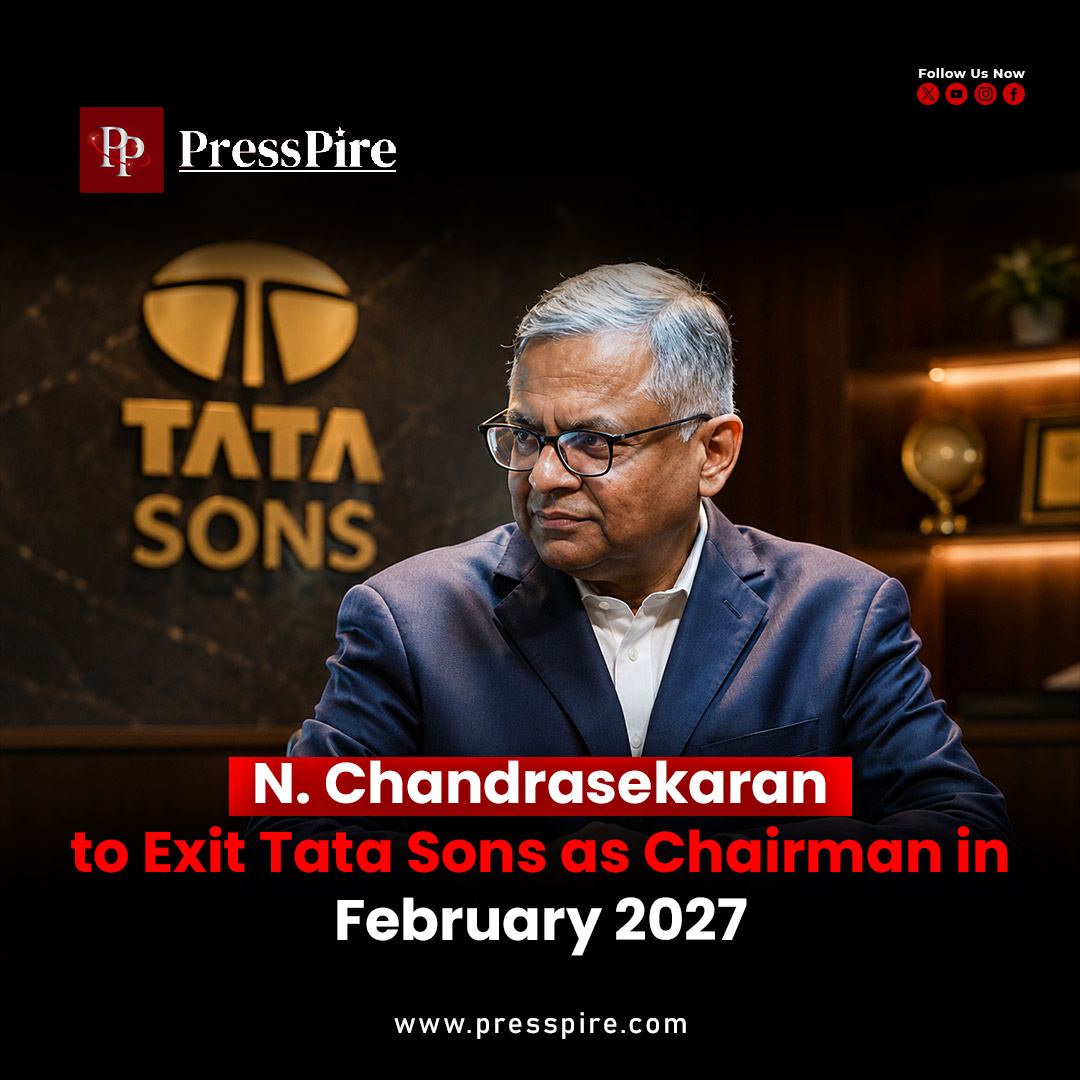
N. Chandrasekaran to Exit Tata Sons as Chairman in February 2027
N. Chandrasekaran will step down as Tata Sons Chairman on February 20, 2027, after deciding not to seek reappointment. His exit follows a lack of unanimous Board support, triggering a succession process for Tata Group’s next chairman. N. Chandrasekaran will exit Tata Sons in February 2027 after deciding not to seek reappointment. Know why he is leaving and what it means for Tata Group.
N. Chandrasekaran Exit Tata Sons: Chairman to Step Down in February 2027
N. Chandrasekaran Exit Tata Sons has emerged as one of the biggest corporate leadership developments in India, with the Tata Sons Chairman deciding not to seek reappointment when his current term ends on February 20, 2027. Chandrasekaran, who has led Tata Sons since 2017, said the decision followed a lack of unanimous support for his continuation on the Tata Sons Board.
The announcement brings an end to nearly a decade of leadership under Chandrasekaran, whose tenure has been marked by the expansion of the Tata Group into semiconductors, electronics manufacturing, aviation, electric mobility, digital businesses and artificial intelligence. His departure also opens an important succession process for Tata Sons at a time when the group is making some of its largest strategic investments in decades.
Tata Trusts has now moved to begin the process of forming a selection committee to recommend the next Tata Sons Chairman. The objective, according to the Trusts, is to ensure a smooth and timely transition that protects the long-term interests and values of Tata Sons and the wider Tata Group.
N. Chandrasekaran Exit Tata Sons: What Happened?
The N. Chandrasekaran exit from Tata Sons will take effect after his existing term ends on February 20, 2027. Chandrasekaran has not announced an immediate departure and will continue as Chairman until the completion of his current tenure. His decision is instead centred on not seeking another term after the Tata Sons Board could not achieve unanimous support for his reappointment.
The development follows months of uncertainty around the question of Chandrasekaran’s continuation. Earlier, the Tata Trusts had supported another term, but the reappointment process subsequently faced resistance within the Tata Sons Board. Chandrasekaran ultimately decided that continuing without full Board support would not provide the leadership clarity needed by a group managing businesses across multiple industries.
His decision has therefore triggered a formal succession exercise rather than an abrupt change at the top. Tata Trusts has said that a selection committee will be formed to recommend the next Chairman of Tata Sons. The process will be closely watched because Tata Sons sits at the centre of one of India’s largest and most influential business groups.
Why N. Chandrasekaran Is Leaving Tata Sons
The key reason behind the N. Chandrasekaran exit from Tata Sons is the absence of unanimous Board support for his reappointment. Chandrasekaran himself has pointed to the importance of having adequate support and leadership clarity rather than presenting his decision as a resignation triggered by a single business disagreement.
The development comes against the backdrop of strategic discussions within the Tata Group about its future direction, investments and capital allocation. Reports have highlighted differences between Chandrasekaran and Tata Trusts Chairman Noel Tata over aspects of the group’s strategy and investment approach. However, these reported disagreements should be distinguished from the formal reason given by Chandrasekaran for not seeking another term.
For Tata Sons, the issue is bigger than one executive’s tenure. The company oversees a vast portfolio of businesses, from technology and automobiles to steel, aviation, consumer products and power. Its leadership needs to balance long-term investment with financial discipline while maintaining confidence among shareholders, employees and other stakeholders.
N. Chandrasekaran Leadership at Tata Sons
The N. Chandrasekaran leadership at Tata Sons began in February 2017, following his appointment as Executive Chairman. Before moving to the top of Tata Group, Chandrasekaran had spent around three decades at Tata Consultancy Services, rising through the organisation before becoming its CEO and Managing Director in 2009. Tata appointed him to the Tata Sons Board in October 2016 before selecting him as Chairman.
His appointment was significant because Chandrasekaran came from a professional management background rather than the Tata family. He inherited the responsibility of guiding the group after a period of major leadership turbulence and was tasked with bringing greater alignment across Tata companies.
His approach centred on creating stronger connections between businesses while improving scale, efficiency and strategic coordination. The “One Tata” philosophy became an important part of his leadership, with the objective of using the collective strengths of Tata companies rather than treating them as completely separate entities.
Almost a decade later, Chandrasekaran leaves behind a Tata Group that has expanded its ambitions significantly, particularly in manufacturing, technology and new-age industries.
Tata Group Growth Under Chandrasekaran
One of the defining features of N. Chandrasekaran leadership at Tata Sons has been the group’s renewed focus on scale and transformation. Under his tenure, Tata expanded aggressively into areas such as semiconductors, electronics manufacturing, electric vehicles, digital commerce and aviation.
The Tata Group also strengthened its position in aviation following the return of Air India to Tata ownership. At the manufacturing end, Tata has pursued major investments in semiconductor production, electronics and battery manufacturing. Chandrasekaran has increasingly positioned these businesses as part of a broader strategy to build an integrated industrial ecosystem in India.
Tata’s own account of its “One Tata” strategy says the group’s combined market capitalisation crossed ₹30 lakh crore in February 2024 and subsequently passed ₹35 lakh crore in August that year. The strategy was built around three broad ideas: simplification, synergy and scale.
The transformation has not been without challenges. Some of the newer businesses require substantial capital and time before they generate mature returns. This will leave the next Tata Sons Chairman with the difficult task of maintaining investment momentum while ensuring that financial discipline remains strong.
N. Chandrasekaran and the One Tata Vision
The N. Chandrasekaran leadership strategy was closely associated with the “One Tata” vision. When he took charge in 2017, he argued that the strength of the group could be multiplied by encouraging Tata companies to work more closely together and use their collective expertise, relationships and capabilities.
The idea became particularly relevant as Tata expanded into sectors where collaboration between companies could create strategic advantages. Technology, manufacturing, automobiles, artificial intelligence, data infrastructure and digital businesses increasingly overlap, creating opportunities for different Tata companies to contribute to larger group-level initiatives.
Chandrasekaran has also increasingly placed artificial intelligence at the centre of Tata’s future strategy. At the India AI Impact Summit 2026, he described AI as a new form of infrastructure and said Tata was adopting AI across the technology stack, from silicon and systems to data centres, applications and AI agents.
This emphasis reflects the broader transformation he attempted to drive: Tata was not simply preserving established businesses but trying to position itself for industries expected to shape the next decade.
Tata Sons Succession After Chandrasekaran
The Tata Sons succession after Chandrasekaran is now the group’s most important governance priority. Tata Trusts has already initiated the process of forming a selection committee to recommend his successor. The Trusts said the process would be aimed at ensuring a smooth and timely transition consistent with the long-term interests and values of Tata Sons.
The succession process will be closely scrutinised because of the unique ownership and governance structure surrounding Tata Sons. The holding company is at the centre of the Tata Group and plays a crucial role in determining its long-term strategic direction.
The next Chairman will inherit a group with enormous opportunities but equally significant responsibilities. Tata is investing in semiconductors, electronics, batteries, artificial intelligence and aviation while its traditional businesses continue to operate across highly competitive global markets.
That means the successor will need more than financial expertise. The next Tata Sons Chairman will need to understand technology, manufacturing, global geopolitics, capital allocation and stakeholder management while preserving the ethical and institutional values associated with the Tata name.
Challenges Facing Tata Sons After Chandrasekaran
The Tata Sons leadership transition after Chandrasekaran comes at a complicated moment for the group. Tata is making long-term investments in businesses that could become important engines of future growth, but many of these ventures require considerable capital before they can deliver mature returns.
Artificial intelligence is one major opportunity. Tata has been building capabilities across AI infrastructure, data centres, applications and talent. Chandrasekaran’s 2026 messaging has positioned AI as a major strategic priority for the group.
Manufacturing is another important area. Tata has expanded its presence in electronics and semiconductors and has invested in new manufacturing facilities. These projects are strategically important for India’s ambitions to become a global manufacturing hub, but they also demand long-term execution.
Aviation presents another challenge. The integration and transformation of Air India remains a major undertaking requiring sustained management attention. The next Chairman will therefore inherit not only Chandrasekaran’s growth strategy but also several complex projects whose success will depend on disciplined execution.
Who Could Replace N. Chandrasekaran?
The question of who will replace N. Chandrasekaran as Tata Sons Chairman has already generated considerable speculation. Several names may emerge during the succession process, including senior Tata executives and experienced candidates from outside the group. Reports have mentioned Tata Steel Managing Director and CEO T. V. Narendran as one potential internal candidate, although no successor has been officially announced.
It is important to treat these names as speculation until the formal selection process is completed. Tata Trusts has begun the process of creating a committee, while the final appointment will depend on the appropriate governance and Board procedures.
The choice will be particularly important because the next Chairman will not simply replace an executive. He or she will inherit Chandrasekaran’s long-term strategic agenda and will have to decide which investments should accelerate, which should be reassessed and where the group should focus its capital.
The successor will also need to maintain the delicate balance between the interests of Tata Sons, Tata Trusts, operating companies, investors and other stakeholders.
N. Chandrasekaran’s Legacy at Tata Sons
The N. Chandrasekaran legacy at Tata Sons is likely to be defined by transformation. He arrived from TCS with a technology and operational background and went on to oversee a period in which Tata expanded its presence in several future-oriented industries.
His tenure saw the group deepen its presence in aviation, electric mobility, electronics, semiconductors and digital businesses. His “One Tata” strategy also encouraged greater coordination between companies and helped establish a stronger group-level identity.
His technology background has also influenced Tata’s approach to the digital economy. AI, advanced manufacturing and data infrastructure have increasingly become central to the group’s long-term plans.
At the same time, Chandrasekaran’s leadership will be judged by how effectively these investments ultimately translate into sustainable businesses. Some of the biggest projects launched during his tenure are still in their early stages, meaning their full impact may become visible only after he leaves office.
That makes his departure less a conclusion than a transition point for a strategy whose most ambitious chapters are still being written.
What N. Chandrasekaran’s Exit Means for Tata Group
The N. Chandrasekaran exit from Tata Sons marks the end of a significant leadership era, but it does not represent the end of the transformation he initiated. He will remain Chairman until February 20, 2027, giving Tata Sons time to identify his successor and prepare for a structured transition.
The biggest question now is whether the next Chairman will continue Chandrasekaran’s strategy at the same pace or introduce a different approach to capital allocation and business expansion. Tata’s investments in semiconductors, electronics, AI, aviation and electric mobility have created a large pipeline of opportunities that will require sustained leadership.
For the Tata Group, continuity will matter. So will the ability to adapt. The next Chairman will inherit one of India’s most recognisable business institutions at a time when technology, manufacturing and global economic competition are changing rapidly.
N. Chandrasekaran’s decision therefore represents more than a change at the top of Tata Sons. It is the beginning of a new chapter for Tata Group. His nearly decade-long tenure has reshaped the conglomerate’s ambitions, and the decisions made during the succession process will determine how those ambitions evolve in the years ahead.
For more insights navigate: PressPire | Stories That Shape the Future
Read previous article here: https://presspire.com/ola-mahashakti/
Follow PressPire on Facebook | Instagram | LinkedIn | YouTube
PressPire | Stories That Shape the Future