
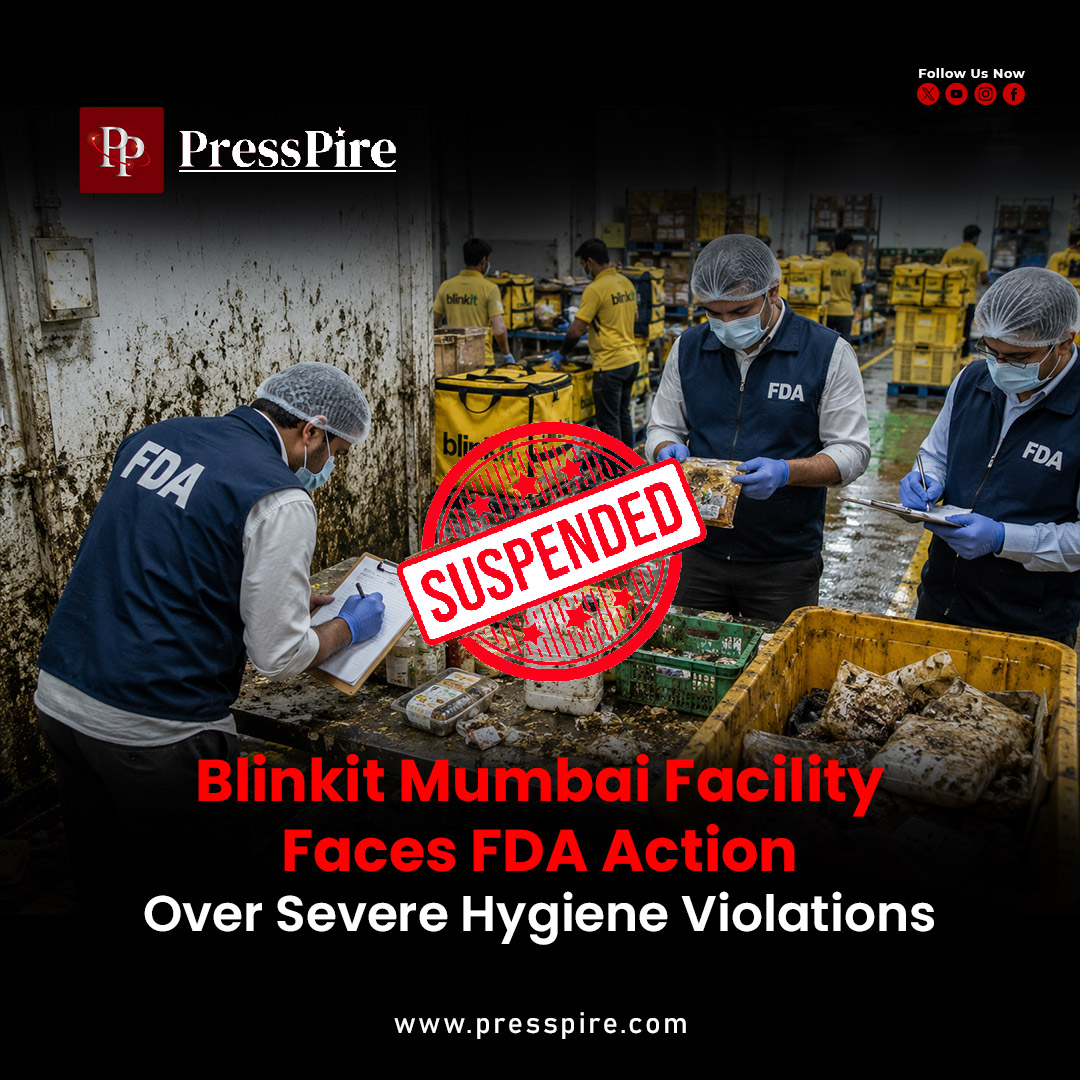
Blinkit Mumbai Facility Faces FDA Action Over Severe Hygiene Violations
Blinkit Mumbai Facility Faces FDA Action
The convenience of receiving groceries within minutes has transformed the way urban India shops. But behind that speed is a network of dark stores and warehouses where food must be stored, handled and moved under strict safety conditions. A recent Blinkit Mumbai facility inspection has brought those responsibilities sharply into focus after Maharashtra’s Food and Drug Administration (FDA) suspended the food licence of a Blinkit dark store in Malad West over serious hygiene and food-safety violations.
The facility, operated by Blink Commerce Pvt Ltd, was inspected by food safety officials on August 7, according to reports. Officials reportedly found extremely unhygienic conditions, including a significant cockroach infestation in areas where fruits and vegetables were stored. The findings prompted regulatory action against the facility and renewed questions about hygiene standards inside quick-commerce warehouses.
The development is important because customers rarely see what happens between placing an order on a smartphone and receiving it at their doorstep. For consumers, the expectation is simple: if a product is listed for sale, it should be safe, properly stored and fit for consumption.
The Blinkit Mumbai facility FDA action therefore goes beyond one warehouse. It raises a broader question about whether the rapid expansion of quick commerce is keeping pace with the food safety systems required to support it.
What the FDA Found at the Blinkit Facility
The FDA inspection reportedly identified conditions that went far beyond an ordinary cleanliness complaint. Officials found cockroaches in areas containing fruits and vegetables, raising concerns about possible contamination of food products. Reports also pointed to improper storage practices and other food-safety deficiencies at the Malad West facility.
For a facility handling food products, pest infestation is particularly serious. Fruits, vegetables, dairy products and packaged foods can be exposed to contamination if storage areas are not properly cleaned, sealed and monitored. Even products that appear intact can become a food-safety concern if the surrounding environment is poorly maintained.
The action also highlights why dark stores cannot be treated simply as conventional retail backrooms. These facilities function as highly active food-storage and fulfilment centres, handling large quantities of products before they are picked and delivered to customers.
The FDA’s decision to suspend the licence indicates that the violations were considered serious enough to warrant regulatory intervention rather than merely an informal warning. It also reinforces the principle that convenience cannot come at the cost of basic food hygiene.
Why Blinkit Hygiene Violations Matter
The significance of the Blinkit hygiene violations lies in the nature of quick-commerce operations. These platforms are built around speed. Customers expect groceries to arrive in minutes, while companies must maintain large inventories close to residential neighbourhoods to make that promise possible.
That model creates a demanding operational environment. Products have to be received, sorted, stored, picked and dispatched rapidly. Fresh produce requires particular attention because it can deteriorate quickly and may be more vulnerable to contamination when storage conditions are poor.
The latest incident also comes after previous regulatory scrutiny of dark stores operated by quick-commerce companies. In 2025, Maharashtra FDA action against dark stores in Mumbai and Pune highlighted problems such as food being stored on floors, dusty racks, missing pest-control documentation, inadequate protective equipment and shortcomings in cold-storage compliance. FSSAI has also documented concerns surrounding food safety in the rapidly expanding quick-commerce sector.
These incidents suggest that food safety must remain a central part of the business model, rather than becoming an operational issue addressed only after inspections.
FDA Action against Blinkit Sends a Strong Warning
The FDA action against Blinkit comes at a time when Maharashtra authorities have been stepping up inspections across the food and hospitality sector. In recent months, restaurants, clubs and other food establishments in Mumbai have faced licence suspensions or other regulatory action after inspections uncovered hygiene and food-safety violations.
The message is increasingly clear: well-known brands and large businesses are not exempt from food-safety requirements. A recognised name may create consumer confidence, but regulatory compliance remains the responsibility of the food business operator.
For Blinkit, the Malad incident puts additional attention on how its dark-store network is managed. The platform has built its identity around speed and convenience, but maintaining consumer trust depends equally on the less visible parts of its operation — cleanliness, pest control, temperature management, product rotation, expiry checks and employee hygiene.
Regulatory inspections serve an important purpose here because consumers cannot independently inspect a warehouse before ordering. They rely on the company and the regulator to ensure that food sold through the platform meets required standards.
Blinkit and the Quick-Commerce Safety Challenge
The Blinkit Mumbai facility incident also reflects a larger challenge facing India’s quick-commerce industry. Platforms such as Blinkit, Zepto and Swiggy Instamart have expanded rapidly, creating extensive networks of neighbourhood fulfilment centres designed to bring products closer to consumers.
That expansion has made dark-store management an important part of food safety regulation. FSSAI has previously stressed that e-commerce food businesses must maintain appropriate hygiene and safety standards at warehouses and storage facilities. The regulator has also discussed requirements involving licence information, product shelf life, food handlers and compliance documentation.
The challenge is not necessarily unique to one company. As the number of dark stores increases, regulators face the task of ensuring that every facility maintains consistent standards. Companies, meanwhile, must ensure that rapid operational growth does not create gaps in supervision.
For the industry, the lesson is straightforward: a dark store may not look like a traditional supermarket, but when it stores and distributes food, the same basic principle applies — food safety must come first.
Food Safety Rules for Dark Stores like Blinkit
Food businesses operating through digital platforms remain subject to India’s food-safety framework. FSSAI has repeatedly emphasised the importance of proper licensing, hygiene, food handling, storage conditions and compliance across e-commerce food operations. Its guidance has also highlighted the need for platforms to maintain information about warehouses and food handlers and strengthen monitoring mechanisms.
This is particularly important for fresh produce and temperature-sensitive products. Warehouses must maintain suitable storage environments, conduct pest-control measures and ensure that damaged or expired products do not enter the customer supply chain.
The regulator’s earlier observations involving quick-commerce facilities show the range of problems that can arise when these systems fail. Issues such as products being kept on floors, dusty storage racks, missing pest-control records and inadequate cold-storage documentation can collectively create significant food-safety risks.
For consumers, these requirements may remain invisible. For operators, however, they form the foundation of a safe and reliable delivery system.
What the Blinkit Mumbai Action Means for Consumers
For customers, the Blinkit Mumbai FDA action is a reminder to pay attention to the condition of food when it arrives. Fresh fruits and vegetables should be checked for unusual damage, contamination or signs of deterioration, while packaged products should be inspected for intact seals, expiry dates and unusual swelling or leakage.
Consumers should also report suspicious products rather than assuming that a refund alone resolves the issue. Food-safety complaints can provide regulators and companies with information about recurring problems in the supply chain.
At the same time, one facility’s regulatory action should not automatically be interpreted as evidence that every Blinkit facility or every product delivered through the platform is unsafe. The FDA action concerns the specific facility inspected and the violations identified there.
The responsibility is shared. Companies must maintain robust internal controls, regulators must conduct effective inspections, and consumers must remain alert to the condition of the products they receive.
The Bigger Question for Quick Commerce: Blinkit Mumbai hygiene case
The Blinkit Mumbai hygiene case ultimately raises a larger question about the future of quick commerce in India: can extreme speed and strict food safety coexist at scale?
The answer should be yes, but only when safety is built into the operating model. Speed should come from better inventory systems, technology, logistics and forecasting — not from shortcuts in storage, cleaning or product checks.
India’s quick-commerce market is entering a phase where operational discipline will matter as much as delivery speed. Consumers may appreciate receiving groceries in minutes, but they are unlikely to accept convenience if it comes with uncertainty about product safety.
The Malad West action is therefore more than a regulatory setback for one facility. It is a reminder to the entire industry that the final delivery begins much earlier — inside the warehouse where the product is stored.
As quick commerce continues to reshape Indian retail, the strongest platforms will be those that understand that trust is delivered alongside every order. Fast delivery may attract customers, but safe delivery is what keeps them.
For more insights navigate: PressPire | Stories That Shape the Future
Read previous article here: https://presspire.com/n-chandrasekaran/
Follow PressPire on Facebook | Instagram | LinkedIn | YouTube
PressPire | Stories That Shape the Future