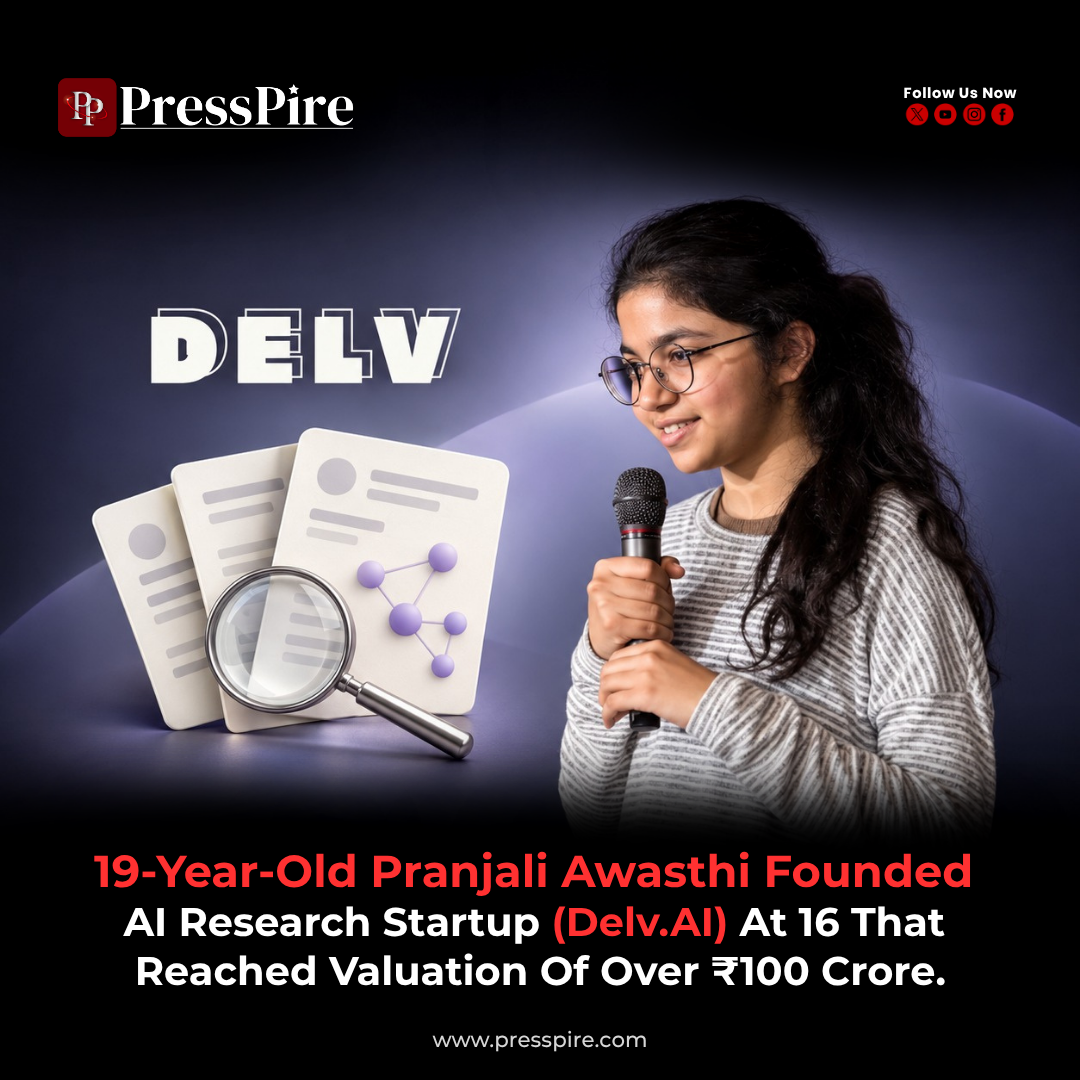
Pranjali Awasthi: The Teen Founder Behind Delv.AI’s Reported ₹100 Crore Valuation
The Indian-born entrepreneur turned an early interest in coding into an AI business. The widely reported valuation dates to 2023, while Delv’s product direction has since evolved.
Information checked on 14 October 2026
Pranjali Awasthi drew attention as a teenage entrepreneur when her startup, Delv.AI, was reported in 2023 to have reached a valuation of approximately $12 million, equivalent to around ₹100 crore at the time.
Described as 19 in recent coverage, Awasthi began building software years before that milestone. Her journey connects childhood coding, university research experience and an attempt to make information easier for researchers to find and use.
There is a distinction in the timeline: Awasthi’s own public account says she had founded a company by 15 and secured investment by 16. The familiar ₹100 crore figure belongs to the company’s earlier funding story.
How Pranjali Awasthi Started Coding
Awasthi was born in India and moved to the United States with her family as a child. She has described an upbringing that encouraged education and technical learning.
According to her public account, she began coding at seven and was running machine-learning experiments in a university laboratory by 13. That early exposure gave her experience with both programming and the practical demands of research.
Recent reporting places her internship at Florida International University. Her work involved searching for information, extracting data and preparing literature reviews.
Those tasks helped her identify a specific problem: finding the useful passage within a large collection of research material could take considerable effort. The opportunity she pursued grew out of work she had experienced herself.
What Delv.AI Was Built to Do
Delv.AI’s original focus was helping researchers work through large amounts of text. The company described its approach as combining its own machine-learning models with other available AI tools to support research and development.
Its company profile identified scientific researchers as an initial audience. In a separate interview, Awasthi described the product as a text-search platform for data analysts.
The proposed benefit was practical. A researcher exploring a subject needs to locate relevant material, extract useful information and understand how different findings relate to one another. Delv sought to make parts of that process easier.
This placed the original business in research software: applying AI to an information problem faced by users. Its usefulness would depend on the relevance of the material it retrieved and how easily people could check and apply the results.
Understanding the Reported ₹100 Crore Valuation
An October 2023 Business Today report put Delv.AI’s funding at approximately $450,000, or ₹3.7 crore at the time, and its valuation at approximately $12 million, or ₹100 crore.
These figures describe different things:
| Measure | Meaning |
|---|---|
| Funding raised | Money invested in the business |
| Company valuation | The value attributed to the company |
| Revenue | Income generated from selling products or services |
| Founder’s personal wealth | The value of the founder’s own assets and interests |
A company’s valuation does not mean it has that amount in its bank account. It also cannot, by itself, establish its founder’s personal wealth.
For readers encountering Awasthi’s story today, the date matters. The widely circulated valuation is a historical milestone; it does not establish Delv.AI’s current valuation, revenue or profitability.
Moving From a Prototype to Investor Conversations
Pranjali Awasthi early development as a founder also involved joining a community of other builders.
In a Thrive Global interview, she described participating in HF0, a 12-week residency for engineers building companies. Working around more experienced people helped her move beyond the technical side of creating software.
One incident illustrates the learning process. During a demonstration to fellow participants and investors, her application crashed because she had accidentally disabled an essential line of code. She said the presentation still led to her first major investor.
Pranjali Awasthi own accounts identify Lucy Guo as an early supporter and mention backing from Backend Capital and Village Global.
The episode offers a more grounded picture of an early startup than a valuation alone: a founder testing software, explaining its purpose and learning how to present a business while the product was still developing.
Pranjali Awasthi also highlighted constructive feedback and mentorship. Her experience suggests that technical ability needs opportunities to meet users and refine a product: who it serves, which task it improves and why someone would continue using it.
Pranjali Awasthi’s Work After Delv’s Early Launch
Pranjali Awasthi subsequently co-founded Slashy with Dhruv Roongta and Harsha Gaddipati. The company was part of Y Combinator’s Summer 2025 batch.
Its founders introduced Slashy as an AI assistant that connected with workplace applications and completed tasks. The company’s current description focuses on email, including drafting replies, organising messages and managing follow-ups.
This represents another application of AI to everyday information work. Researchers face large collections of documents; people managing a business face messages, requests and unfinished tasks across their working day.
These are separate products and milestones in Awasthi’s entrepreneurial history. The earlier Delv.AI valuation should not be applied to Slashy.
How Delv’s Product Direction Has Changed
Delv’s current website presents a personalised writing assistant with a waitlist. It describes learning from previous messages and tailoring drafts to both the sender’s style and the recipient.
The site says general-purpose language models made text summarisation more widely available, putting pressure on its original research proposition.
That account suggests a commercial challenge: when a once-specialised capability becomes widely accessible, a startup must establish what makes its product worth choosing. Delv’s current positioning centres on personalised communication. Its waitlist also means readers should check availability before assuming the new offering is broadly accessible.
What the Journey Shows About Building an AI Business
Awasthi’s experience illustrates the opportunity in noticing a recurring task and building software around it. It also shows why an AI company’s story continues after its first funding milestone.
A product needs a reason for users to choose it repeatedly. As underlying AI capabilities become easier to access, that reason may depend on a better understanding of users, dependable results and a service that fits their work.
The next evidence of progress will be concrete: released products, sustained customer use and clearly disclosed commercial results. Those measures will show how the ideas developed by Pranjali Awasthi translate into an enduring business.
For more insights navigate: PressPire | Stories That Shape the Future
Read previous article here : raktkhoj-openai-challenge-blood-search/
Follow PressPire on Facebook | Instagram | LinkedIn | YouTube
PressPire | Stories That Shape the Future