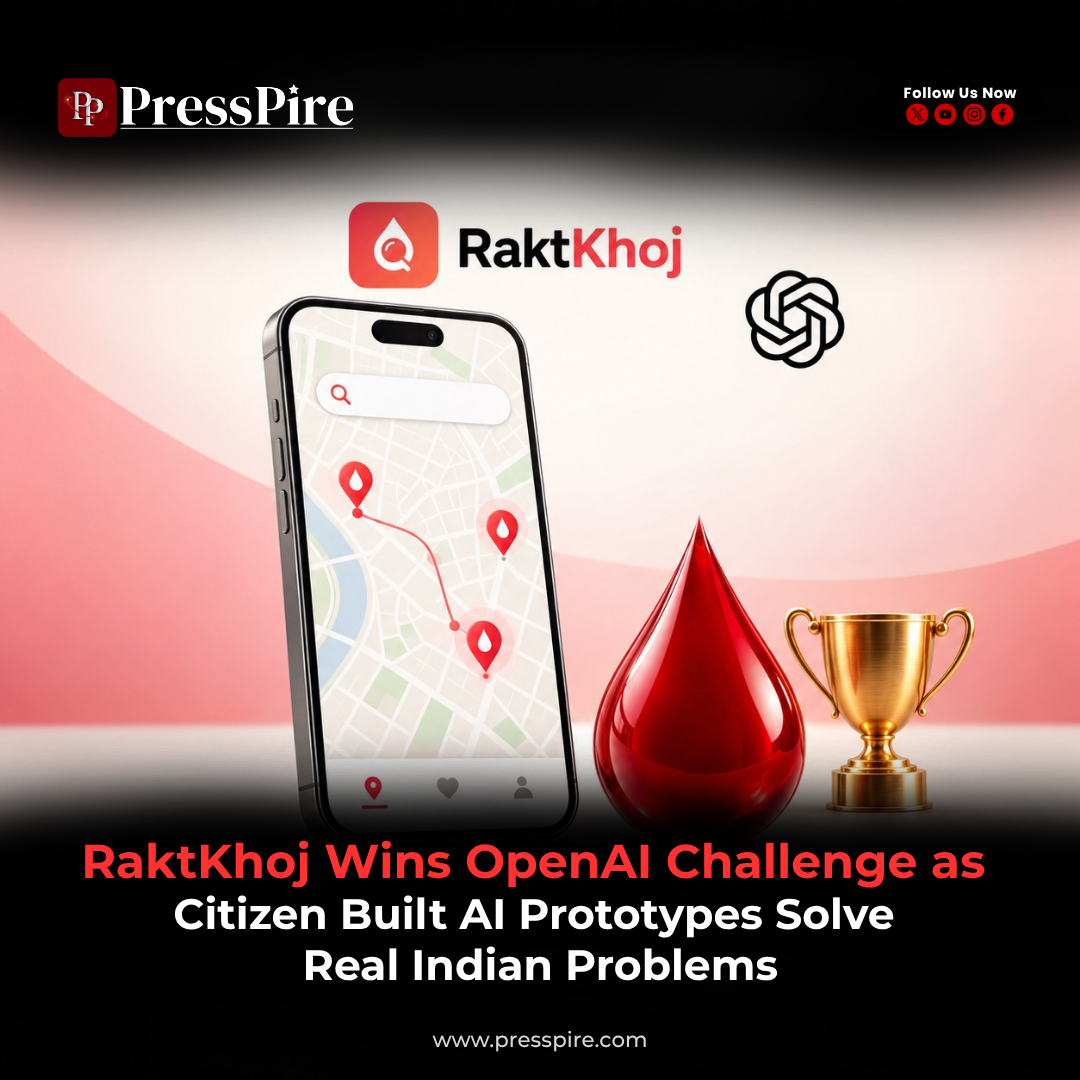
RaktKhoj Wins OpenAI-Backed Challenge to Simplify Blood Search
Created by Gurjot Singh Ahluwalia and Sanan Goyal, the prototype emerged as the winning concept at Build What Moves India, which also showcased ideas for cybercrime reporting and visa applications.
Information checked on 13 October 2026
RaktKhoj has won Build What Moves India, an independent initiative presented by entrepreneur and creator Varun Mayya in partnership with OpenAI. The project proposes a simpler way for families to search for blood at nearby blood banks and explore potential donor support during emergencies.
The challenge attracted more than 13,000 registrations, with 250 projects shortlisted and 10 finalists presenting their prototypes in Bengaluru. The finale took place on 12 September 2026, putting ideas developed by individual builders and small teams in front of judges and mentors.
RaktKhoj remains a demonstration project. Its recognition highlights a proposed improvement in access to information; its own website says the team is seeking support for future adoption.
What Is RaktKhoj?
RaktKhoj was created by Gurjot Singh Ahluwalia and Sanan Goyal, who have known each other since school. Their project focuses on the experience of someone trying to locate blood quickly while dealing with a medical emergency.
The proposed service brings blood-bank discovery and donor outreach into one guided journey. Its design asks users for essential details, then shows how a system could help them explore nearby options.
That approach addresses a specific product-design problem: helping a person understand what to do next when an initial search does not produce a suitable result. For a family under pressure, clear instructions and visible progress could make the process easier to follow.
How the RaktKhoj Blood Search Prototype Works
The creators describe a workflow that begins with the patient’s blood group, location and number of units required.
The intended experience has four main steps:
- Collect the request: Ask for the information needed to begin a local search.
- Explore nearby blood banks: Show relevant options and availability information.
- Reach potential donors: Demonstrate outreach to matched donors through WhatsApp when bank stock is unavailable.
- Track responses: Help the requester see who has responded.
Ahluwalia also describes questions presented one at a time, language support and a read-aloud option.
These are proposed capabilities demonstrated through the project. The public material does not establish that RaktKhoj currently operates a verified national inventory or an active emergency donor network.
How RaktKhoj Relates to eRaktKosh
India already has eRaktKosh, the government’s blood-centre information and management platform.
The Centre for Development of Advanced Computing describes eRaktKosh as providing information about blood availability, blood banks, donation camps and donor registration. It also supports blood-bank operations and connects with other digital services.
RaktKhoj’s creators have used that existing service as the starting point for their redesign. Their ambition is to make the user journey easier to navigate and show how bank searches and donor outreach could fit together.
The project’s website explicitly identifies it as an independent demo without government endorsement. Its reference to eRaktKosh should therefore be understood as the service it seeks to improve, rather than an announced government integration.
How Build What Moves India Selected Its Finalists
The competition asked participants to identify a difficulty they had encountered while using an Indian public digital service and build a working alternative.
Suggested areas included travel, taxation, pensions, certificates, payments and grievances. Participants could enter individually or in teams of two, and the initiative welcomed developers, designers, students and other independent builders.
According to the organisers, 250 shortlisted projects received a week of mentorship before the field narrowed to 10 finalists. Mayya subsequently reported that three teams received winning recognition.
Judging considered the importance of the problem, whether the main user journey worked, usability and the practicality of the design. Participants also had to explain their limitations and identify simulated elements.
These figures distinguish people who registered from projects that reached the final showcase.
Samarthan and Atithi Address Other Public-Service Problems
The showcase extended beyond healthcare, with projects exploring how people report cybercrime and prepare travel applications.
| Project | Problem addressed | Proposed approach |
|---|---|---|
| RaktKhoj | Finding nearby blood-bank options and potential donors | A guided search with donor outreach |
| Samarthan | Difficulty explaining and organising a cybercrime complaint | Assistance that turns voice or text accounts into structured complaint information |
| Atithi | Complexity in the Indian e-Visa application journey | A clearer process for eligibility, documents and application progress |
Samarthan, developed by Amrudh Vishal and Parichay Prabhu, finished third, according to the team’s public account. Vishal describes a prototype that can interpret spoken accounts and screenshots to help organise relevant details.
Atithi demonstrates an alternative application experience for visitors to India. Its interface includes eligibility guidance, document preparation and ways to resume or check an application. It clearly labels itself as a hackathon prototype.
These projects illustrate different uses for AI assistance. Their demonstrations establish concepts for further development, without confirming official processing of complaints or visa applications.
The Role of Codex and AI in the Challenge
The programme required meaningful use of Codex in developing the submitted prototype, according to its published FAQ. Participants could use other tools and libraries, provided they explained their contribution and had permission to use them.
This matters because AI can play two separate roles in such projects: assisting the builder who creates the software, and supporting features that a future user interacts with.
The distinction helps explain why a successful AI-assisted build does not automatically prove every proposed feature is reliable in public use.
The brief called for a complete, working user journey and encouraged designs suitable for mobile devices, slower connections and people with limited digital experience. It also required simulated data where real personal information or government-system access would be involved.
What Would Be Needed for Public Use?
RaktKhoj’s next step is to establish a path from demonstration to implementation.
Its pre-registration page currently asks people to express support for the idea. The page describes this as a way to show interest to departments that could potentially implement it.
For a service built around urgent blood searches, a practical assessment would need to examine how inventory information is updated, how donor participation is confirmed and how personal information is protected. Those are implementation requirements, rather than capabilities established by winning the competition.
The challenge’s organisers also make clear that selection carries no promise of government adoption.
RaktKhoj has demonstrated an approach worth evaluating. Its next meaningful milestones would be confirmed implementation partners, testing with intended users and evidence that the service provides dependable information when people need it.
For more insights navigate: PressPire | Stories That Shape the Future
Read previous article here : slayrobe-ai-styling-app-women/
Follow PressPire on Facebook | Instagram | LinkedIn | YouTube
PressPire | Stories That Shape the Future