
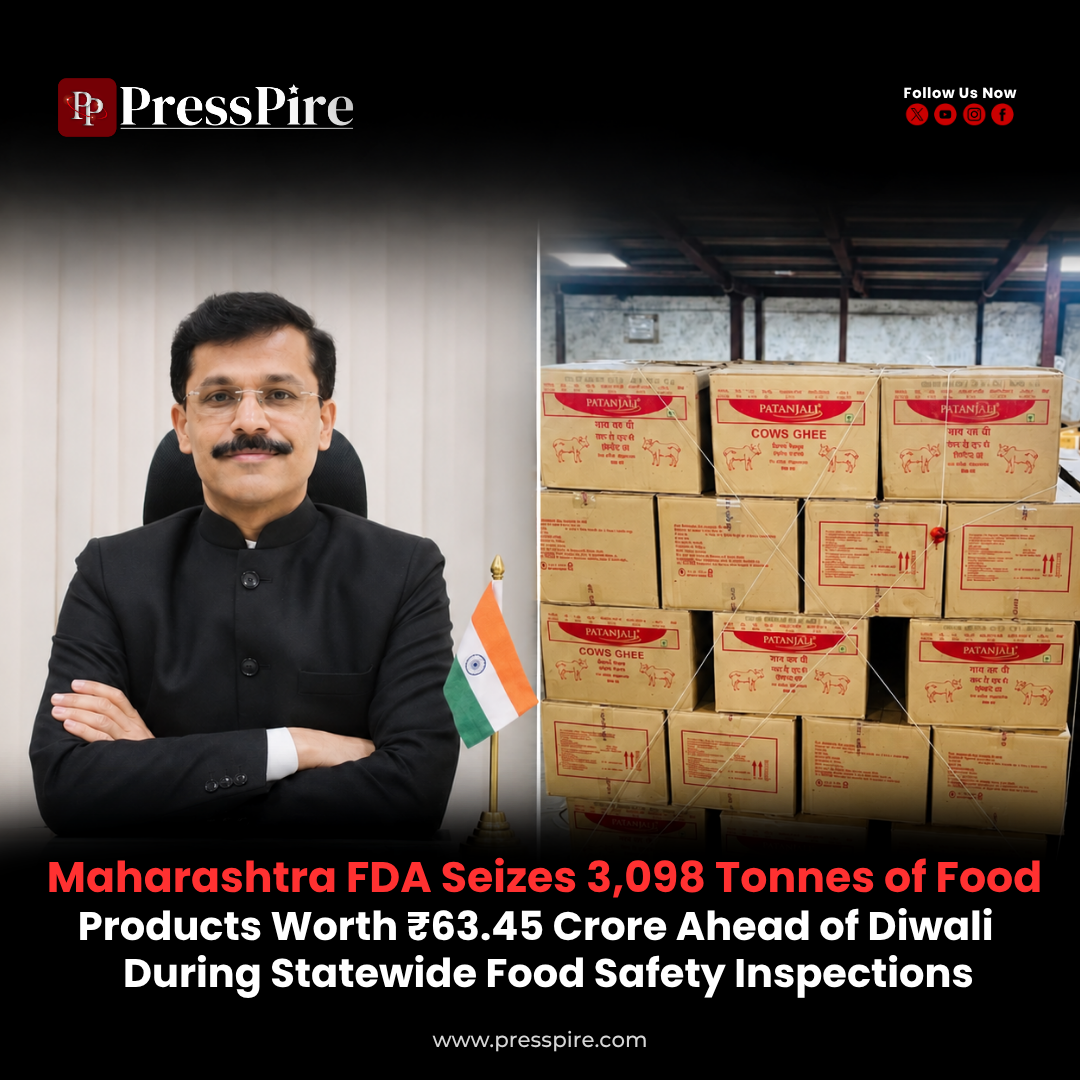
Pre-Diwali Drive: Maharashtra FDA Seizes 3,098 Tonnes of Food Worth ₹63.45 Crore
Statewide festive inspections covered 9,667 food establishments, resulting in 954 licence and registration suspensions alongside substantial food seizures.
The Maharashtra FDA seized 3,098.46 tonnes of food stock worth ₹63.45 crore during a statewide enforcement drive conducted between 1 September and 3 November 2026, according to figures released by the department.
The findings, reported on 5 November, reflect inspections across Maharashtra ahead of Diwali. Authorities examined food businesses, collected samples and took enforcement action as part of the wider festive-season campaign.
The operation included a shorter, dedicated Diwali inspection drive. Keeping these two reporting periods separate is essential to understanding the scale of the action.
Maharashtra FDA Food Safety Drive: Key Figures
The department reported the following results for the broader festive campaign and the Diwali-specific period:
| Enforcement measure | Festive drive: 1 September–3 November | Diwali drive: 15 October–3 November |
|---|---|---|
| Food establishments inspected | 9,667 | 3,332 |
| Improvement notices issued | 4,603 | 1,501 |
| Licences and registrations suspended | 954 | 326 |
| Cancellation proceedings initiated | 25 | 15 |
| Food samples collected | 8,835 | 3,864 |
| Food stock seized | 3,098.46 tonnes | 1,886.44 tonnes |
| Value of seized stock | ₹63.45 crore | ₹44.37 crore |
The ₹44.37 crore seized during the Diwali drive forms part of the ₹63.45 crore overall total. It represents approximately 70% of the recorded seizure value, rather than an additional amount.
Which Food Products Were Seized?
The seizures covered several categories used in everyday cooking and festive food preparation.
Salt, spices and condiments accounted for the largest reported commodity category by value. Edible oils represented another substantial share, followed by milk products and dry fruits.
| Selected food category | Quantity seized | Reported value |
|---|---|---|
| Salt, spices and condiments | 895.32 tonnes | ₹21.09 crore |
| Edible oils | 925.11 tonnes | ₹16.31 crore |
| Milk products, including ghee and khava | 171.57 tonnes | ₹7.63 crore |
| Dry fruits | 156.66 tonnes | ₹7.47 crore |
These are selected categories from the broader festive-period figures. Other seized products included sweets, savoury snacks, milk and bakery items.
The range of products shows that the campaign extended beyond finished sweets. It also covered ingredients that move through manufacturers, suppliers and retailers before reaching consumers.
Inspections Extended Across the Food Supply Chain
The Maharashtra FDA’s campaign covered manufacturing premises, storage facilities, transport operations, retail businesses and food service establishments.
Online sellers, quick-commerce operations and their storage facilities were also included. These checks are relevant because food ordered through an app still passes through physical warehouses, handling systems and delivery arrangements.
The administration identified 19 sectors for particular attention, including dairy products, edible oils, sweets, dry fruits, packaged foods, gift hampers and catering.
Officials also monitored the movement of khava and mawa supplied from other states.
This approach examines food at different stages of its journey. Problems involving ingredients, storage or labelling may arise before a product reaches the shop or platform where a customer buys it.
What Inspectors Were Looking For
Reported inspection priorities included adulteration, misleading product descriptions, unsuitable ingredients and the sale of expired food.
Specific areas of concern included:
- Products marketed as ghee or paneer despite containing vegetable-fat substitutes.
- Sweets made with colours that are not permitted.
- Aluminium decoration presented as edible silver leaf.
- Dry fruits with artificial colour coatings.
- Expired products placed into newly assembled gift hampers.
- Cooking oil subjected to repeated reuse.
These were areas targeted by the inspection programme. They should not be presented as confirmed findings for every item included in the seizure totals.
Similarly, the collection of 8,835 samples does not mean that all those samples failed testing. The published figures describe samples collected, while laboratory findings and subsequent decisions determine the outcome of individual cases.
Where the Highest Seizure Values Were Recorded
During the broader festive drive, the Konkan division recorded the highest reported seizure value at ₹21.17 crore.
This was followed by Chhatrapati Sambhajinagar division at ₹12.37 crore and Pune division at ₹10.39 crore.
Pune recorded the highest number of inspections among the divisions highlighted in the report, with 2,540 establishments inspected, followed by Konkan with 2,202 and Greater Mumbai with 1,504.
Inspection counts and seizure values measure different aspects of enforcement. A larger value can reflect the type and quantity of stock involved, so it should not be treated as a direct measure of how widespread violations are within a division.
Why Festive Food Safety Requires Particular Attention
Diwali purchases often include sweets, dairy products, snacks and assorted gift boxes. These products can differ considerably in their ingredients, handling requirements and shelf life.
FSSAI’s guidance on traditional milk products emphasises hygiene during preparation, suitable storage and consumption within the product’s shelf life. Milk-based sweets require particular care because they can deteriorate relatively quickly.
The guidance also identifies raw-material quality, packaging and the use of permitted ingredients as important parts of food safety.
Maharashtra’s published regulatory programme includes a Festival Food Safety Enforcement Standing Order, 2026, covering surveillance, inspections, sampling and measures against adulteration during festivals and large gatherings. The latest campaign sits within this broader enforcement framework.
What Shoppers Can Check Before Buying
Consumers can use product information to make more informed purchases during the festive rush.
For packaged foods, useful checks include:
- Dates: Read the manufacturing, expiry or use-by information.
- Ingredients: Check the ingredient list and allergen declarations.
- Identification: Look for the FSSAI logo and licence number.
- Storage: Follow the instructions provided on the packaging.
- Gift hampers: Examine the labels of individual products inside the box.
FSSAI’s consumer guidance encourages shoppers to read dates, ingredients and storage instructions rather than relying only on the appearance of a package.
For freshly prepared sweets, asking the seller about preparation, storage and recommended consumption time can provide additional practical information.
What Happens After the Inspections?
The reported actions include improvement notices, suspensions and the initiation of cancellation proceedings. These are different stages of enforcement and should be described separately.
In particular, proceedings to cancel 25 licences or registrations should not be reported as 25 completed cancellations.
The next indicators of the campaign’s outcome will include sample-testing results, correction of identified deficiencies and final decisions in individual cases.
The Maharashtra FDA figures establish the scale of the festive inspection effort. Its longer-term effectiveness will depend on whether businesses address the problems identified and maintain food safety practices after the holiday rush.
For more insights navigate: PressPire | Stories That Shape the Future
Read previous article here : tcs-porsche-deal-mhp-acquisition-ai-partnership/
Follow PressPire on Facebook | Instagram | LinkedIn | YouTube
PressPire | Stories That Shape the Future