IIT Madras 6G Test: What 6.39 Gbps Means for India’s Telecom Future
The wireless demonstration highlights India’s work on indigenous communication technologies as international development of 6G standards continues.
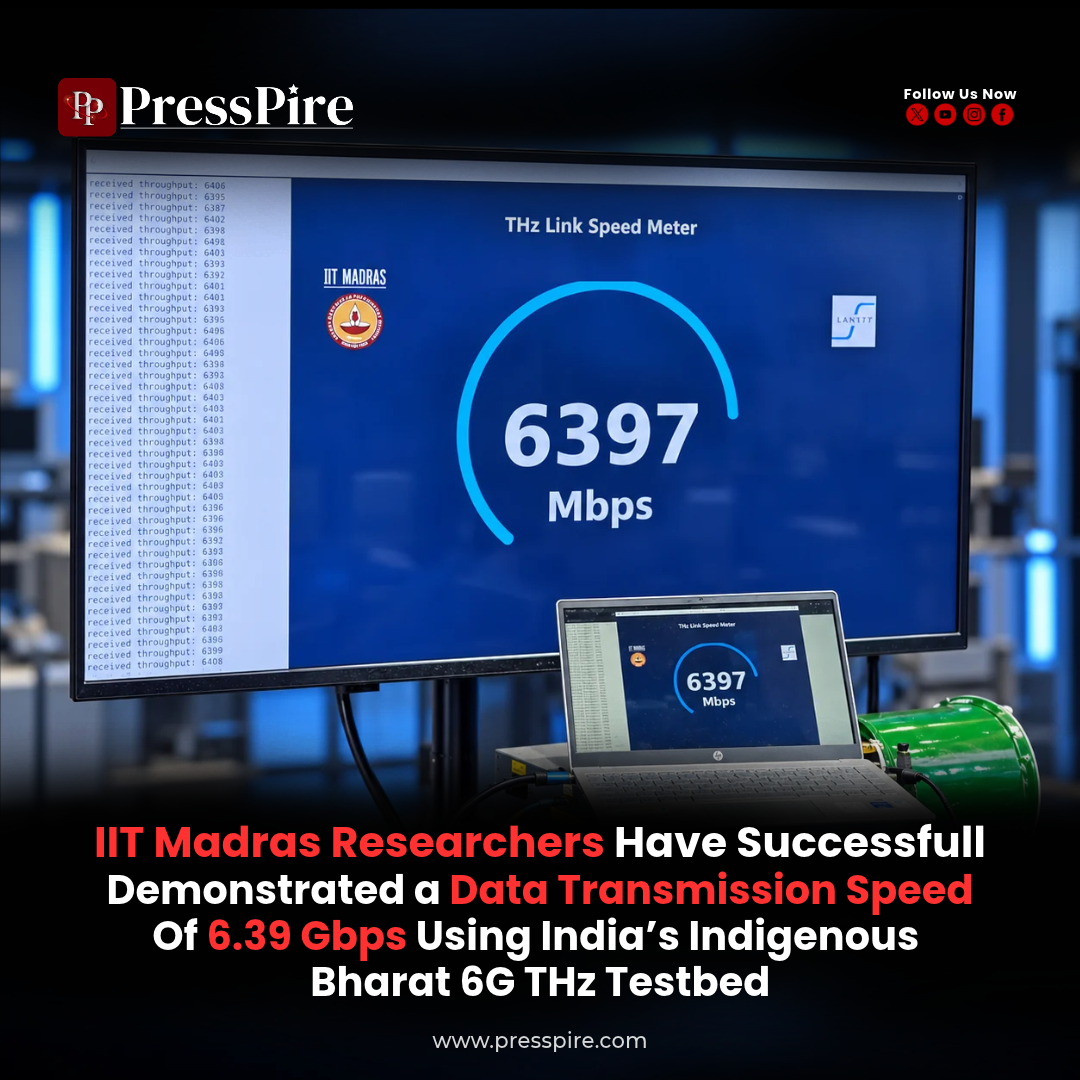
An IIT Madras 6G test has demonstrated wireless data transmission at 6.39 gigabits per second, using the Bharat 6G THz Testbed.
The result, publicly reported in August 2026 and featured by the Bharat 6G Alliance, represents progress in developing and evaluating technologies that could contribute to future communication networks.
The work involves collaboration with the Society for Applied Microwave Electronics Engineering & Research, known as SAMEER, and support from the Telecom Technology Development Fund, or TTDF.
Its significance extends beyond the speed figure. Developing experimental communication systems within India helps researchers build the technical knowledge needed to design, test and improve future telecom equipment.
IIT Madras 6G Test: Key Details
| Detail | Information |
|---|---|
| Reported achievement | Wireless data transmission at 6.39 Gbps |
| Research institution | IIT Madras |
| Platform | Bharat 6G THz Testbed |
| Research collaborator | SAMEER |
| Funding support | Telecom Technology Development Fund |
| Research area | High-frequency wireless communication for future 6G networks |
| Development stage | Research demonstration |
The result demonstrates a capability within an experimental system. A commercial mobile network requires additional components, testing, standards compliance and deployment infrastructure.
How Fast Is 6.39 Gbps?
A transmission rate of 6.39 Gbps means approximately 6.39 billion bits of data per second.
In byte terms, that is roughly 799 megabytes per second, before allowing for communication overheads. This conversion helps illustrate the scale of the reported rate.
Actual file-transfer performance depends on more than the wireless link. Devices, servers, network congestion, signal conditions and communication protocols can all affect the speed experienced by a user.
The reported figure therefore describes the demonstrated link’s data rate. It does not establish the download speed that a future mobile customer would receive.
For researchers, the next questions include how consistently the system performs and how its results change under different operating conditions.
What Is the Bharat 6G THz Testbed?
A testbed is an experimental platform used to develop and evaluate technology.
In wireless communication research, it allows engineers to examine how transmitting equipment, receiving equipment, antennas and signal-processing systems work together.
India’s government-backed terahertz testbed programme involves SAMEER, IIT Madras, IIT Guwahati and IIT Patna.
A July 2026 Ministry of Communications update described it as a three-year project funded through TTDF under Digital Bharat Nidhi. The government also reported that the project had demonstrated a high-data-rate, line-of-sight link at India Mobile Congress 2025.
Such infrastructure provides a setting for testing ideas before they are considered for larger networks. Researchers can identify weaknesses, modify designs and compare results across successive experiments.
Why High-Frequency Wireless Communication Matters
Terahertz and related high-frequency communication technologies are being explored as possible tools for future networks.
The attraction includes opportunities to use wide communication channels capable of carrying substantial amounts of data.
However, frequency alone does not determine performance. A working link also depends on its available bandwidth, signal quality, antennas, electronics and processing capabilities.
The International Telecommunication Union has published research on the technical feasibility of mobile communication in bands above 100 GHz. That work considers propagation, components, antenna techniques and possible deployment arrangements.
The IIT Madras demonstration sits within this wider effort to understand how high-frequency links might be used effectively.
Why This Is a Research Milestone
Developing a complete mobile generation requires much more than demonstrating a fast connection between a transmitter and receiver.
Networks must support multiple users, moving devices, dependable coverage, secure operation and equipment from different manufacturers.
They must also be affordable to deploy and practical to operate.
The value of a testbed result lies in establishing and examining a particular capability. It provides evidence that researchers can use to refine equipment and contribute to broader technology development.
Comparing the 6.39 Gbps figure directly with a consumer’s current 4G or 5G connection would overlook differences in test conditions, bandwidth and network configuration.
Where Could Future 6G Capabilities Be Used?
The ITU’s IMT-2030 framework identifies several areas being explored for 6G, including immersive communication, highly reliable connections, widespread connectivity, and integrated sensing and communication.
Potential applications include richer interactive experiences, connected industrial systems and services that combine communication with information about their surroundings.
Different applications require different combinations of speed, reliability, responsiveness and coverage.
For example, transferring a large dataset places substantial demands on capacity. Coordinating connected equipment may place greater emphasis on consistent response times and dependable communication.
A high transmission rate addresses one part of this wider set of requirements. It does not, by itself, demonstrate every capability envisioned for 6G.
How the Work Fits India’s Bharat 6G Vision
India released its Bharat 6G Vision in March 2023, setting out an ambition to develop domestic capabilities and become a significant contributor to the technology by 2030.
Government initiatives include research funding, experimental testbeds and support for participation in international standards organisations.
The practical opportunity is to develop expertise in communication hardware, software and system integration.
Domestic research platforms could also help universities, startups and equipment companies evaluate ideas and identify where they can contribute useful technology.
The commercial value will depend on whether those ideas can eventually meet performance, manufacturing and cost requirements.
What Happens Next?
International 6G development remains underway. The ITU’s process invites candidate radio-interface proposals between February 2027 and February 2029, followed by evaluation within the IMT-2030 programme.
For research teams, useful next steps include demonstrating repeatable performance, reporting test conditions and assessing how systems behave across different environments.
The IIT Madras 6G test contributes a reported wireless transmission result to that development process. Its longer-term importance will depend on how the technology progresses towards reliable, interoperable and commercially practical communication systems.
For more insights navigate: PressPire | Stories That Shape the Future
Read previous article here : gslv-f18-launch-nvs-03-navic/
Follow PressPire on Facebook | Instagram | LinkedIn | YouTube
PressPire | Stories That Shape the Future