
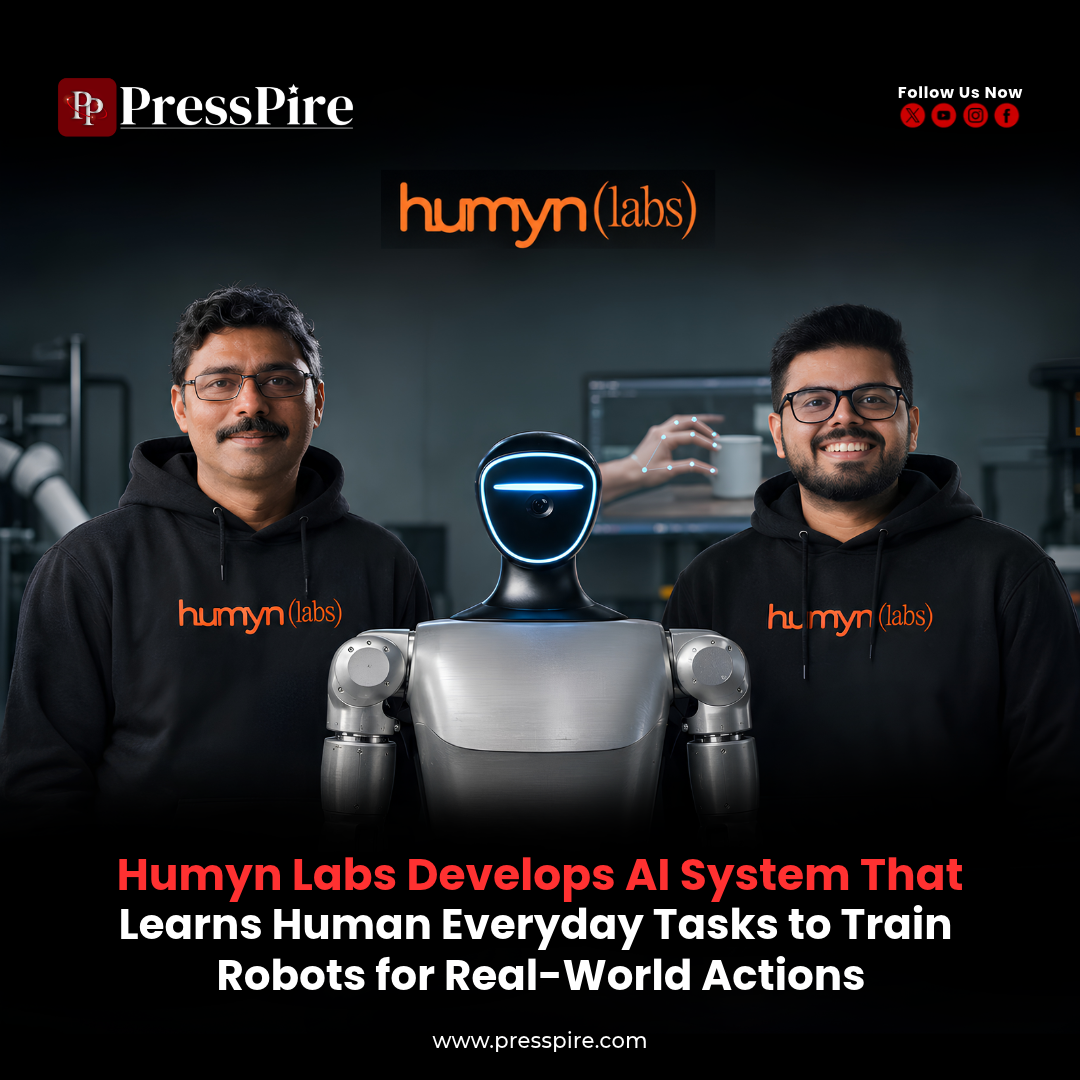
Humyn Labs Turns Everyday Human Actions Into Training Data for Real-World Robots
Humyn Labs is building a platform that captures people performing everyday activities and converts those demonstrations into structured training data for robotics and physical artificial intelligence. The approach aims to help developers teach machines how to interact with objects and carry out tasks in real environments.
Based in Bengaluru and founded by Manish Agarwal and Ishank Gupta, the company focuses on the data behind robot learning. Its work brings together recording tools, validation and labelling to make human activity useful for machine learning.
The central idea is straightforward: familiar actions can contain valuable examples of coordination, sequencing and object handling. Turning those examples into dependable robot behaviour, however, requires careful data preparation and further engineering.
How Humyn Labs Records Everyday Human Tasks
The company’s Humyn Lens app invites contributors to record activities such as washing dishes, folding laundry, sorting groceries and painting. It captures head-mounted video alongside synchronised motion-sensor readings, providing a first-person view of the activity.
This perspective, often called egocentric video, places the camera near the demonstrator’s viewpoint. It can show how hands approach an object, how the object moves and how the surrounding workspace changes during a task.
Humyn Labs also describes dedicated capture hardware called egoS1. According to its technical documentation, the device combines stereo cameras and an inertial measurement unit, or IMU, with checks during recording. The IMU records movement, while the paired cameras support depth information.
How Humyn Labs Converts Demonstrations Into Training Data
A recording becomes more useful for training when developers can identify the objects, movements and stages within it. The company describes several forms of structured information that its platform produces.
| Data component | Information it provides |
|---|---|
| Hand keypoints | Positions of tracked points on the hands |
| Object detection and tracking | Locations and movements of objects |
| Action labels | Identified activities and smaller task steps |
| Stereo depth | Estimated distances and spatial relationships |
| Scene information | Context about the surrounding environment |
| Motion readings | Movement of the person wearing the recording device |
These outputs help organise demonstrations into signals that AI developers can incorporate into their training systems.
Consider an illustrative task: moving a cup from a table to a shelf. A useful demonstration could distinguish reaching, grasping, lifting, positioning and releasing. It could also preserve where the cup started and where it ended. That structure gives developers a clearer account of the task than an unlabelled clip alone.
Why Human Demonstrations Matter for Robotics
The approach taken by Humyn Labs addresses a practical challenge: collecting examples across many objects, people and environments. Wearable recording allows human demonstrations to be gathered without requiring a robot at every recording location.
Learning from demonstration uses examples of task execution to inform a model’s behaviour. In imitation learning, the model learns relationships between observations and actions. The usefulness of those examples depends on factors including task coverage, annotation quality and variation between demonstrations.
Human movement still needs to be connected to the robot’s capabilities. A person’s fingers, reach and coordination differ from a machine’s grippers and joints. Developers must account for those differences when turning demonstration data into actions.
Independent research illustrates the engineering involved. The EgoMimic project combines first-person human video and hand tracking with robot demonstrations, using alignment methods and joint training. Its findings support the broader research direction; they do not establish the performance of this company’s datasets.
Where the Technology Could Be Used
Humyn Labs identifies manufacturing, logistics, retail, hospitality and agriculture among the environments its data platform aims to serve. These settings involve physical interactions that can vary with the workspace and the objects being handled.
Potential examples include:
- Household assistance: Organising items, handling dishes or working with fabric.
- Warehouse operations: Sorting products, picking objects and packing containers.
- Manufacturing support: Positioning components or demonstrating an assembly sequence.
- Hospitality services: Arranging supplies and carrying out routine handling tasks.
These examples illustrate possible training applications. Each would require a clearly defined task, suitable robot hardware and evidence that the resulting system works reliably under its intended operating conditions.
Data Quality and Consent Shape the System
For Humyn Labs, useful training data depends on recording quality as well as volume. Its documentation describes checks for issues such as poor lighting, blocked views and inadequate visibility of interactions between hands and objects. The workflow also includes synchronisation, labelling and human review.
The practical reason is easy to understand. If a camera misses the moment an object is grasped, the recording may provide an incomplete example. If sensor readings and video are misaligned, the relationship between movement and visual information becomes harder to interpret.
Consent is another part of collection. The Humyn Lens listing states that each login session begins with explicit consent and that acceptance is recorded with a timestamp. It also explains that uploaded recordings are used for AI training.
Humyn Labs Announces $47 Million in Financing
On November 18, 2026, the company announced $47 million in financing comprising $26 million in equity led by Accel and $21 million in venture debt led by Lighthouse Canton, with participation from Trifecta Capital.
The company said the funding would support infrastructure for preparing robot deployments in Brazil, South Korea and India, further development of its capture hardware and data enrichment engine, and a presence in San Francisco, London and Seoul.
The financing gives the business resources to expand its collection and processing capabilities. Whether that expansion delivers better robot performance will depend on the quality and usefulness of the resulting data.
What Will Determine Real-World Progress
The practical value of Humyn Labs will be measured by how effectively its data helps developers build robots that complete defined tasks. Useful evaluation would examine successful task completion, performance with unfamiliar objects and the amount of human intervention required.
For example, a convincing packing demonstration would need to work across different product shapes and arrangements. A household task would need testing under changes in lighting, clutter and object placement. These are the kinds of conditions that separate a promising demonstration from a dependable service.
Humyn Labs is pursuing a concrete role in that development process: making everyday human activity available as structured learning material. Its longer-term opportunity depends on helping robotics teams translate those demonstrations into measurable improvements in physical performance.
For more insights navigate: PressPire | Stories That Shape the Future
Read previous article here : candela-p-12-maharashtra-sea-trials/
Follow PressPire on Facebook | Instagram | LinkedIn | YouTube
PressPire | Stories That Shape the Future