
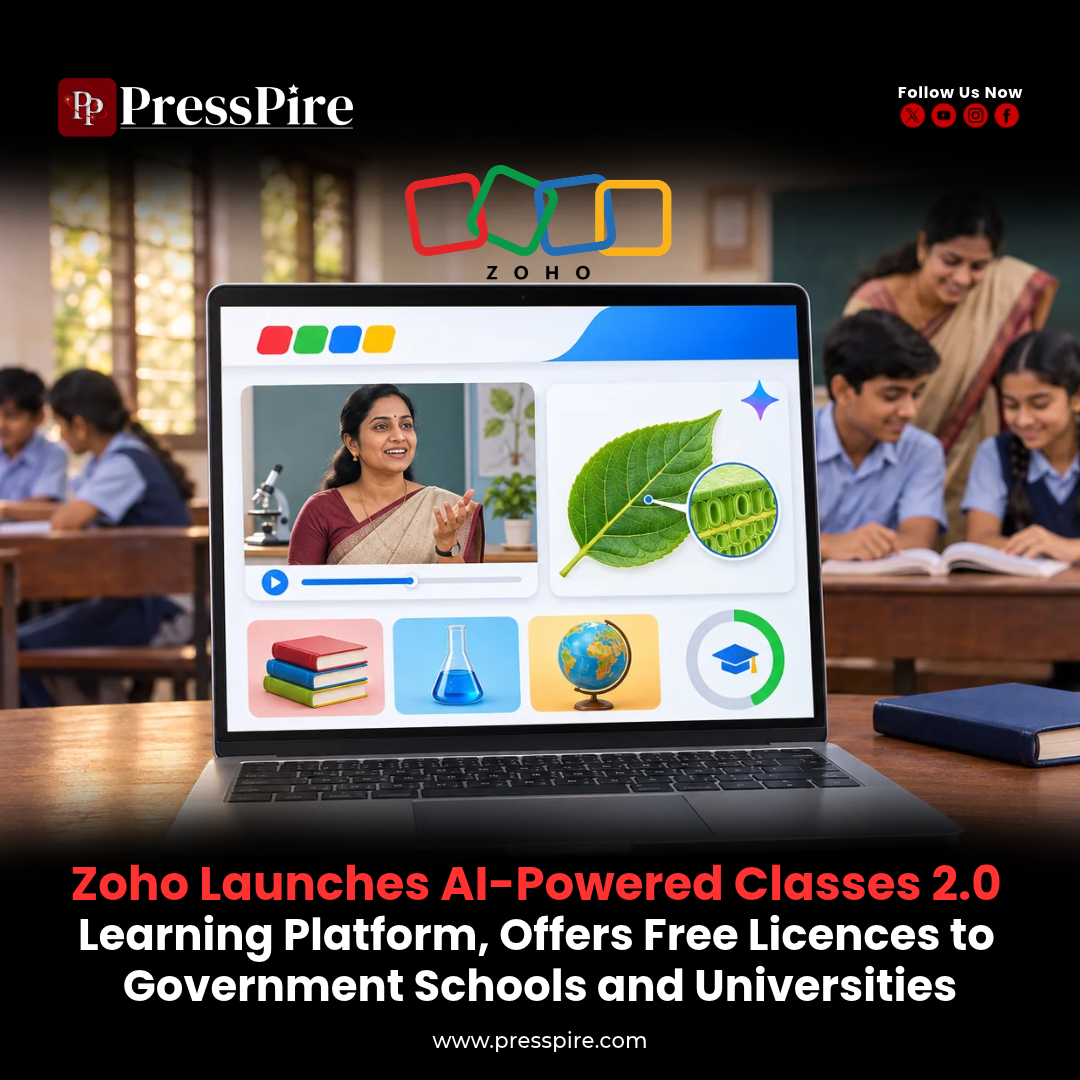
Zoho Classes 2.0 Offers Free AI LMS Licences to Government Institutions in India
The education platform combines AI-assisted teaching, student support and academic administration, with free product licences for government institutions across India.
India | Education and Technology
Launch announced: 15 July 2026 | Updated: 24 November 2026
Zoho launched Zoho Classes 2.0 on 15 July 2026, introducing an artificial intelligence-powered learning management system with free product licences for all central and state government schools, colleges and universities in India.
Built in India, the platform brings course preparation, assignments, student engagement and institutional administration into one system. Its central proposition is to reduce repetitive academic work while giving teachers more time to explain concepts, guide discussions and support students.
Alongside the government-institution offer, Zoho provides free access for an individual teacher with up to 100 students. Private educational institutions can subscribe to paid plans.
Free Access Under Zoho Classes 2.0
The licensing arrangements distinguish between government institutions, individual educators and private institutions.
| User category | Announced access arrangement |
|---|---|
| Central and state government schools in India | No product-licensing charge |
| Central and state government colleges and universities in India | No product-licensing charge |
| Individual teachers with up to 100 students | Free teacher plan |
| Private educational institutions | Paid subscription plans |
Zoho’s current pricing page lists Standard and Pro plans billed per instructor, alongside the free teacher option.
The 100-student condition applies to the individual-teacher plan. The government-institution offer was announced separately and specifically concerns product licensing.
For public education providers, removing that licence charge could make it easier to consider a common platform for teaching and administration. Institutions still need to organise the devices, connectivity and staff preparation required for effective use.
AI Tools Aim to Reduce Routine Teaching Work
Zoho Classes 2.0 includes an AI Course Builder that turns a syllabus, topic or lesson plan into structured teaching material.
According to Zoho, the tool can generate a course draft in under 30 seconds, including reading material, video-lesson outlines, assignments with assessment criteria and practice tests. The intended benefit is to give teachers a starting point that they can adapt to their students and curriculum.
Teaching workflows in Zoho Classes 2.0 also include assignment creation, question-paper preparation, attendance tracking and syllabus management. Zoho’s product pages describe automated support for multiple-choice and coding-assignment grading.
Teacher review remains important. In a launch interview, product lead Dev Anand Ramasamy explained that educators review generated course material and can edit AI-produced feedback before returning it to students.
That approach keeps academic judgement with the educator while using software to assist with preparation and evaluation.
An AI Tutor and Organised Learning for Students
Students using Zoho Classes 2.0 can access an AI Tutor designed to provide syllabus-based learning support.
The platform also brings together course materials, assignments, practice tests, announcements and deadlines. Zoho’s student-app description lists access to grades, course discussions and educational videos, alongside notifications about academic activity.
These features address different parts of the learning process. A student can revisit course content, practise a topic and keep track of work that needs to be submitted.
Zoho also includes microlearning and interactive activities, with the aim of encouraging regular participation. Their educational value will depend on the quality of the content and how teachers incorporate them into lessons.
Supporting a More Interactive Classroom
Zoho Classes 2.0 supports a flipped-learning approach, in which students review material before a classroom session.
A teacher can distribute a course in advance and then use class time for questions, discussion and problem-solving. Scheduled content releases and practice activities can help organise that preparation.
For example, students might review an introductory science lesson before meeting their teacher. The classroom session can then focus on explaining difficult concepts, examining examples and checking understanding.
This is a teaching approach supported by the platform. It works best when the preparatory material is accessible and the teacher connects it clearly with the lesson that follows.
Support for All 22 Scheduled Indian Languages
Zoho Classes 2.0 supports all 22 scheduled Indian languages, according to the company’s launch announcement.
The stated coverage extends to AI-assisted teaching, assessments and learning content. This is particularly relevant to institutions where students study in regional languages or find it easier to understand a concept in their mother tongue.
Language support can make digital material more usable, but terminology and explanations still need to fit the subject and classroom. Teachers play an important role in checking that generated content communicates the intended meaning.
For a platform intended to serve schools and universities across India, this localisation is a central part of its design.
Institutional Tools Cover Student Progress and Reporting
For administrators, Zoho Classes 2.0 includes student lifecycle management, covering the journey from enrolment to course completion.
Zoho says institutional analytics can help staff review engagement, academic outcomes and students who may need additional support. Bringing these records together can make it easier to identify where follow-up is needed.
The platform also supports Course Outcome and Programme Outcome tracking, alongside reporting and documentation used in accreditation processes.
A low-code application builder allows institutions to create custom tools for tasks such as admissions, lesson planning and syllabus management. This gives education teams scope to adapt parts of the system to their own processes.
For medical institutions, Zoho describes support for competency tracking, clinical logs and assessment documentation. These capabilities are intended to organise academic records and reporting.
Mobile Access Connects Classroom and Independent Study
Access to Zoho Classes 2.0 extends through dedicated student and faculty applications.
The student app allows learners to review material, submit work, follow course discussions and check deadlines. Its listing specifies that the student’s school, college or university needs a Zoho Classes account.
The faculty app includes course and assignment tools, attendance, announcements and file sharing. This supports educators who need to manage classroom activity while moving between lessons or locations.
The practical benefit is continuity: learning materials and academic updates can remain available beyond a single classroom session, within the institution’s organised learning environment.
Adoption Will Depend on Classroom Use
The free-licence offer lowers one barrier to adopting Zoho Classes 2.0, while the platform’s wider value depends on regular, effective use.
Teacher preparation, clear course structures and accessible student materials will influence whether the tools save time and support learning. Institutions also need a sensible process for reviewing AI-generated content and using student-progress information to guide support.
A useful measure of success will be whether educators spend less time on repetitive administration, students receive clearer feedback and academic teams can act on reliable records. Those outcomes will determine how effectively the platform supports everyday education.
For more insights navigate: PressPire | Stories That Shape the Future
Read previous article here : satsure-satellite-data/
Follow PressPire on Facebook | Instagram | LinkedIn | YouTube
PressPire | Stories That Shape the Future