
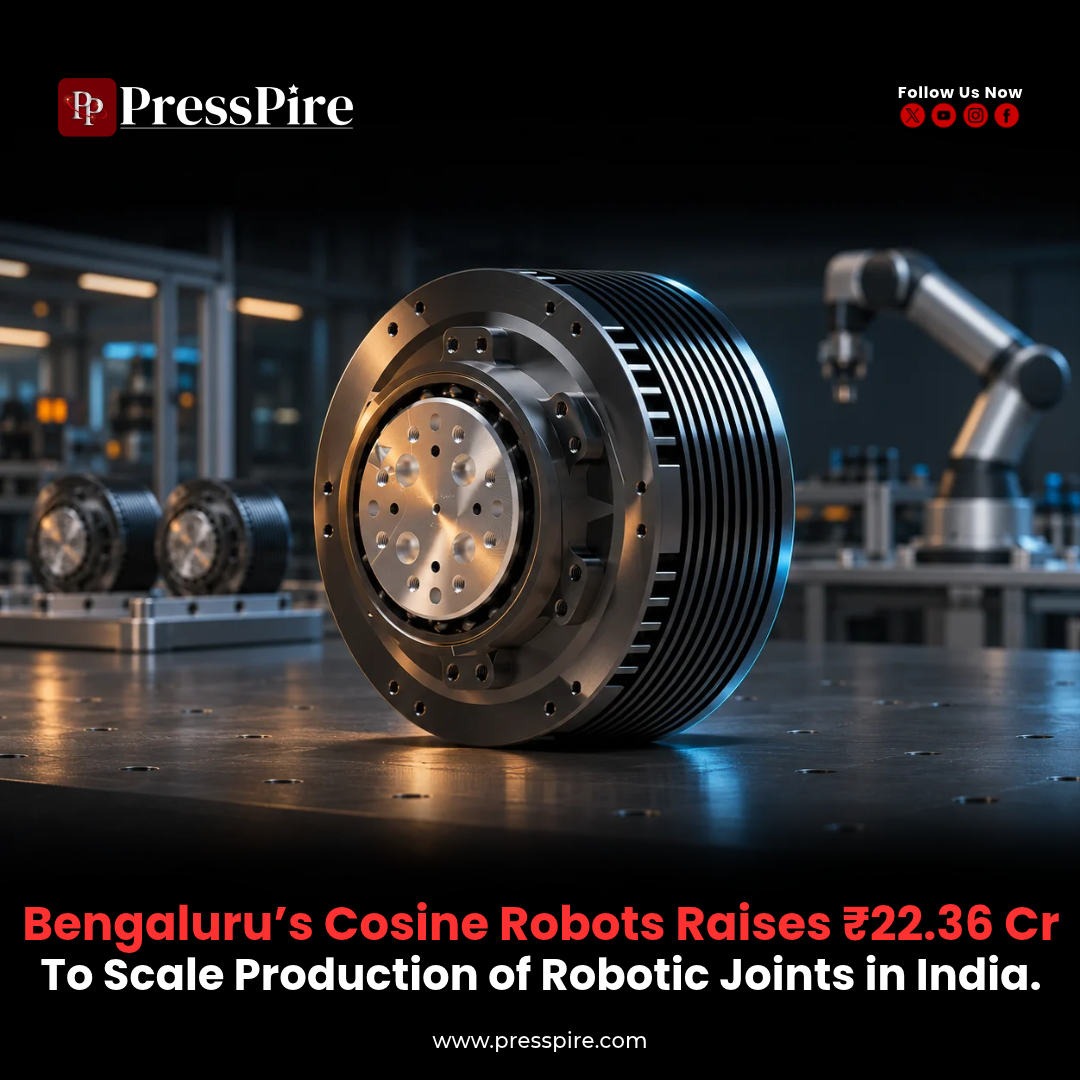
Cosine Robots Raises ₹22.36 Crore to Expand Robotic Joint Manufacturing in India
The Bengaluru startup will use the investment to develop robotic actuators, strengthen engineering and build production capabilities for customers in India and overseas.
Bengaluru | 24 November 2026
Cosine Robots has raised ₹22.36 crore in a funding round led by Avaana Capital, with participation from WEH Ventures and angel investors. The investment will support the Bengaluru startup’s work on actuators, the components that produce and control movement in robotic joints.
Founded by Kiran Mathew Koshy and Delip Thomas, Cosine Robots is developing motion systems for robot manufacturers. Its ambition centres on making advanced robotics more accessible through components designed and manufactured in India.
“Our goal is to make high-quality robotics more accessible,” said Koshy, the company’s co-founder and chief executive, in the funding announcement.
How Cosine Robots Plans to Use the Funding
The company plans to invest in a dedicated research and development and production facility, expand its engineering team and accelerate development of its integrated servo actuator portfolio.
The facility is intended to bring precision machining, assembly, calibration and endurance testing together. These activities cover the journey from making individual components to checking how a completed actuator performs over repeated operation.
Bringing development and production closer together could help engineers respond more quickly to testing results. For a hardware startup, that feedback matters: a promising design must also be practical to manufacture consistently as orders grow.
Building the Components That Move Robots
Cosine Robots develops integrated servo actuators that combine motors, gearboxes, sensors, electronics and proprietary control software in one system. The company says developing these elements together allows it to address precision, reliability, torque response and cost as connected engineering problems.
An actuator turns energy into movement. In a robotic joint, its behaviour helps determine how accurately a machine moves and how much turning force, known as torque, it can deliver.
For example, an arm repeatedly placing a component needs controlled positioning. A mobile robot also needs joints suited to movement and changing loads. These examples illustrate why robot manufacturers need motion components matched to the machine’s intended task.
Precision Control at the Joint
Cosine Robots says its control architecture combines dual-position sensing with a 25 kHz control loop, equivalent to 25,000 updates per second. The company presents this approach as a way to improve control over movement and torque.
The emphasis is on controlling motion within the joint itself. By combining sensing and control software with the mechanical assembly, the startup aims to make the actuator a more capable building block for robot designers.
For customers, the practical value will depend on how the complete unit performs under the loads and operating conditions of their application.
A Product Range for Different Robotics Applications
The Cosine Robots catalogue includes both cycloidal and planetary actuators, reflecting the company’s effort to serve different motion requirements. Its website lists the C-20 cycloidal actuator alongside forthcoming C-60, C-120, C-280 and P-50 models.
The C-20 product page lists a peak torque of 20 newton-metres and an output encoder for position sensing. However, its datasheet describes the specifications as preliminary, with final values to accompany the production release. Several other models remain marked as coming soon.
This gives readers a more precise picture of the expansion: the startup is developing a broader product family while building the manufacturing capabilities needed to support it.
What Domestic Actuator Manufacturing Could Enable
Cosine Robots aims to supply manufacturers in India and overseas with locally developed motion systems. Its intended applications include industrial robotic arms, collaborative robots, quadrupeds and humanoids.
A capable domestic supplier could give Indian robot builders more options when selecting components and coordinating design changes. Closer engineering collaboration may also help with adapting a joint to a particular machine or resolving integration issues.
Realising those advantages will require consistent product quality, dependable delivery and responsive technical support. Customers will need a supplier able to support the component throughout development and deployment.
For the wider industry, the opportunity extends to the specialised engineering and manufacturing work required to produce dependable motion systems.
A Growing Global Market for Robotics Hardware
The investment arrives as industrial robot installations reach new highs. The International Federation of Robotics reports that 603,307 industrial robots were installed worldwide in 2025, an increase of 11% from the previous year.
For Cosine Robots, the expanding installed base helps explain the commercial interest in components that support precise and dependable movement.
The same report also distinguishes established industrial automation from emerging humanoid systems. Many humanoids remain at the prototype or pilot stage, with wider deployment dependent on improvements in reliability, safety, operating time and economics.
A portfolio serving several robot categories could therefore give the startup opportunities across markets developing at different speeds.
Why the Investors Are Backing the Company
The investors backing Cosine Robots emphasised the importance of motion technology within the broader robotics industry.
Avaana Capital partner Vikas Verma pointed to the combination of precision mechanics, proprietary controls and manufacturing expertise. He described the founders’ work as addressing a fundamental engineering challenge in robotics.
WEH Ventures managing partner Deepak Gupta highlighted the role that capable actuator suppliers could play in supporting robot manufacturers in India and globally.
Together, those comments explain the investment thesis: a supplier of critical components could participate in the development of many robotic platforms.
Turning Funding Into Manufacturing Progress
The next stage for Cosine Robots will be translating its engineering work and fresh capital into products that customers can evaluate, integrate and order consistently.
Useful indicators of progress will include final production specifications, completion of models currently under development and evidence of dependable performance in customer applications. These milestones will help show how the business advances from product development towards repeatable manufacturing.
The ₹22.36 crore investment gives the startup resources to pursue that transition. Its longer-term position will depend on how effectively it combines motion control, production quality and customer support into a commercially competitive offering.
For more insights navigate: PressPire | Stories That Shape the Future
Read previous article here : zoho-classes-2-0-free-government-licences/
Follow PressPire on Facebook | Instagram | LinkedIn | YouTube
PressPire | Stories That Shape the Future