
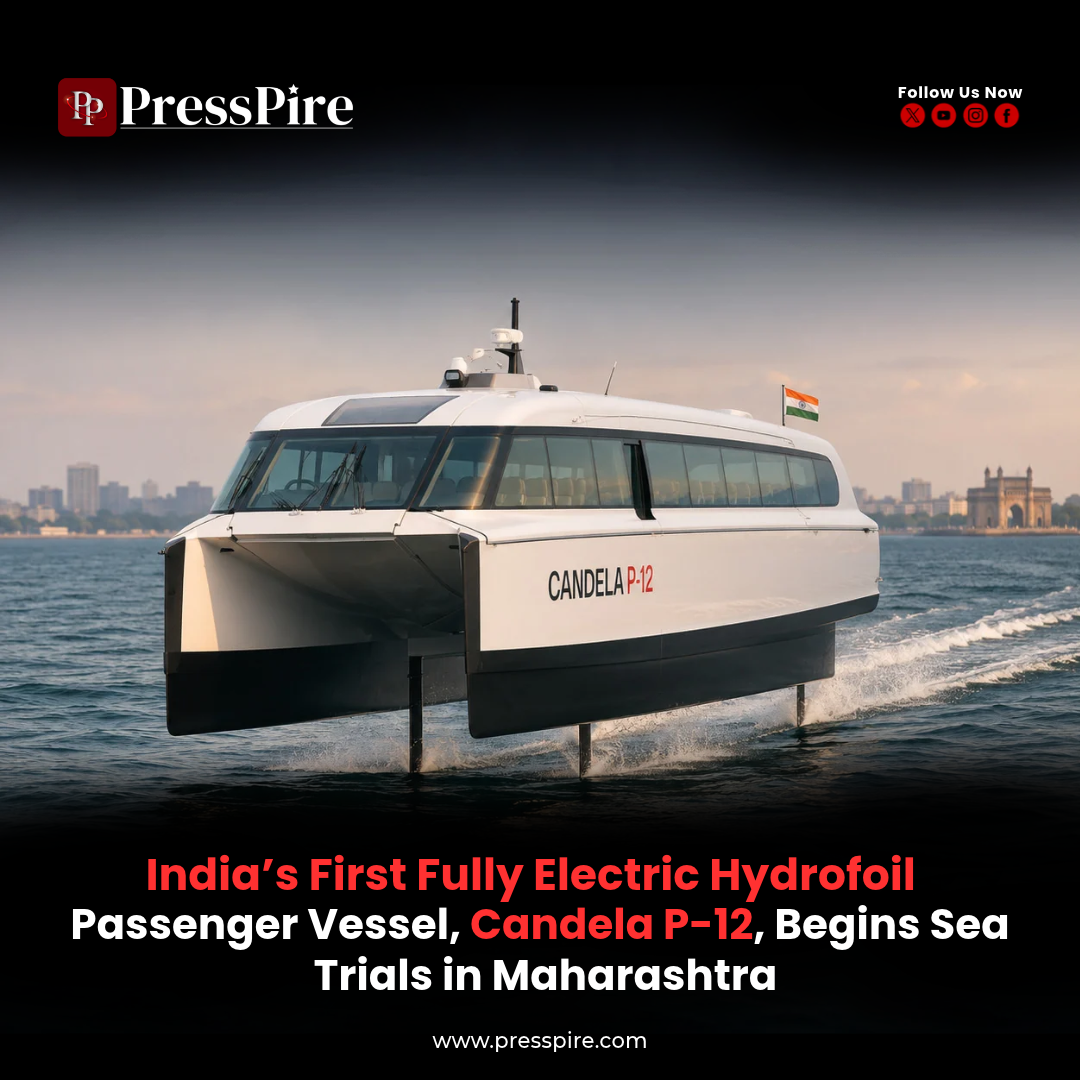
Candela P-12: India’s First Electric Hydrofoil Begins Sea Trials off Maharashtra
Candela P-12, described by state officials as India’s first fully electric hydrofoil passenger vessel, has begun sea trials in Maharashtra, bringing a new form of water transport to Mumbai’s coastline.
The Maharashtra Maritime Board conducted the first trial off the Gateway of India on 20 November 2026. The Swedish-built vessel uses underwater wings to raise its hull above the surface while cruising, reducing the resistance that conventional boats encounter.
The trial is an early step towards evaluating electric hydrofoils for local passenger services. Sadhav Shipping has described the imported vessel as a technology demonstrator supporting the larger Mumbai Water Metro project.
How Candela P-12 Uses Hydrofoils to Reduce Drag
Hydrofoils work like underwater wings. As water flows around them, they generate lift, raising the hull as the vessel accelerates.
With less of the hull moving through the water, resistance falls. That reduction helps make battery-powered travel practical at speeds that would otherwise require substantially more energy.
Candela combines the foils with sensors and computer-controlled stabilisation. The system continuously adjusts the foils to help maintain the vessel’s balance as conditions change.
For passengers, the intended result is a smoother journey with less wave impact. For operators, the central advantage is using less energy to maintain cruising speed.
Passenger Capacity, Speed and Range
For the Candela P-12, passenger capacity depends on the interior configuration.
In its November investor call, Sadhav Shipping described the Indian demonstrator as a 16-seat luxury vessel. The manufacturer’s wider product family also includes a 30-passenger Shuttle configuration intended for commuter services.
Candela publishes the following specifications for its Business version:
| Feature | Manufacturer specification |
|---|---|
| Length | 11.99 metres |
| Width | 4.5 metres |
| Service speed | 25 knots, approximately 46 km/h |
| Advertised range | Up to 40 nautical miles, approximately 74 km |
| Propulsion | Two C-Pod electric motors |
| Battery capacity | 378 kWh nominal; 336 kWh usable |
| Charging | DC fast charging |
The range is advertised at the stated service speed. Local trials will help establish performance under Mumbai’s operating conditions, including passenger load, weather and onboard electricity demand.
From Sweden to the Mumbai Waterfront
The Candela P-12 reached Mumbai through an international delivery programme that began earlier in 2026.
Ports of Stockholm reported that the vessel travelled under its own power from Frihamnen to Stockholm Norvik Port in early April. It was then loaded onto a larger ship for transport via Antwerp to Mumbai.
Candela separately announced that its first Business vessel had been commissioned in Stockholm before shipment to customers in Mumbai.
That sequence places the Maharashtra trials within a wider effort to introduce the Swedish manufacturer’s electric hydrofoils to international passenger transport markets.
Mumbai Routes and the Proposed Fleet
The proposed deployment of Candela P-12 vessels includes connections between the Gateway of India and Mandwa, as well as the Gateway of India and Elephanta Caves. A Versova–Mandwa connection has also been discussed.
Ports Minister Nitesh Rane has outlined plans for 12 vessels, with regular services targeted for the end of 2026, subject to operational arrangements.
For travellers, the value of these routes would depend on more than the crossing itself. Convenient access to terminals, reliable departures and onward transport would determine whether the service becomes useful for everyday journeys.
Confirmed routes, fares and timetables will be important indicators of how the proposed network develops.
What the Sea Trials Need to Demonstrate
Testing the Candela P-12 in Maharashtra gives operators an opportunity to evaluate how its technology performs in local waters.
Useful areas of assessment include:
- Passenger comfort: Stability and ride quality across different sea conditions.
- Energy consumption: Electricity use during representative journeys.
- Terminal operations: Manoeuvring, docking and boarding at intended locations.
- Battery performance: Available reserves across repeated trips.
- Crew preparation: Familiarity with the vessel and its control systems.
These are practical evaluation priorities, rather than published findings from the current trials.
Performance across a complete operating day will be particularly valuable. A passenger service needs a dependable pattern of departures, charging and turnaround times that can be repeated consistently.
Energy Efficiency and Passenger Comfort
The manufacturer says the Candela P-12 Business can use up to 80% less energy while foiling than conventional vessels. Savings on a specific route will depend on operating conditions and the vessel used for comparison.
The company also reported cabin noise levels of 63–64 decibels during commissioning trials in Stockholm. That measurement relates to those tests and provides context for its emphasis on quieter passenger travel.
Fully electric propulsion removes onboard combustion exhaust during operation. The wider environmental footprint also depends on electricity generation, battery production and the vessel’s service life.
The opportunity is to combine lower energy demand with a comfortable ride that encourages passengers to consider water transport.
Charging and Service Readiness
Introducing the Candela P-12 into regular service will require dependable shore infrastructure alongside the vessel itself.
The minister has proposed public-private operation, with charging infrastructure near Ferry Wharf.
Charging plans need to fit the timetable, available electrical capacity and the energy required for each crossing. Operators would also need arrangements for maintenance, spare parts, crew training and service interruptions.
Terminal design matters as well. Safe boarding, accessible facilities and convenient connections to road or rail services can make a substantial difference to the overall passenger experience.
These operational details will help determine how effectively the technology translates into a usable transport service.
Local Manufacturing and Commercial Prospects
The Candela P-12 initiative could also support a wider maritime manufacturing opportunity. Maharashtra has reportedly signed a memorandum of understanding with Candela concerning hydrofoil manufacturing in the state.
Developing that proposal into production would require a defined investment plan, technical partnerships, skilled workers and sustained demand.
The demonstration phase can provide useful evidence for those decisions. Operating data will help clarify maintenance needs, charging requirements and the economics of different passenger configurations.
For the Candela P-12, the next milestone is a dependable passenger operation supported by clear schedules and suitable infrastructure. The decisive measure will be whether operators can turn these tests into reliable departures, practical fares and a service that passengers choose to use.
For more insights navigate: PressPire | Stories That Shape the Future
Read previous article here : goa-ai-policy-2026/
Follow PressPire on Facebook | Instagram | LinkedIn | YouTube
PressPire | Stories That Shape the Future