D-Propulse: India’s Engine Startup Eyes Testing Revenue
The IIT Madras-incubated company is developing indigenous propulsion technology while exploring testing services as a potential source of income during engine development.
Updated: 3 November 2026
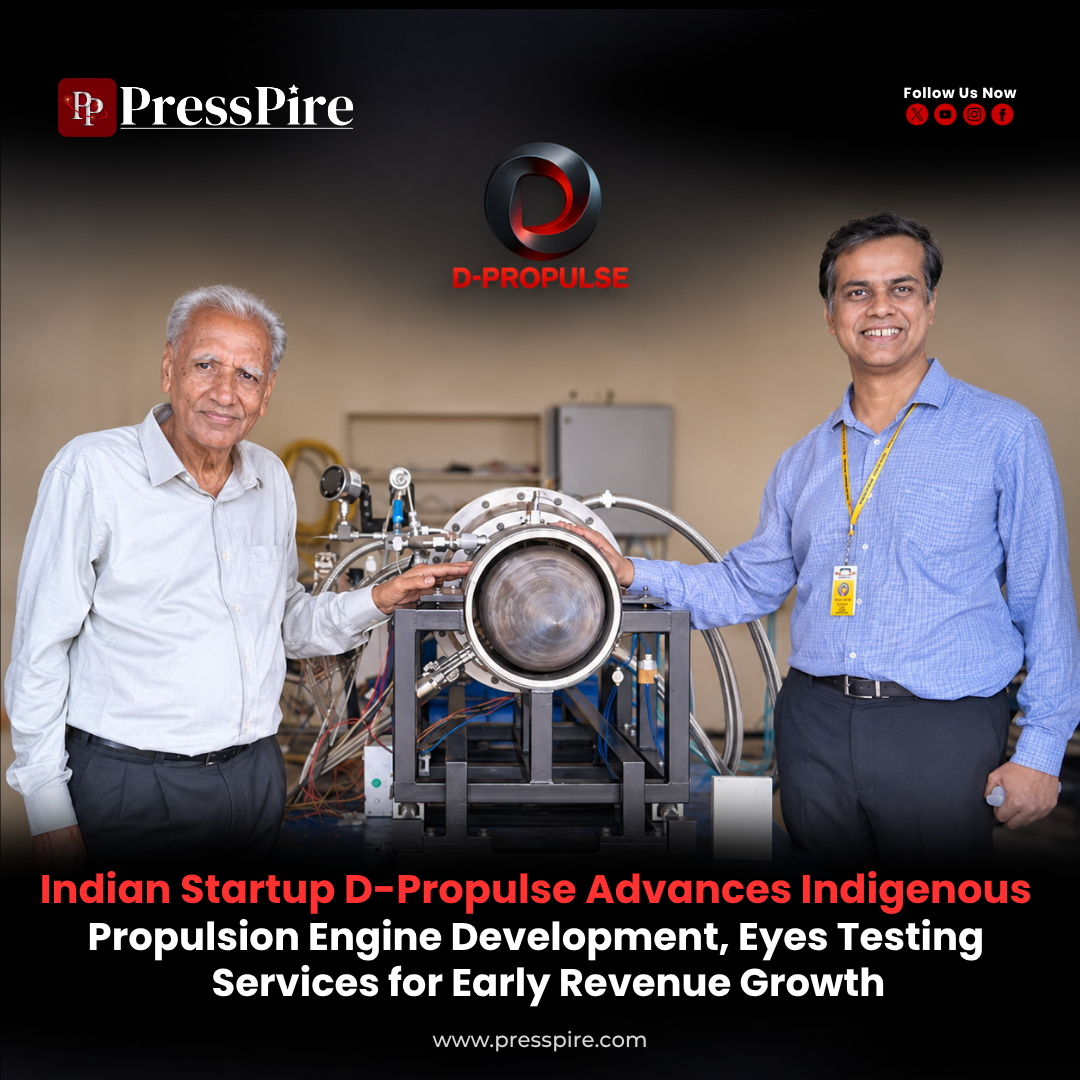
D-Propulse, an Indian aerospace startup developing rotating detonation engines, is pursuing a business opportunity alongside its propulsion programme: providing access to testing infrastructure.
The New Delhi-based company has reported ground-test progress on an indigenous engine intended for high-speed defence applications. Its next phase involves advancing that technology towards flight demonstrations and eventual production.
According to an Inc42 profile published on 31 October 2026, D-Propulse is exploring testing services as an early revenue opportunity. At the time of the report, the startup had not generated revenue or secured clients.
The proposal reflects a practical challenge for an engineering business: building useful capabilities during a development programme that takes time to reach commercial sales.
The Founders Behind D-Propulse
D-Propulse was incorporated in 2025 and is incubated through the IIT Madras Incubation Cell, according to its listing in the IIT Madras Research Park directory.
The company brings together two distinct professional backgrounds.
Saurav Jha, co-founder and CEO, is a defence analyst and the founder of Delhi Defence Review. His work has focused on defence policy and strategic technology.
Dr V. Ramanujachari, co-founder and CTO, previously worked at the Defence Research and Development Organisation. His experience includes leading India’s scramjet engine programme and contributing to propulsion development.
Their venture seeks to turn specialised engineering knowledge into propulsion products that can be developed and manufactured in India.
What Kind of Engine Is D-Propulse Developing?
D-Propulse is working on Rotating Detonation Engine technology, commonly abbreviated as RDE.
At a broad level, this technology uses rapidly travelling combustion waves to generate pressure and thrust. Researchers are investigating the approach because it could improve the efficiency and compactness of propulsion systems.
D-Propulse’s programme focuses on an air-breathing engine, with intended applications including high-speed unmanned aircraft and other defence platforms.
The company’s commercial proposition combines domestic development with the prospect of a mechanically simpler propulsion architecture. However, the practical benefits must be demonstrated in the complete system, including its performance, durability and suitability for the platform it powers.
For customers, the relevant comparison will ultimately involve the engine’s delivered performance and support requirements, alongside its purchase price.
The July Ground-Test Milestone
The startup’s most prominent announced technical milestone came during a test campaign on 21–22 July 2026 at a government facility in Hyderabad.
D-Propulse said its prototype demonstrated 5 kilonewtons of thrust and reached Technology Readiness Level 5, or TRL-5.
The company described this as a transition from laboratory component work to an integrated prototype tested in a relevant environment. Its public updates also identified the engine as a ground-test prototype of a design intended for flight.
This is a development milestone rather than confirmation of an operational product.
Ground testing allows engineers to examine whether a system behaves as expected under controlled conditions. Flight demonstrations add another stage of evidence about how the propulsion system performs when integrated into a vehicle.
The distinction matters commercially because a customer’s requirements extend beyond a successful individual test.
Why Testing Services Could Become a Business
Alongside engine development, D-Propulse is reportedly planning a combustor testing facility exceeding 5,000 square feet at IIT Madras, supported by computing infrastructure.
The proposed services business would give external organisations access to capabilities developed for the company’s engineering work.
In business terms, there are two potential uses for such an asset: supporting internal product development and providing a service that another engineering team may be willing to purchase.
For example, a smaller developer might need access to specialist equipment for a limited programme without being ready to establish a permanent facility of its own. A testing provider would need to offer a service that matches that developer’s requirements, schedule and budget.
The opportunity therefore depends on more than owning equipment. Clear service specifications, dependable scheduling, suitable expertise and useful test documentation would all influence a prospective customer’s decision.
For D-Propulse, these are potential commercial advantages. Public reporting does not yet establish a functioning testing-services revenue stream.
₹25 Crore Funding Supports Engineering Development
IAN Alpha Fund announced a ₹25 crore seed investment in D-Propulse on 28 January 2026.
The investor said the capital would support recruitment, computing and simulation capabilities, and testing infrastructure.
These spending priorities reflect the resources needed to develop physical technology. Engineering teams must progress through design, analysis, prototype development and testing before establishing a repeatable product.
The funding announcement also stated that D-Propulse was integrating artificial intelligence into its operations and technical development to help accelerate design and validation work.
AI is therefore described as a supporting capability within the development process. The company’s central product programme remains propulsion hardware.
D-Propulse’s Development Roadmap
The company’s public roadmap includes several stages, with future dates representing targets.
| Stage | Reported position |
|---|---|
| Seed investment | ₹25 crore investment announced in January 2026 |
| Ground demonstration | A 5 kN engine test campaign reported in July 2026 |
| Flight development | Flight testing targeted during 2027 |
| Initial production | Limited series production targeted by the end of 2028 |
In its July announcement, D-Propulse identified December 2027 as the target for a flight-ready engine.
Meeting subsequent production goals would require the company to translate its engineering results into a consistently manufacturable product. Customer qualification and delivery commitments would provide further evidence of commercial progress.
What Indigenous Propulsion Could Offer
Developing propulsion domestically could give Indian organisations greater access to the engineering knowledge behind critical equipment.
If successful, that capability could make it easier to investigate faults, adapt a design and support products over their working lives. Those benefits would depend on the supplier retaining expertise and maintaining dependable manufacturing and support operations.
D-Propulse’s announced work addresses a specialised part of this opportunity. Its progress will be measured through the systems it demonstrates and the requirements it can meet.
The startup now has an announced ground-test milestone, seed funding and a proposed additional business line. Flight results, paying customers and reliable delivery will show how those foundations translate into a sustainable aerospace company.
For more insights navigate: PressPire | Stories That Shape the Future
Read previous article here : ncert-ai-module-classes-9-12/
Follow PressPire on Facebook | Instagram | LinkedIn | YouTube
PressPire | Stories That Shape the Future