
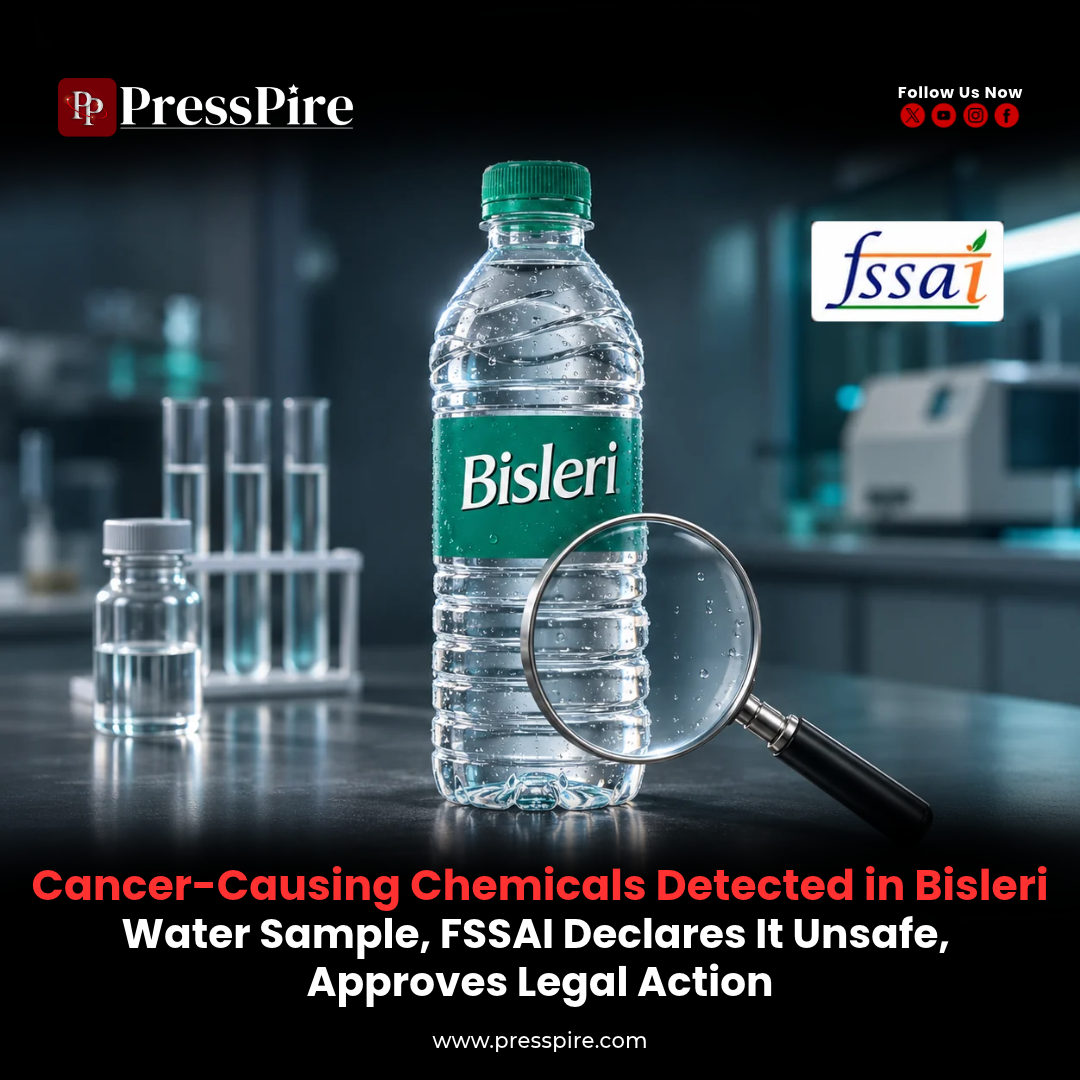
Laboratory findings involving bromate and PAHs have prompted regulatory action, while Bisleri disputes the results and maintains that its drinking water is safe.
India | Business and Consumer Safety
Updated: 24 November 2026
A Bisleri water sample has been declared unsafe by the Food Safety and Standards Authority of India, which announced on 22 November that it had sanctioned prosecution against Bisleri International Pvt. Ltd. under the Food Safety and Standards Act, 2006.
The regulator cited an initial failure to meet bromate limits and a subsequent referral laboratory finding involving polynuclear aromatic hydrocarbons, or PAHs. Bisleri has challenged the findings and said it would cooperate with the regulatory process.
The development places laboratory testing, manufacturing controls and consumer confidence under scrutiny. However, the findings concern a specific tested sample; they do not establish that every bottle sold under the brand is unsafe.
FSSAI Findings on the Bisleri Water Sample
According to FSSAI, officials collected a regulatory sample from the company’s premises for analysis. The product was classified as packaged drinking water other than mineral water.
The first laboratory examination found that the sample did not comply with the prescribed bromate limits. Following an appeal by the company, it was sent to a referral food laboratory, which also classified it as unsafe after detecting PAHs.
The Bisleri water sample therefore received an unsafe classification at both testing stages, although the regulator’s account identified different chemical concerns. That distinction matters when assessing the company’s response: a compliant bromate result alone would not resolve a separate finding involving PAHs.
FSSAI said the laboratory findings established violations relating to unsafe food and that permission had been granted to launch prosecution.
Bisleri Disputes the Results and Details Its Response
In its statement on 23 November, Bisleri said the matter concerned a single batch manufactured in September 2025 at its Goa facility.
The company said officials collected six samples on 30 September 2025. Five met the applicable standards, while the Bisleri water sample at issue recorded bromate at 12 micrograms per litre against a limit of 10 micrograms per litre.
On those company-reported figures, the initial result was 20% above the stated limit. This describes the difference in concentration; it is not a measure of an individual’s cancer risk.
Bisleri said it appealed on 22 November 2025. According to the company, the referral laboratory subsequently found bromate within the prescribed limit but separately flagged PAHs.
It also said an independent examination by an FSSAI-approved laboratory found bromate within the permitted limit. Bisleri stated that it submitted those results to FSSAI’s Western Regional Office on 2 February 2026 and received no further communication.
As of its 23 November statement, the company said it had received no official notice by email or in hard copy. It maintained that its products were safe and cited more than 90 quality tests across a 10-step manufacturing process. These remain the company’s representations in response to the regulatory findings.
Bromate and PAHs Explain the Chemical Concerns
The Bisleri water sample case involves two distinct categories of contaminants, which should be assessed separately.
Bromate can form during water treatment when ozone reacts with bromide already present in source water. Its detection does not, by itself, establish that it was deliberately added.
The World Health Organization sets a provisional drinking-water guideline value of 10 micrograms per litre for bromate. Its guidance describes bromate as possibly carcinogenic to humans, based on sufficient evidence from animal studies and inadequate evidence in humans.
PAHs are a large group of chemicals associated with the incomplete burning of coal, oil, wood and other organic material. Some members of this group have carcinogenic properties. They can enter the environment through several pathways, so identifying their presence does not automatically establish the source of contamination.
FSSAI’s published packaged drinking water standards specify a maximum bromate concentration of 0.01 milligrams per litre, equivalent to 10 micrograms per litre, and require PAHs to be non-detectable.
For the Bisleri water sample, a meaningful assessment of potential health effects would require details about the compounds detected, their concentrations and actual exposure. The public account of the referral finding does not identify individual PAHs or their measured levels.
A laboratory finding of a chemical hazard is serious, but it does not establish that consumers developed cancer. Health effects depend on factors including the substance involved, the dose and the duration of exposure.
What the Prosecution Approval Means
Approval to prosecute over the Bisleri water sample is a step toward legal proceedings under India’s food safety framework. It is not a conviction or a final judicial finding against the company.
Section 42 of the Food Safety and Standards Act sets out a process involving sample analysis, scrutiny of laboratory findings, sanction and prosecution before the appropriate court.
The company’s objections and supporting test reports would need to be considered through the applicable regulatory and legal process. Equally, its assurance that its products are safe does not overturn the regulator’s announced findings.
The evidence will need to address both chemical concerns and explain why the laboratory results differed.
Wider Scrutiny of Packaged Drinking Water
The Bisleri water sample dispute has also drawn attention to checks across the bottled water market. Reuters reported, citing a government source, that authorities planned to test additional Bisleri samples nationally and samples from other companies.
Separately, FSSAI introduced a testing scheme for packaged drinking water and mineral water effective from 1 January 2026. It requires manufacturers to maintain testing records and follow specified controls to establish compliance.
That scheme took effect after the September 2025 sampling date given by Bisleri. It provides context for current industry oversight, rather than explaining the original test results.
For manufacturers, the case illustrates the value of traceable batches, documented laboratory methods and a clear response when test results conflict.
Details That Could Clarify the Case
Further disclosure about the Bisleri water sample would help establish the precise scope of the findings. Relevant information includes the affected batch identifier, the specific PAHs detected, their concentrations, the testing methods used and the distribution of the batch.
The full laboratory reports would also help clarify the relationship between the initial bromate result, the referral laboratory’s findings and the independent test cited by the company.
The Bisleri water sample case now places a practical responsibility on the regulator and manufacturer to explain the evidence clearly. Publishing precise findings and any resulting corrective measures would give consumers a firmer basis for understanding the issue than broad assurances or alarming claims alone.
For more insights navigate: PressPire | Stories That Shape the Future
Read previous article here : humyn-labs-robot-training-human-tasks/
Follow PressPire on Facebook | Instagram | LinkedIn | YouTube
PressPire | Stories That Shape the Future