
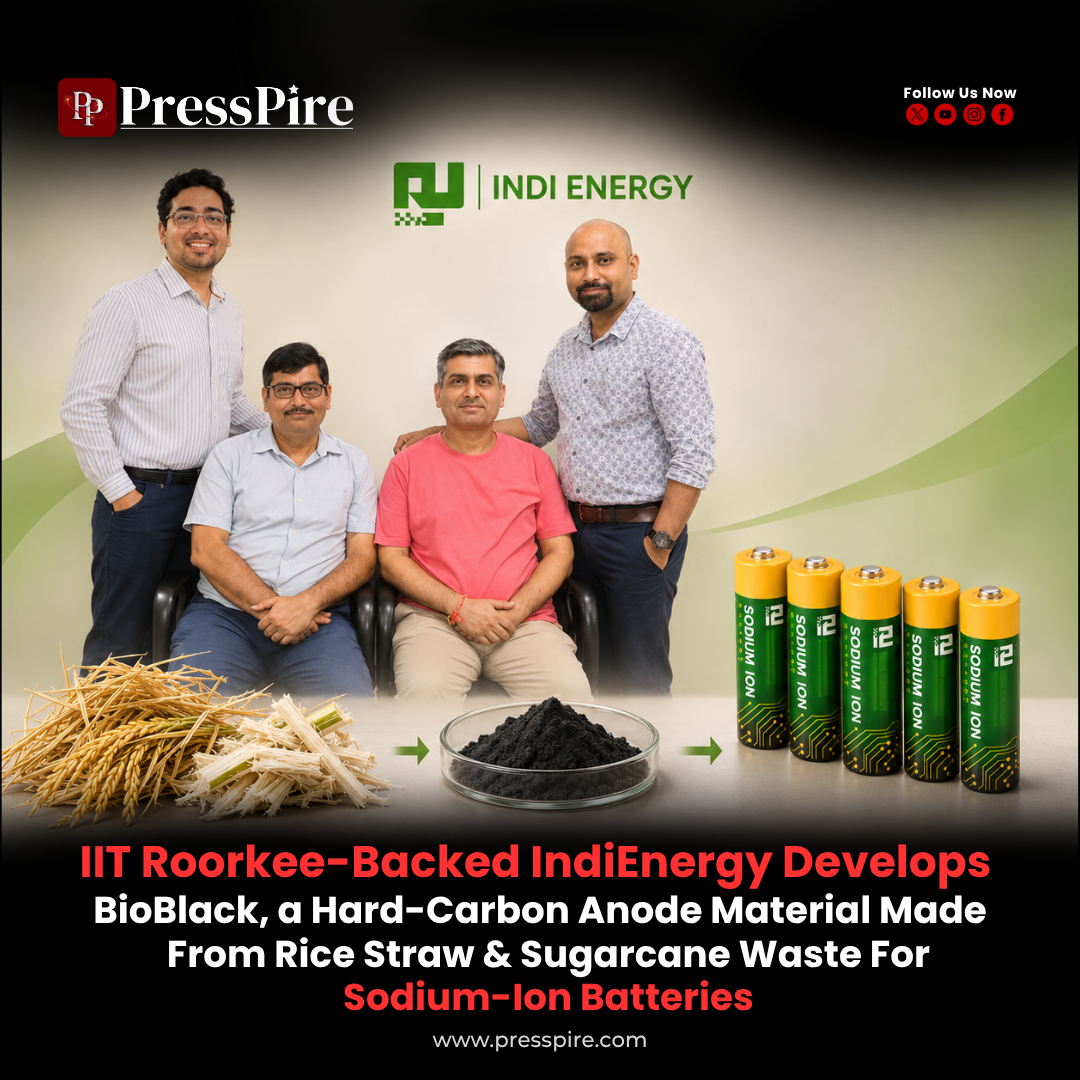
IndiEnergy BioBlack Turns Farm Waste Into Battery Material
The IIT Roorkee-incubated startup is developing sodium-ion battery materials from agricultural residues, including rice straw and sugarcane bagasse.
IndiEnergy BioBlack is a hard-carbon anode material developed by Roorkee-based startup IndiEnergy for sodium-ion batteries. The company’s work uses agricultural biomass to produce an ingredient for rechargeable energy storage.
Its raw materials include rice straw and sugarcane bagasse, the fibrous residue left after sugarcane processing. Through controlled processing, these resources can become carbon materials suitable for use inside batteries.
The development forms part of IndiEnergy’s wider effort to build sodium-ion battery technology in India, covering essential materials as well as complete cells.
The Startup Behind IndiEnergy BioBlack
IndiEnergy, formally known as Indigenous Energy Storage Technologies Private Limited, was founded in 2019. Its co-founders are Akash Soni, Professor Yogesh Kumar Sharma, Dr Asit Sahoo and Dr Nagesh Kumar.
The company emerged from IIT Roorkee’s research and incubation ecosystem. TIDES, the institute’s business incubator, lists it among its graduated startups.
Its founding team combines entrepreneurship with research in energy storage and battery materials. Soni leads the company as CEO, while the scientific team works on the materials and cell technologies needed to develop its products.
BioBlack is one part of that broader programme. IndiEnergy also describes work on sodium-ion cathodes and battery cells, giving the company an interest in several stages of battery development.
How Farm Waste Becomes Battery Material
Agricultural residues contain carbon, but converting them into a useful battery ingredient requires controlled processing.
IndiEnergy’s published patent application describes a method for producing hard carbon from rice straw. At a broad level, the process involves preparing the biomass, removing impurities and applying controlled heat treatment to obtain the desired carbon structure.
The company separately identifies sugarcane bagasse as a raw material for BioBlack.
Battery manufacturers need materials with predictable properties. The engineering task is therefore to control the structure and purity of the resulting carbon so it can perform consistently during charging and discharging.
| Part of the development | Its role |
|---|---|
| Rice straw and sugarcane bagasse | Biomass sources used in the company’s materials work |
| Hard-carbon production | Converts suitable biomass into an engineered carbon material |
| Anode | Accommodates sodium during the battery’s charging cycle |
| Complete battery cell | Combines the anode with other components to store and release electrical energy |
Why Hard Carbon Matters for Sodium-Ion Batteries
The choice of anode material influences a rechargeable battery’s performance. Hard carbon has a disordered structure that makes it useful for sodium storage and has become an important material in sodium-ion battery development.
IndiEnergy’s published BioBlack specifications list a reversible capacity of 330 ±5 milliampere-hours per gram, under the company’s stated measurement window extending to 1.0 volt.
This figure describes how much charge the material can reversibly store per gram under specified conditions. It does not establish the energy density, driving range or operating life of a finished battery.
Those outcomes depend on the complete cell, including its cathode, electrolyte, design and operating conditions. For buyers, material specifications form one part of a wider evaluation.
Government Support for Commercialisation
On 2 April 2026, the Technology Development Board, under the Department of Science and Technology, announced financial assistance to IndiEnergy for commercialising hard carbon derived from agricultural and biological waste.
The supported project focuses on expanding domestic production of anode materials for sodium-ion batteries.
The announcement confirms institutional backing for the company’s manufacturing ambitions, although it does not disclose the amount of financial assistance.
Moving from material development to dependable production is an important business milestone. Manufacturers need to deliver consistent batches, meet customer specifications and maintain reliable supplies as demand grows.
Where Sodium-Ion Batteries Could Be Used
The government’s announcement identifies several potential applications for the technology:
- Grid-scale storage: Storing electricity for use when required.
- UPS and inverter systems: Providing backup power.
- Solar street lighting: Supporting lighting outside daylight hours.
- Lower-speed electric mobility: Applications including e-rickshaws, e-scooters and e-cycles.
These uses create different requirements. A stationary storage system may prioritise cost and operating life, while a mobility application must also account for weight, size and charging needs.
IndiEnergy’s opportunity is to develop materials and cells suited to those requirements. A material that performs well in laboratory testing still needs to demonstrate its value within the battery system a customer intends to use.
Building a Domestic Battery Materials Supply Chain
BioBlack’s potential significance extends beyond the use of agricultural waste.
Producing battery materials locally could give Indian manufacturers another source of supply and closer access to the engineers developing those materials. It could also create a route for agricultural residues to enter higher-value manufacturing.
For farmers and processors, any commercial benefit would depend on how collection, transport and purchasing arrangements develop. Availability alone does not determine whether a residue can become an economical industrial input.
Similarly, the environmental outcome depends on the complete manufacturing process. Energy consumption, material yield, water use and treatment of processing waste all matter when assessing the benefits of biomass-derived carbon.
What Will Determine BioBlack’s Commercial Progress?
The next stage will be judged by production consistency, customer qualification and the performance of batteries using the material.
Important indicators include repeat orders, dependable delivery and evidence that the manufacturing process remains economical as output increases.
For battery manufacturers, the practical questions concern how reliably the material performs, how easily it fits into production and whether the supplier can maintain quality over time.
IndiEnergy BioBlack brings a clear idea to India’s battery industry: use locally available biomass to develop an essential energy-storage material. Its commercial value will depend on turning that idea into a reliable product that manufacturers can use at scale.
For more insights navigate: PressPire | Stories That Shape the Future
Read previous article here : d-propulse-indigenous-engines-testing-revenue/
Follow PressPire on Facebook | Instagram | LinkedIn | YouTube
PressPire | Stories That Shape the Future