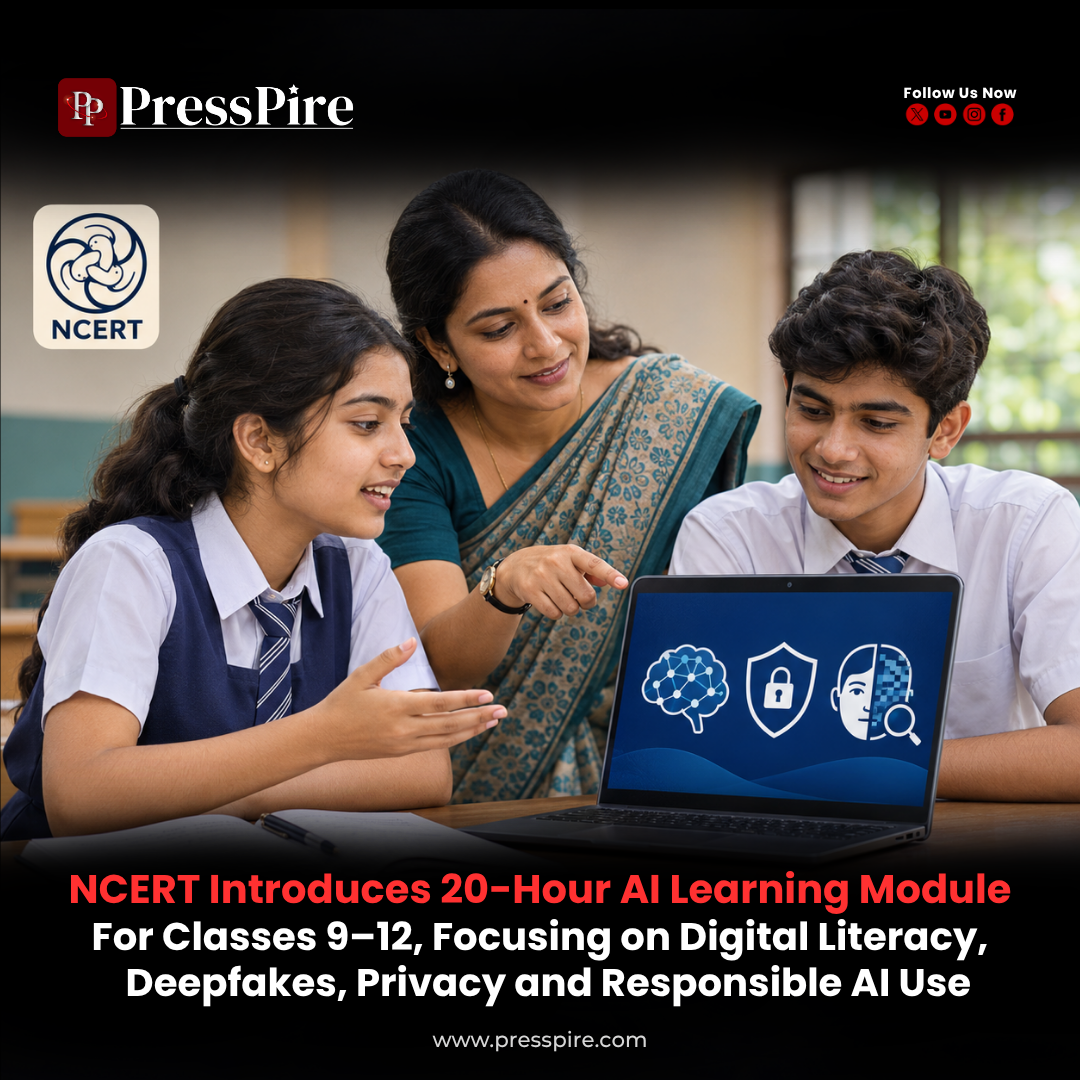
NCERT AI Module: 20-Hour Learning Guide for Classes 9–12
The introductory resource covers computational thinking, misinformation, data privacy and responsible AI use, with classroom activities that can work with or without digital devices.
Updated: 3 November 2026
The NCERT AI module gives students in Classes 9–12 a structured introduction to artificial intelligence, with a suggested teaching plan of 20 classroom hours. Its focus includes recognising AI in everyday applications, understanding its limitations, protecting personal information and checking information before sharing it.
Announced on 23 October 2026, the resource combines Computational Thinking (CT) and Artificial Intelligence (AI) through discussions, practical exercises and reflection. It was developed with contributions from experts at IIT Madras, IIT Jodhpur and NCERT.
The module is intended for beginners. Its educational aim is to help students make informed decisions about technology and remain responsible for their own work.
Publication of the resource should, however, be distinguished from its inclusion in a particular board’s curriculum. CBSE issued a subsequent update affecting Class 9 implementation.
Who Is the NCERT AI Module Designed For?
The resource provides a common foundation for students across Classes 9, 10, 11 and 12. Previous knowledge of AI is not assumed, and learners do not need programming experience to begin.
Its approach connects technological concepts with situations students can recognise. These include digital recommendations, predictive text and the information produced by AI tools.
Computational thinking introduces a structured way to approach problems: identifying relevant information, recognising patterns and considering the steps needed to reach a solution.
This foundation can help students ask more useful questions about technology. What information does a system use? What might it overlook? How should its answer be checked?
The module’s emphasis is consistent with the National Education Policy 2020’s focus on critical thinking, practical learning and problem-solving.
Five Learning Areas in the NCERT AI Module
The resource is organised into five units that move from recognising AI to evaluating and using it responsibly.
| Learning area | Main focus |
|---|---|
| AI in daily life | Identifying familiar applications and distinguishing AI from ordinary automation |
| Learning from examples | Exploring how training data influences a system’s responses |
| Errors and misinformation | Examining incorrect answers, deepfakes and verification |
| Privacy and responsibility | Understanding personal data, consent, fairness and safe sharing |
| Working with AI tools | Improving prompts, reviewing responses and retaining independent judgement |
This sequence connects practical use with evaluation. Students encounter both what a tool can do and the questions they should ask before trusting its output.
Understanding How Machines Learn
One part of the module introduces learning from examples through a simple classification activity.
Students can train a system to recognise everyday objects and then test circumstances in which it makes mistakes. The exercise draws attention to the examples used during training and whether they represent the situations the system later encounters.
The educational value lies in examining the failure. A system may perform well on familiar examples while struggling when conditions change.
For a classroom, that creates an opportunity to discuss how evidence supports a conclusion. Students can compare results, identify missing examples and explain why a prediction may be unreliable.
Deepfakes and Confident but Incorrect Answers
The module addresses misinformation, AI-generated errors and deepfakes as part of digital literacy.
Students are introduced to a five-check approach that considers the source, the type of claim, comparison with other information, a pause before acting and the confidence justified by the evidence.
The practical lesson is that a convincing presentation does not establish accuracy. A polished response still needs to be examined, particularly when it contains a claim that matters.
For example, a classroom discussion could consider an apparent announcement about a school closure. Students could identify the original publisher, check the date and compare it with the school’s own communication. This illustrates how verification can become a repeatable habit.
The aim is to develop careful evaluation, rather than suggest that every manipulated image or video can be identified by appearance alone.
Data Privacy and Responsible Sharing
Privacy is another central part of the learning resource.
Students examine the information apps collect, the permissions users provide and the questions raised by data sharing. The module also introduces India’s Digital Personal Data Protection Act, 2023, within its discussion of rights and responsibilities.
Its practical guidance cautions against entering sensitive information into AI tools, including identity numbers, passwords, one-time passwords and personal documents.
This gives teachers a concrete starting point for discussion. Before uploading information, students can consider whether it is necessary, whether it belongs to someone else and whether they have permission to share it.
Using Prompts While Keeping Ownership of Learning
The final unit focuses on working with modern AI tools. Students practise writing prompts, reviewing responses and improving their instructions.
The resource encourages students to retain responsibility for the thinking involved in a task. That includes identifying errors and deciding which suggestions are useful.
For example, a learner could request practice questions on a topic, attempt the answers independently and compare the tool’s explanations with classroom material.
Such an exercise makes the student’s reasoning visible. It also gives the teacher something more meaningful to assess than the fluency of a generated answer.
NCERT Activities With or Without Computers
The suggested teaching plan accommodates different classroom resources through three formats:
- Individual or paired use: Students work with a device independently or together.
- Teacher demonstration: A shared screen supports a whole-class activity.
- Offline activities: Paper-based exercises and discussion cover the underlying concepts.
This flexibility allows schools with limited connectivity or equipment to undertake the core learning activities.
Students are also encouraged to maintain a “Curious Notebook” containing observations, experiments, verification exercises and reflections. The portfolio can help teachers follow how a student’s understanding develops across the units.
What CBSE’s Latest Circular Means
CBSE’s April 2026 guidance had anticipated NCERT modules for Classes 9–12 to be taught for internal assessment.
A later circular, Acad-70/2026, dated 29 October 2026, states that the CT and AI modules will not form part of the Class 9 curriculum for the 2026–27 session.
The same circular separately lists Artificial Intelligence among the available skill subjects. That is a different course route from the introductory modules.
NCERT’s resource therefore remains relevant as published learning material, while schools need to follow the applicable board instructions for curriculum and assessment.
For students NCERT, its value will depend on practising the habits it introduces: checking evidence, protecting information, explaining their reasoning and making deliberate choices about when and how to use AI.
For more insights navigate: PressPire | Stories That Shape the Future
Read previous article here : temple-wearable-pre-orders-price-india/
Follow PressPire on Facebook | Instagram | LinkedIn | YouTube
PressPire | Stories That Shape the Future