
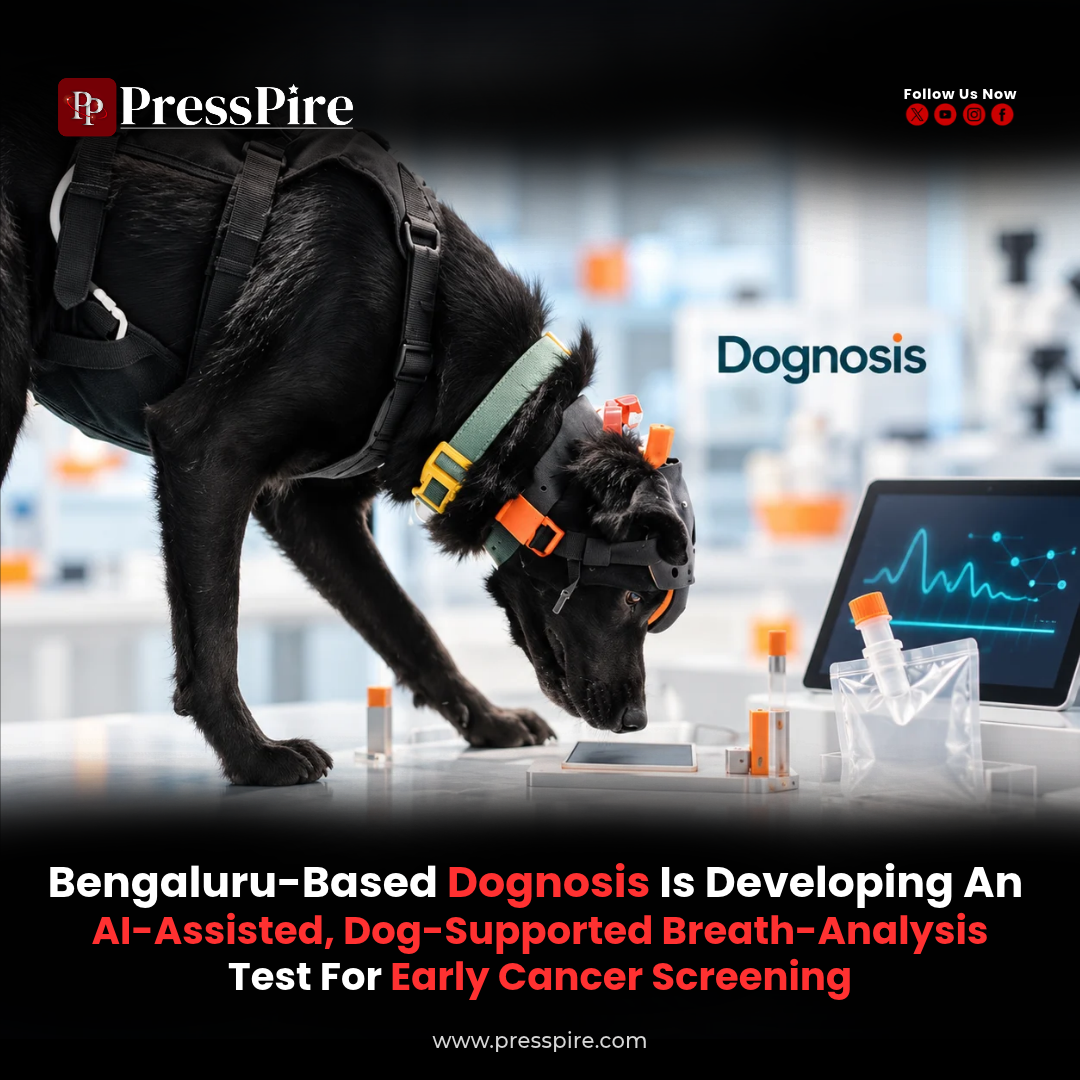
Bengaluru Startup Dognosis Uses AI and Dogs to Develop Cancer Breath Test
The startup’s Breathe Easy platform combines canine scent detection with data analysis, with a published Phase II study supporting further research into early cancer screening.
Dognosis, a Bengaluru-based startup, is developing a breath-analysis test that brings together trained dogs, sensors and artificial intelligence to look for signals associated with cancer.
Called Breathe Easy, the platform aims to make sample collection simple: a person breathes into a mask, which is then analysed at a laboratory. The company wants the resulting information to help clinicians identify people who may need further investigation.
Founded by Akash Kulgod and Itamar Bitan, Dognosis is working across canine training, neuroscience, engineering and healthcare. Its website currently describes Breathe Easy as a pilot that provides clinicians with risk scores based on breath compounds, while broader cancer-screening applications remain under validation.
How the Dognosis Cancer Test Works
The approach centres on volatile organic compounds, or VOCs: chemicals that can be present in exhaled breath.
Changes in the body’s biological processes can affect the mixture of these compounds. Researchers are investigating whether patterns associated with disease can provide useful information for detection.
Dognosis uses trained dogs to respond to these scent patterns. Sensors and software are designed to turn the animals’ responses into information that can be recorded, analysed and compared.
The technical challenge is to make those responses consistent enough to support a reliable testing process.
From a Breath Sample to a Clinician’s Report
According to Dognosis’s published product description, the proposed workflow has four main stages:
- Collect the sample: A person wears a custom mask and breathes naturally for approximately 10 minutes.
- Package the mask: The sample is sealed and sent to the laboratory using the supplied kit and handling instructions.
- Analyse the sample: Trained dogs and the company’s analysis system examine the collected breath profile.
- Share the report: A clinician receives a VOC risk report to help determine appropriate follow-up.
The dogs work with collected samples in a controlled setting. People providing samples do not need to interact with them.
The convenience lies in the collection step. Laboratory processing and clinical interpretation still take place afterwards; this is not a ten-minute cancer diagnosis.
Where Artificial Intelligence Fits In
Dognosis describes a broader technology platform with three main components:
| Component | Stated role |
|---|---|
| DogSense | A non-invasive, custom-fitted system that records canine brain activity, with additional sensors tracking breathing and movement |
| DogOS | Software that processes information from sensors and cameras and uses machine learning to interpret canine responses |
| SniffSpace | An automated workstation that presents breath samples to trained detection dogs |
The company’s aim is to capture more information than a handler could obtain by watching a single behavioural response.
A useful distinction is between this wider technology programme and the method assessed in its published clinical study. That study combined dogs’ sample indications with Bayesian statistical modelling, accounting for previous dog performance and participant-related variables.
What the Published Cancer Study Found
A Phase II study published online in the Journal of Clinical Oncology on 23 April 2026 evaluated the approach across six hospitals in Karnataka.
Researchers enrolled 3,275 participants, divided into 1,773 for training and 1,502 for testing. The test group comprised 283 people with biopsy-confirmed cancer who had not started treatment and 1,219 controls, including healthy volunteers and people with other conditions.
The study covered seven broad cancer groups: head and neck, breast, lung and thoracic, gynaecological, upper gastrointestinal, lower gastrointestinal, and genitourinary cancers.
| Performance measure | Result reported in the final publication |
|---|---|
| Sensitivity | 90.8% |
| Specificity | 91.3% |
| Sensitivity for stage I–II disease | 90.6% |
Sensitivity describes the proportion of cancer cases correctly identified. Specificity describes the proportion of people without cancer correctly classified as negative.
The authors concluded that the findings supported further prospective evaluation in actual screening populations.
Research Collaboration and the Limits of the Evidence
The UK charity Medical Detection Dogs helped conceptualise and design the study and advised on canine training. Its account describes a team of seven detection dogs and identifies Dognosis India as the study’s funder.
The published research was a case-control study: it compared samples from people with known cancer status and controls. That is a useful step in assessing a method, but routine screening brings a different mix of people, diseases and practical conditions.
The results therefore support further testing of the approach. They do not establish that a screening programme using it reduces cancer deaths.
A positive screening result would require diagnostic follow-up. A negative result would not exclude every cancer or remove the need for established screening and assessment of symptoms.
For patients, the eventual value depends on the whole care pathway: what happens after a result, how quickly further tests are available and whether clinically important disease is found earlier.
The Founders Behind Dognosis
Akash Kulgod, the company’s co-founder and chief executive, studied cognitive science at the University of California, Berkeley. Dognosis’s account of its origins connects his interest in healthcare with growing up in a family of doctors in Karnataka.
Itamar Bitan brings experience in canine handling and training, including service in Israel’s Oketz canine unit. His background complements the venture’s work on interpreting animal responses through technology.
The founders’ combined experience reflects the company’s operational demands. Building this service requires trained dogs, dependable equipment, consistent sample handling and collaboration with clinicians.
That makes Dognosis a business involving both laboratory operations and software development.
Investor Backing and Commercial Plans
Dognosis was selected for the inaugural Accel Atoms X cohort, announced by Accel and Prosus on 25 March 2026. The programme supports early-stage companies working on scientific and engineering challenges.
YourStory reported on 13 October 2026 that Dognosis had raised $6.1 million in total funding, including an earlier $1.5 million pre-seed round.
The same report said the company was targeting an early-2027 Bengaluru launch, with plans for access through partner hospitals and clinics. Its website has an open waitlist.
These are commercial plans. The company’s current product description continues to identify Breathe Easy as a pilot, with additional applications undergoing research.
What Dognosis Needs to Demonstrate Next
For Dognosis, expansion will require evidence that the process remains dependable as more samples, collection sites and canine teams are added.
From an operational perspective, the key questions include sample transport, turnaround times, quality controls, training capacity and the cost of running the service. Animal care is also part of maintaining a sustainable laboratory operation.
Clinical development must establish how the test performs among the people it is intended to screen, including those without symptoms. Follow-up studies will also need to clarify how results guide further investigation.
The startup has brought an unusual combination of biological sensing and computing into clinical research. Its next stage is to show how that combination can fit into accessible, evidence-based cancer care.
For more insights navigate: PressPire | Stories That Shape the Future
Read previous article here : nvs-03-launch-isro-navic-positioning/
Follow PressPire on Facebook | Instagram | LinkedIn | YouTube
PressPire | Stories That Shape the Future