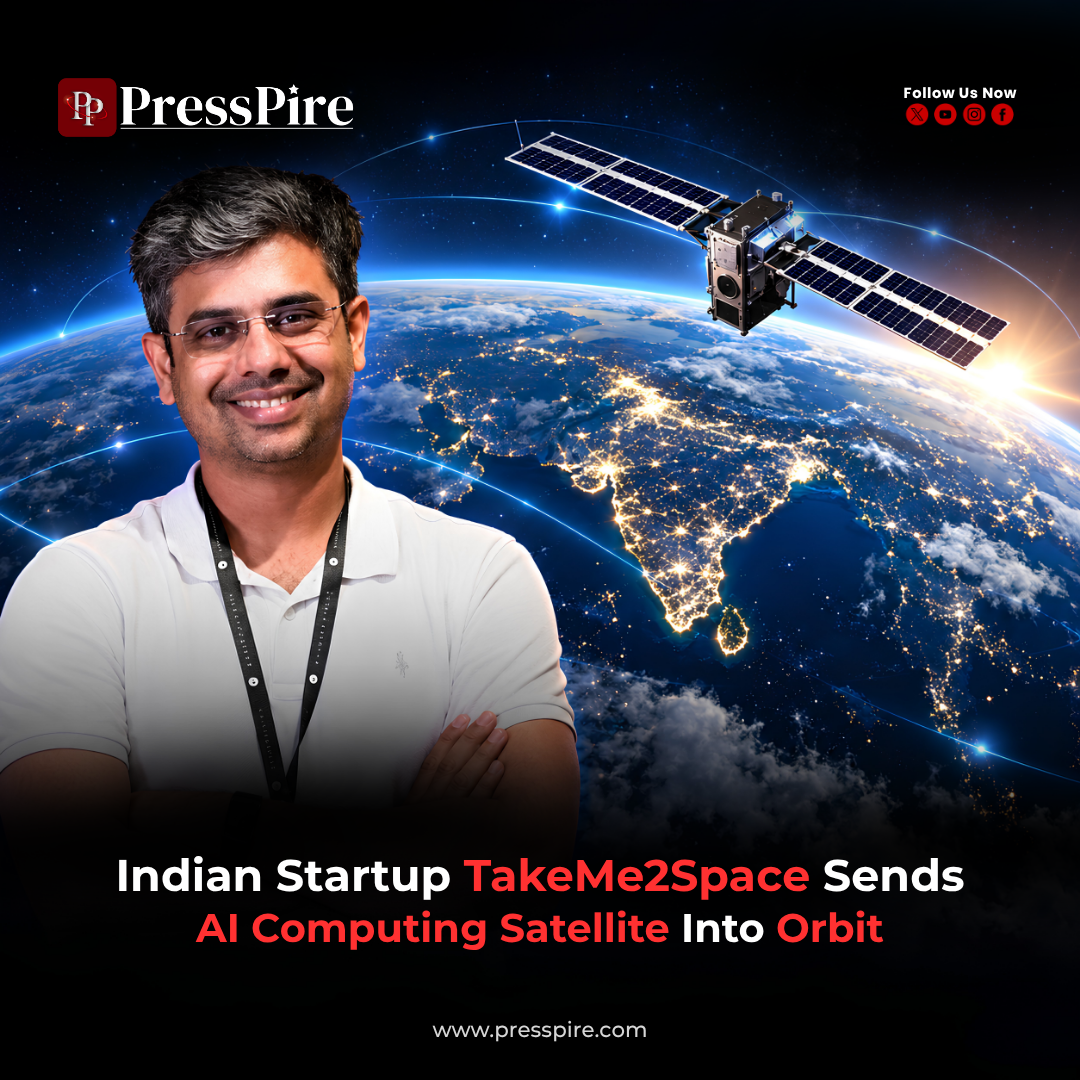
Indian Startup TakeMe2Space Sends AI Computing Satellite Into Orbit
Indian space-tech startup TakeMe2Space has sent its MOI-1A orbital computing satellite into space aboard SpaceX’s Falcon 9 as part of the Transporter-18 rideshare mission, marking a new stage in the company’s effort to process satellite data directly in orbit.
The Falcon 9 launched from Vandenberg Space Force Base in California on October 1, 2026, carrying MOI-1A along with a large group of commercial and technology payloads. TakeMe2Space describes MOI-1A as India’s first orbital computing satellite.
Unlike conventional satellite operations, where large amounts of collected data are transmitted to Earth for processing, MOI-1A is designed to perform computing onboard the spacecraft. The satellite can run AI models on Earth-observation data in orbit and send useful results to the ground rather than transmitting all of the original raw data.
The company says this approach can reduce the amount of data that needs to be transmitted from space while allowing users to receive processed information more quickly.
TakeMe2Space Sends MOI-1A Into Orbit
TakeMe2Space’s MOI-1A reached orbit aboard SpaceX’s Transporter-18 mission after the Falcon 9 launch from California.
The company later said that MOI-1A had made it to orbit onboard an orbital transfer vehicle (OTV) deployed during the mission. TakeMe2Space stated that the spacecraft is expected to be injected into its final orbit by the OTV on October 10, after which it will go through a short initial period before operations begin.
This distinction is important because the Falcon 9 launch and orbital deployment are only part of the spacecraft’s journey. The satellite still has to complete its orbital injection and commissioning process before its operational computing activities begin.
The Transporter-18 mission is part of SpaceX’s rideshare programme, which carries multiple spacecraft on a single Falcon 9 launch.
MOI-1A Is Designed as a Computer in Space
The central idea behind MOI-1A is orbital computing.
Traditional Earth-observation satellites collect imagery and other information and then transmit that data to ground stations. Large datasets can require substantial communication capacity before they can be processed on Earth.
TakeMe2Space is taking a different approach.
MOI-1A is designed to process information onboard the satellite itself. Customers can upload their AI models to the spacecraft, allowing the system to analyse relevant Earth-observation information while it is still in orbit. The resulting insights can then be transmitted to Earth.
TakeMe2Space says its platform is designed to transmit intelligence rather than raw data, addressing what the company describes as a downlink bottleneck.
MOI-1A Uses 117 TOPS of AI Computing
MOI-1A is a compact satellite, but it carries dedicated computing hardware for AI workloads.
According to TakeMe2Space, the spacecraft has:
- 117 TOPS of onboard computing
- 16GB LPDDR5 memory
- 2TB onboard storage, configurable to 4TB
- 9-band multispectral imaging
- 14kg mass
- A 6U CubeSat form factor
The onboard computing system uses an NVIDIA Jetson Orin NX processor. TakeMe2Space says the processor is protected using its proprietary RadShield coating, developed to protect terrestrial-grade electronics from radiation in low Earth orbit.
The company’s technology page describes MOI-1A as an orbital AI laboratory capable of processing Earth-observation information in space.
AI Models Can Run Directly on the Satellite
One of the important features of MOI-1A is that customers are not restricted to receiving raw satellite imagery and processing everything after downloading it.
Instead, customers can upload containerised AI models that can run on the satellite.
When MOI-1A passes over a specified region, the system can process relevant information and send the resulting analysis back to Earth.
For example, an organisation interested in monitoring a particular geographic area could use an AI model to identify specific features in satellite imagery. Instead of downloading the complete dataset and processing it on the ground, the satellite can perform the initial computation in orbit.
TakeMe2Space told Reuters that the model is aimed at customers who currently spend significant resources downloading raw satellite data before carrying out their own computing.
TakeMe2Space Targets Agriculture, Mining and Insurance
The company had signed 23 customers for the mission before launch, according to information shared ahead of the flight.
The customers include organisations working across sectors such as:
Agriculture
Satellite imagery can be used to monitor large areas of land and identify changes that require further analysis.
Mining
Earth-observation information can support monitoring and analysis of mining areas.
Supply Chain
Satellite data can be used for location-based intelligence and monitoring.
Insurance
Earth-observation information can provide additional data for certain insurance-related applications.
The customer base also includes geographic information system companies and educational institutions. US-based space-data analytics company Little Place Labs is among the customers identified for the mission.
TakeMe2Space Builds on Earlier Orbital AI Demonstration
MOI-1A is not the company’s first attempt to demonstrate AI processing in space.
TakeMe2Space previously conducted an orbital technology demonstration in 2024. The company says the demonstration successfully validated onboard computing and its RadShield technology during a 14-day orbital mission completed in January 2025.
The earlier demonstration showed that applications could be uploaded from Earth, executed in orbit and have their results downloaded.
According to Reuters, that mission demonstrated the company’s ability to upload applications, perform AI inference in orbit and download the resulting information.
The experience became an important technical foundation for the company’s next spacecraft.
MOI-1 Was Lost During an Earlier Launch Attempt
The path to MOI-1A also included a setback.
TakeMe2Space’s MOI-1 spacecraft was lost during the PSLV-C62 mission in January 2026 after a launch-vehicle third-stage failure. The loss occurred before the company could move that spacecraft into its planned operational phase.
MOI-1A represents the company’s next mission in its orbital computing programme.
Rather than waiting for another domestic launch opportunity, the company secured a rideshare opportunity aboard SpaceX’s Falcon 9 Transporter-18 mission.
TakeMe2Space Wants to Build a Larger Orbital Computing Network
MOI-1A is intended to be a starting point for a larger orbital computing system.
TakeMe2Space’s longer-term plan is to build multiple satellites equipped with onboard computing capabilities.
The company says its planned constellation will eventually include six satellites, with the network designed to provide broader coverage and greater computing capacity. Its website currently states that the six-satellite constellation is targeted to provide daily global coverage by Q4 2027.
The company is also planning larger satellites for future missions.
According to information published by IN-SPACe, TakeMe2Space’s future roadmap includes additional satellites with more powerful NVIDIA computing hardware and improved imaging capabilities.
TakeMe2Space Plans Orbital Data Centres
The startup’s long-term ambition goes beyond placing individual AI-processing satellites in orbit.
TakeMe2Space describes its broader vision as building data centres in space.
The company’s planned architecture involves multiple satellites with onboard computing and storage capabilities. The idea is to create an orbital infrastructure layer where Earth-observation data can be processed closer to where it is collected.
The company is also developing OrbitLab, its software platform for accessing orbital computing infrastructure.
Through OrbitLab, users can upload AI models, run experiments and process Earth-observation data using computing resources available in orbit.
From Raw Satellite Data to Processed Intelligence
The main technical argument behind orbital computing is the amount of information produced by modern satellites.
High-resolution imaging systems can generate large datasets. Sending all of that information to Earth requires communication capacity and time.
TakeMe2Space’s approach is to process the information before it reaches the ground.
The company’s orbital-processing pipeline is designed around five stages:
- Capture — collect multispectral imagery.
- Process — run AI models on the satellite.
- Filter — identify actionable information.
- Downlink — transmit selected insights.
- Deliver — provide processed intelligence to the user.
TakeMe2Space says this approach can reduce transmission requirements compared with traditional workflows.
MOI-1A Also Carries EON Space Labs’ MIRA
MOI-1A is also carrying the MIRA imaging system developed by EON Space Labs.
MIRA is a compact optical telescope designed for space imaging. The payload is part of EON Space Labs’ work on small-satellite imaging technology.
This makes the mission relevant not only to orbital AI computing but also to Earth-observation imaging.
The combination allows MOI-1A to demonstrate the relationship between collecting information from space and processing that information directly onboard the spacecraft.
India’s Private Space Sector Moves Into Orbital Computing
The MOI-1A mission comes as India’s private space industry expands beyond conventional satellite manufacturing and launch services.
Several Indian space startups participated in the Transporter-18 mission, including TakeMe2Space, Dhruva Space, SatLeo Labs and EON Space Labs. Their technologies cover areas such as satellite platforms, thermal imaging, Earth observation and AI-based data processing.
For TakeMe2Space, the mission is focused specifically on demonstrating that computing can happen directly in orbit.
The company is now moving from an earlier technology demonstration toward a satellite intended to support customer workloads.
What Comes Next for MOI-1A
The immediate next stage for MOI-1A is orbital injection and commissioning.
TakeMe2Space has stated that the spacecraft is expected to be injected into its orbit by the orbital transfer vehicle on October 10. After the stated initial period, the company expects to begin operations.
The satellite will then provide the platform for testing and running customer AI workloads in orbit.
The company’s broader roadmap involves adding more satellites, increasing computing capacity and developing a network capable of processing Earth-observation information across a wider geographic area.
MOI-1A therefore represents both a satellite mission and a practical test of TakeMe2Space’s larger orbital-computing business model.
For more insights navigate: PressPire | Stories That Shape the Future
Read previous article here: whatsapp-business-platform-pricing-india/
Follow PressPire on Facebook | Instagram | LinkedIn | YouTube
PressPire | Stories That Shape the Future