
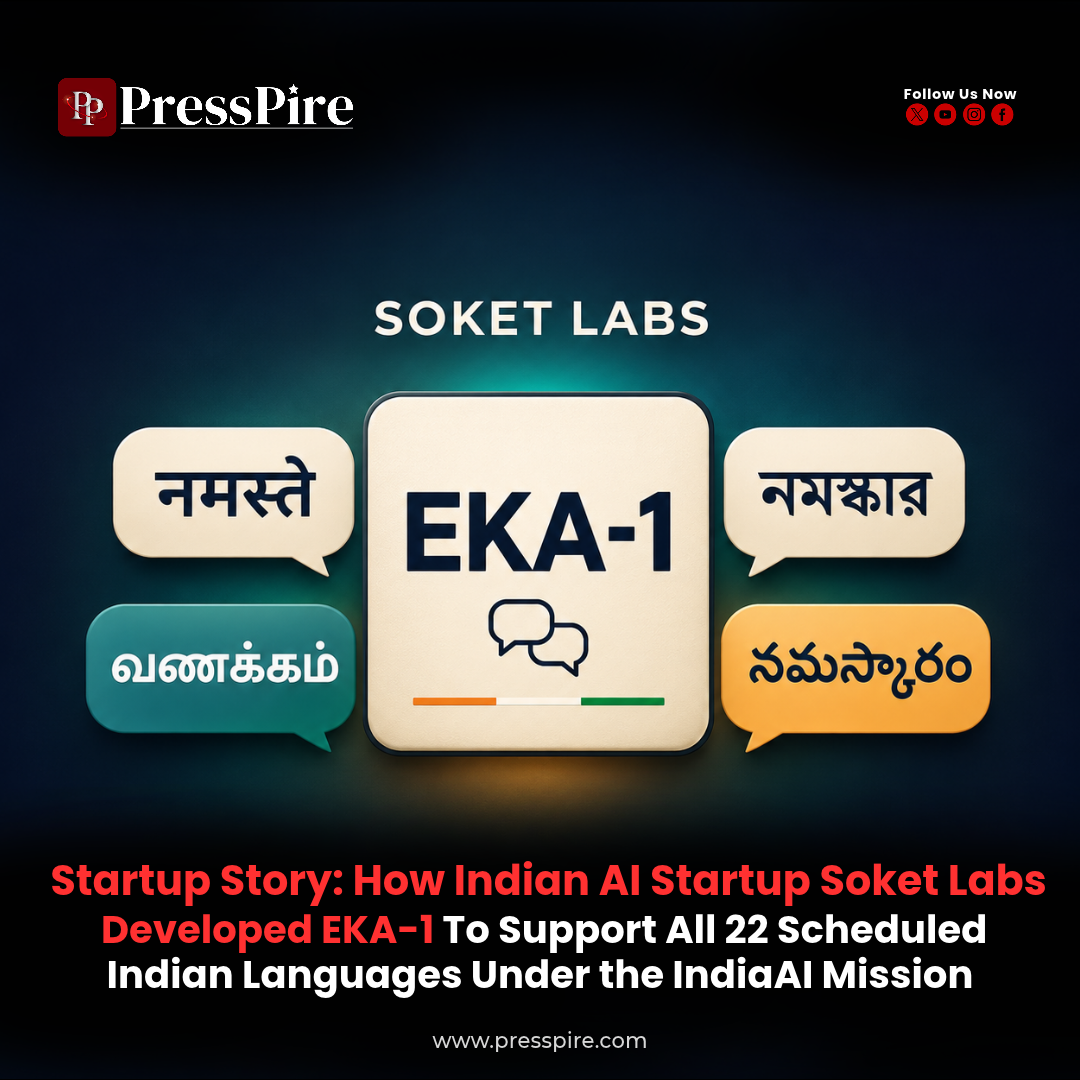
Soket Labs EKA-1: How One Startup Built AI for All 22 Scheduled Indian Languages
From multilingual datasets and Pragna-1B to the IndiaAI-supported EKA-1, Soket Labs has steadily expanded its work on AI for Indian languages.
For Soket Labs, building artificial intelligence for Indian languages began with the material needed to train it. Before developing EKA-1, the startup worked on multilingual datasets, language processing and a smaller model designed around Indian-language requirements.
The Soket Labs EKA-1 launch marked a new stage in that journey. Unveiled on November 3, 2026, under the IndiaAI Mission, the foundation model supports all 22 scheduled Indian languages alongside English, according to the government’s announcement.
Led by founder and CEO Abhishek Upperwal, the startup has moved from early experiments with language data to a model intended for mathematics, coding, reasoning and applications in sectors such as banking and cybersecurity.
The Founder and the Early Search for a Direction
Soket was founded in 2019. Upperwal’s background includes studying at the Indian Institute of Science and working with data projects connected to India’s Smart Cities Mission.
In a 2025 interview, he described a formative challenge for the business: developing useful AI required access to substantial datasets and computing resources.
The company’s early years involved exploring opportunities and collecting data before concentrating more closely on Indian-language models.
That focus gave Soket a specific research problem to work on. Its team needed to assemble relevant training material and develop methods suited to different languages and scripts.
Bhasha: Building Resources for Indian-Language AI
A visible step came on April 17, 2024, when Soket introduced its Bhasha dataset series.
The initial releases included Bhasha-wiki and Bhasha-wiki-indic. Bhasha-wiki brought together English Wikipedia material and translations into six Indian languages: Hindi, Gujarati, Urdu, Tamil, Kannada and Bengali.
Bhasha-wiki-indic focused more closely on content relevant to India.
The two datasets addressed related needs. One expanded the availability of multilingual text, while the other concentrated on Indian context.
Soket made these resources available for wider research and development. They also documented an early priority that continues in its work: treating language data and cultural context as central parts of model development.
Pragna-1B Provided an Early Model-Building Milestone
On April 30, 2024, Soket introduced Pragna-1B, a model with approximately 1.25 billion parameters, supporting Hindi, Gujarati, Bengali and English.
Its development involved work on datasets, training methods and tokenisation—the process of dividing text into units that a language model can process.
Soket’s technical account described efforts to represent Indian-language text more efficiently. It also acknowledged that computing constraints influenced the languages prioritised during training.
Pragna-1B therefore provides an instructive early chapter in the startup’s story. The team was working through practical questions about language representation and the resources available to train a model.
Its documentation shows the research that preceded EKA-1, without establishing that the later model simply reused Pragna’s underlying design.
How the IndiaAI Mission Supported Development
Soket was selected under the IndiaAI Innovation Centre’s foundation-model programme, part of the IndiaAI Mission administered by the Ministry of Electronics and Information Technology.
According to the government, access to subsidised national AI computing infrastructure, together with support for related research expenses, enabled the development of the released models.
For Soket, this support addressed a constraint that had featured in its earlier work: access to sufficient computing resources.
The company’s broader Project EKA programme brings together research on multilingual data, model architecture, tokenisation, training and efficient deployment.
Soket describes EKA-1 as the first release from that programme and says it trained the model from scratch.
Soket Labs EKA-1: What Was Announced?
The government presented EKA-1 as an open, sparse hybrid language model with capabilities spanning technical reasoning and multilingual use.
| Feature | Announced details |
|---|---|
| Developer | Soket Labs Technology and Research Private Limited |
| Public unveiling | November 3, 2026 |
| Model size | 26.3 billion parameters |
| Training scale | Approximately 7.5 trillion tokens |
| Language coverage | All 22 scheduled Indian languages and English |
| Intended tasks | Mathematics, coding, reasoning and agentic applications |
| Government programme | IndiaAI Innovation Centre under the IndiaAI Mission |
Parameters are learned numerical values within a model, while tokens are the text units processed during training.
Soket also says EKA-1 uses 128 expert components that activate selectively. The company presents this approach as a way to manage computing requirements.
These are specifications and capabilities reported by the developer and government. Their usefulness for a particular organisation will depend on performance in its own tasks and languages.
Why Support for 22 Scheduled Languages Matters
The language coverage represents a substantial expansion from the four-language scope of Pragna-1B.
Supporting more Indian languages creates opportunities for developers to build services around the languages people use in education, work and everyday transactions.
Potential applications include multilingual document assistance, customer communication and access to institutional information. These are possible uses of the technology, rather than a claim that EKA-1 already operates all such services.
The practical challenge is maintaining quality across different scripts, vocabulary and subject areas. Announced language coverage provides a starting point; dependable applications require evaluation in the language and setting where they will be used.
Banking, Financial Services and Cybersecurity Are Priorities
At the launch, Upperwal said EKA-1 had been developed with attention to India’s banking, financial services and cybersecurity requirements.
That positioning connects the model’s language capabilities with Soket’s work on mathematics, code and reasoning.
The company’s broader product strategy also includes tools for running models and AI agents within an organisation’s own infrastructure.
For the startup, this creates a path from research releases to enterprise applications. The commercial opportunity lies in turning model capabilities into systems that customers can deploy, evaluate and use consistently.
The Next Stage for Soket Labs
Project EKA remains a broader research programme, with further model development described on Soket’s website. Its larger development targets are separate from EKA-1’s announced 26.3-billion-parameter specification.
The company’s Project EKA page also invites early-access requests. The government’s description of the model as open should therefore be read alongside the access arrangements available to developers.
Soket’s progress is visible through concrete milestones: the Bhasha datasets, Pragna-1B, selection under IndiaAI and the EKA-1 unveiling.
The next stage will be establishing how reliably that research translates into useful applications across Indian languages and the sectors the company is targeting.
For more insights navigate: PressPire | Stories That Shape the Future
Read previous article here : odisha-pumped-storage-project-4708-crore/
Follow PressPire on Facebook | Instagram | LinkedIn | YouTube
PressPire | Stories That Shape the Future