
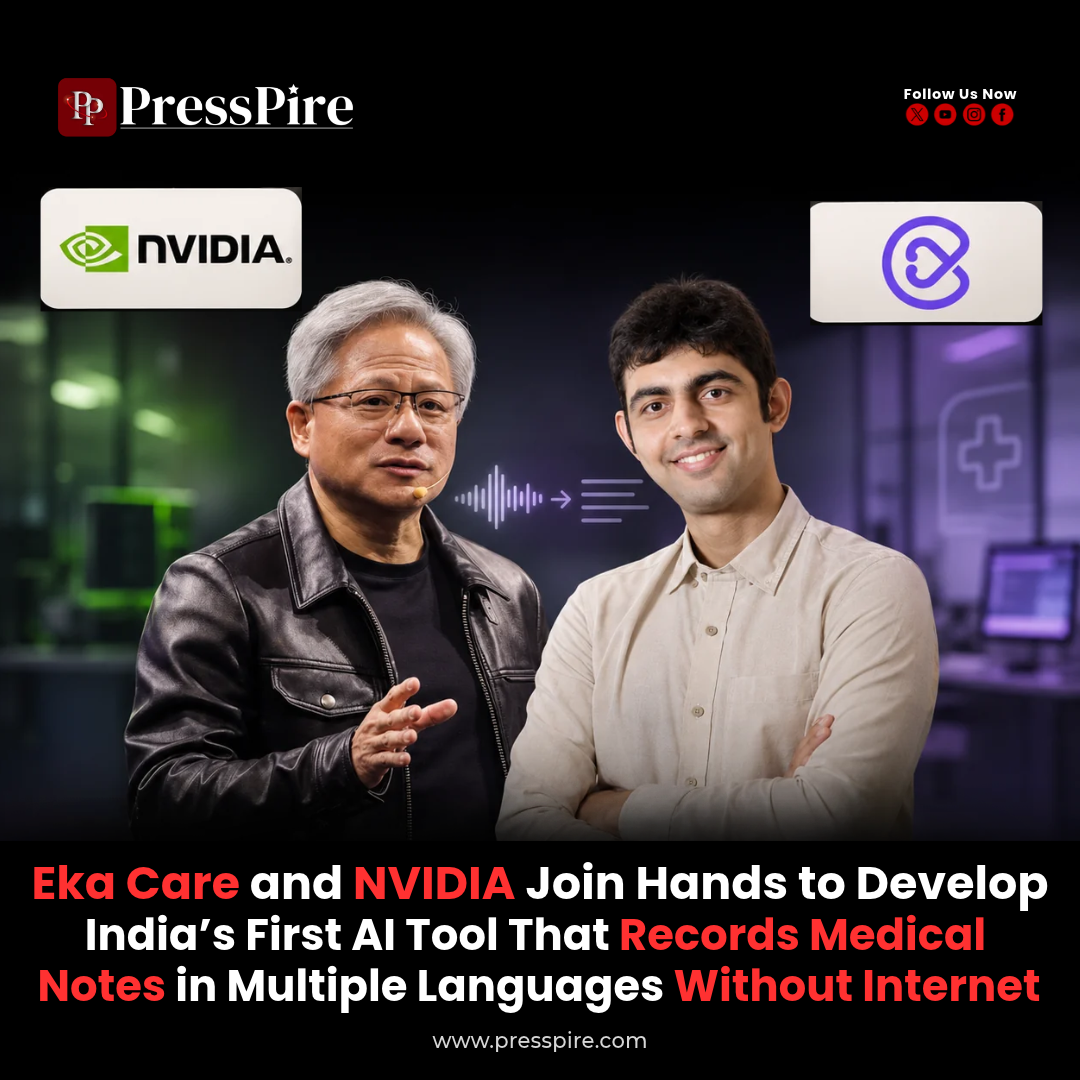
Eka Care and NVIDIA to create offline AI medical scribe for multilingual clinics
The collaboration aims to help doctors turn multilingual consultations into structured notes, with an offline variant designed for settings where internet access is unreliable.
Eka Care has announced a collaboration with NVIDIA to develop a multilingual AI medical scribe, including a variant intended to operate entirely offline. Reported in February 2026, the initiative brings together Eka Care’s clinical expertise and NVIDIA’s AI infrastructure to address documentation challenges in Indian healthcare.
The proposed system targets a familiar problem: doctors need to listen to patients while also recording symptoms, history and treatment decisions. Automating part of that paperwork could give clinicians more time for the consultation itself.
The offline component is a development objective. It should not be confused with confirmation that a fully offline mobile product is already broadly available.
How the AI medical scribe would support consultations
Eka Care’s existing EkaScribe product provides a useful starting point for understanding the workflow. Its product materials describe recording or uploading consultation audio, processing medical terminology and generating structured documentation, including clinical summaries and SOAP notes.
SOAP stands for subjective, objective, assessment and plan. This format organises information about the patient’s account, observations, clinical assessment and next steps.
A usable note needs more than a word-for-word transcript. It must preserve relevant details and place them in the correct sections. A draft that is easy to review and edit can be more useful than a long, unstructured record of everything said.
The planned collaboration seeks to make this kind of documentation more accessible across different languages and connectivity conditions.
Offline operation could widen access
An offline AI medical scribe could help clinics continue documenting consultations when internet service is weak or unavailable. The proposed variant would process consultations locally, reducing dependence on a continuous connection to remote servers.
That possibility is relevant to outreach settings and clinics with intermittent connectivity. A doctor could potentially complete the documentation step during a visit instead of waiting for a connection to return.
Local processing can also reduce the need to transmit consultation audio for cloud processing. However, practical privacy protections would still depend on how recordings are stored, who can access the device and how records are later shared or synchronised.
The eventual product’s device requirements and offline feature coverage will determine how widely this approach can be used.
Multilingual support must reflect real conversations
For an AI medical scribe to be useful in India, it needs to handle the way patients and doctors actually speak. Eka Care has highlighted code-mixing, regional accents and independence from cloud connectivity as central challenges behind the collaboration.
Code-mixing means switching between languages within the same conversation. A patient might describe a concern in Hindi while the doctor uses English medical terminology.
The design challenge is to retain meaning through those changes. A system must also distinguish the patient’s account from the clinician’s assessment and preserve important qualifications.
For example, a consultation note should distinguish a symptom that a patient reports from one the patient explicitly denies. Capturing words without their context would undermine the usefulness of the finished record.
NVIDIA’s role in model development
The AI medical scribe initiative sits within Eka Care’s broader use of NVIDIA’s development tools. In an April 2026 technical update, the company described using NVIDIA NeMo Curator, Nemotron pre-training data and NVIDIA GPUs in its healthcare AI work.
The original collaboration announcement also described evaluating NVIDIA Nemotron Speech models, including Parakeet automatic speech recognition. The stated goal was to combine speech recognition and large language model capabilities into a more efficient architecture.
These components address different parts of the task: preparing training data, recognising spoken language and turning consultation content into structured information.
Efficiency matters for the offline ambition. A system intended for local deployment must deliver useful performance within the computing resources available on the target device. The announcement’s architectural goals do not, by themselves, establish its eventual speed or clinical accuracy.
Doctors remain responsible for the final record
An AI medical scribe is most useful when it produces a draft that clinicians can inspect, correct and approve. The relevant measure is the quality of the reviewed record and the work required to produce it.
A practical evaluation would examine missed information, incorrect attribution and the time doctors spend making corrections. It would also test performance across languages, accents, consultation types and background noise.
This emphasis on review is reflected in Eka Care’s later work with the National Health Authority. The company describes a workflow in which a verified doctor reviews, edits where necessary and approves a note before it is saved and linked to the patient’s health account.
That review step keeps the clinician involved in the information that becomes part of the medical record.
Integration will influence everyday adoption
An AI medical scribe must fit into the systems a clinic already uses. If staff have to move notes manually between disconnected applications, some of the intended convenience can be lost.
Eka Care’s platform includes electronic medical records for clinics and hospitals, personal health records and developer capabilities for connecting services. Its April update places the scribe within this broader product portfolio.
That context gives the collaboration a potential route into existing clinical workflows. Its practical value will depend on how smoothly consultation capture, note review and record storage work together.
For a clinic, adoption will be shaped by this complete experience, alongside cost, device compatibility and support.
November developments provide additional context
Eka Care’s wider AI medical scribe work progressed through a separate public-health initiative in November 2026. A company announcement dated 13 November said the National Health Authority had selected it as a technology partner for an ambient voice documentation solution under the Ayushman Bharat Digital Mission.
According to that announcement, the solution supports more than 15 Indian languages and is intended to run on NHA infrastructure powered by Amazon Web Services. Those details describe that specific programme and should not be treated as the specifications of the proposed offline mobile variant.
Separately, Eka Care announced the open-sourcing of Lipi on 11 November. The tool turns conversations into structured notes and can run on an organisation’s own infrastructure. Self-hosting and fully offline operation on a doctor’s phone are distinct deployment models.
The next milestone is a proven offline product
The collaboration’s significance lies in its focus on language diversity, clinical documentation and limited connectivity. Bringing these requirements together could make digital records easier to create in a wider range of care settings.
The next meaningful evidence will be a clearly defined offline release, supported-device information and performance results from realistic consultations. These would help clinics assess the product’s capabilities against their own needs.
If the planned AI medical scribe can generate useful drafts locally and handle multilingual conversations reliably, doctors could spend less effort reconstructing notes after appointments and more time completing records while the consultation is still fresh.
For more insights navigate: PressPire | Stories That Shape the Future
Read previous article here : deepak-rajawat-air-india-express-ceo/
Follow PressPire on Facebook | Instagram | LinkedIn | YouTube
PressPire | Stories That Shape the Future