
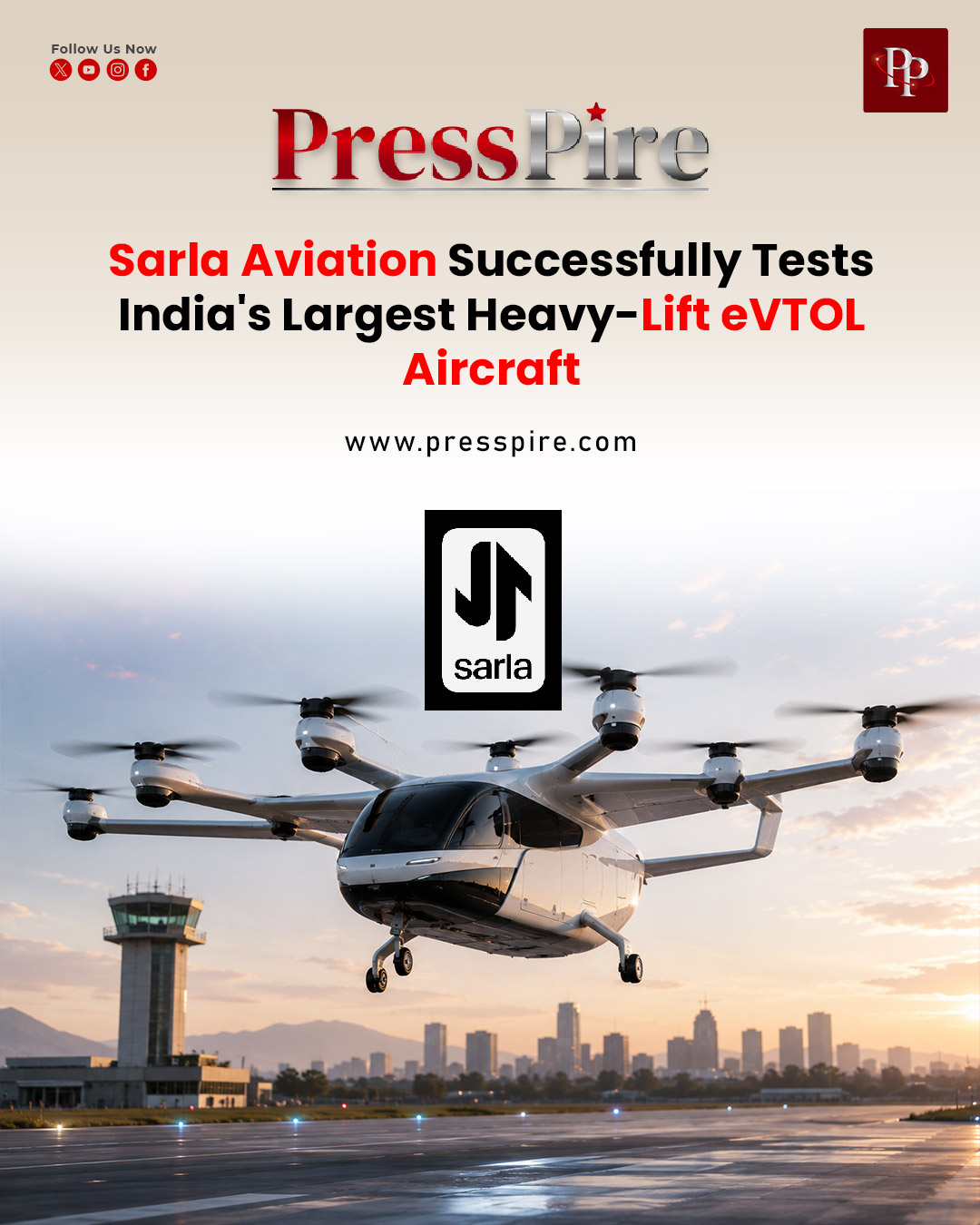
Sarla Aviation Successfully Tests India’s Largest Heavy-Lift eVTOL Aircraft
Sarla Aviation successfully tests India’s largest heavy-lift eVTOL aircraft, strengthening India’s urban air mobility ambitions and the future of electric aviation.
India’s aviation technology ecosystem has achieved another significant milestone as Sarla Aviation successfully completed the test flight of India’s largest heavy-lift eVTOL aircraft, reinforcing the country’s ambition to become a global hub for advanced air mobility solutions. The successful demonstration represents far more than an engineering accomplishment—it signals India’s growing confidence in building next-generation electric aircraft capable of transforming passenger transport, cargo logistics, emergency services, and urban connectivity. While global aviation companies have dominated conversations around electric vertical take-off and landing (eVTOL) technology, Indian startups are increasingly proving that they possess the engineering expertise, innovation capabilities, and manufacturing potential required to compete on the international stage. Sarla Aviation’s achievement comes at a time when governments worldwide are investing heavily in sustainable transportation, zero-emission aviation, and smart city infrastructure. As congestion continues to rise across India’s metropolitan regions and demand for faster transportation intensifies, heavy-lift eVTOL aircraft could eventually emerge as an efficient alternative to conventional road transport. The successful test therefore marks not only an important moment for Sarla Aviation but also a defining chapter for India’s rapidly evolving aerospace innovation ecosystem.
Sarla Aviation Heavy-Lift eVTOL Aircraft Achieves Historic Test
The successful test of the Sarla Aviation Heavy-Lift eVTOL Aircraft demonstrates the remarkable progress Indian aerospace startups have made within a relatively short period. Unlike conventional aircraft that require lengthy runways for take-off and landing, eVTOL aircraft use multiple electric-powered rotors to lift vertically before transitioning into forward flight, making them particularly suitable for crowded urban environments. Sarla Aviation’s heavy-lift platform has been designed with higher payload capabilities than many existing prototypes, opening opportunities across commercial logistics, emergency medical transportation, industrial cargo movement, disaster relief operations, and eventually passenger mobility. The engineering achievement required the integration of advanced battery technology, electric propulsion systems, lightweight composite materials, intelligent flight control software, and extensive safety redundancies to ensure stable flight performance. Industry observers view this successful demonstration as evidence that Indian deep-tech startups are progressing beyond concept development into practical engineering execution. As investors increasingly seek opportunities within climate technology and advanced mobility, Sarla Aviation’s milestone also strengthens confidence in India’s ability to commercialize cutting-edge aviation technologies while supporting the country’s broader objective of building indigenous high-value manufacturing capabilities under initiatives promoting innovation and technological self-reliance.
Sarla Aviation Heavy-Lift eVTOL Aircraft Strengthens India’s Aviation Vision
The successful demonstration of the Sarla Aviation Heavy-Lift eVTOL Aircraft aligns closely with India’s long-term vision of becoming a global leader in advanced aviation technologies. Over the past decade, India has steadily expanded its aerospace ecosystem through policy reforms, startup incentives, manufacturing initiatives, drone regulations, and investments in research and development. The emergence of companies such as Sarla Aviation illustrates how entrepreneurial innovation is complementing government efforts to develop future-ready transportation infrastructure. Heavy-lift eVTOL technology is particularly relevant for India because of the country’s rapidly expanding urban population, growing logistics requirements, and increasing emphasis on sustainable mobility solutions. Electric aircraft have the potential to significantly reduce carbon emissions compared to conventional helicopters while lowering operational costs through simplified electric propulsion systems. Additionally, India’s expertise in software engineering, electronics, artificial intelligence, and battery innovation provides a competitive advantage for developing autonomous flight systems and intelligent fleet management platforms. By investing in indigenous aviation technologies today, India positions itself not merely as a consumer of imported aircraft but as a creator of globally competitive aerospace products capable of serving both domestic and international markets over the coming decades.
Sarla Aviation Heavy-Lift eVTOL Aircraft Could Transform Urban Mobility
One of the most promising aspects of the Sarla Aviation Heavy-Lift eVTOL Aircraft lies in its potential to reshape urban transportation across India’s major cities. Metropolitan regions including Bengaluru, Mumbai, Delhi, Hyderabad, Chennai, and Pune face increasing traffic congestion, longer commute times, and infrastructure constraints that conventional road expansion alone cannot solve. Electric vertical mobility offers an entirely new transportation layer above existing roads, enabling rapid point-to-point connectivity while reducing dependence on ground infrastructure. Heavy-lift eVTOL aircraft could transport medical supplies, emergency equipment, high-value cargo, and eventually passengers between designated vertiports within minutes rather than hours. Such capabilities become particularly valuable during natural disasters, medical emergencies, and situations where road networks become inaccessible. Beyond passenger transportation, industries such as e-commerce, healthcare, defence support, mining, infrastructure maintenance, and disaster management could all benefit from electric heavy-lift aircraft capable of carrying substantial payloads efficiently. As battery technologies continue improving and charging infrastructure expands, operating costs are expected to decline, making commercial deployment increasingly viable. The long-term success of urban air mobility will depend upon careful planning, regulatory coordination, public acceptance, and continuous technological advancement, but Sarla Aviation’s successful test represents an important first step toward that future.
Sarla Aviation Heavy-Lift eVTOL Aircraft Creates New Opportunities for India
The commercial implications of the Sarla Aviation Heavy-Lift eVTOL Aircraft extend well beyond transportation alone. Every successful aviation platform creates demand across an extensive value chain that includes battery manufacturers, electric motor suppliers, avionics developers, software companies, composite material producers, maintenance providers, certification agencies, infrastructure developers, pilot training institutions, and digital fleet management services. This ecosystem has the potential to generate thousands of highly skilled jobs while encouraging further investment into India’s aerospace sector. International investors are already closely monitoring advanced air mobility startups because analysts forecast substantial long-term growth in electric aviation worldwide. For India, nurturing indigenous companies like Sarla Aviation could reduce technological dependence while strengthening exports of high-value engineering products. Universities, engineering institutions, and research laboratories may also benefit through greater collaboration on propulsion technologies, battery chemistry, autonomous systems, lightweight structures, and aviation safety research. Such developments contribute not only to economic growth but also to India’s broader ambition of becoming a knowledge-driven innovation economy capable of competing in emerging global industries where intellectual property, engineering excellence, and advanced manufacturing determine long-term competitiveness.
Sarla Aviation Heavy-Lift eVTOL Aircraft Faces Regulatory and Infrastructure Challenges
Despite the optimism surrounding the Sarla Aviation Heavy-Lift eVTOL Aircraft, several important challenges must be addressed before widespread commercial deployment becomes a reality. Aviation remains one of the world’s most highly regulated industries, requiring rigorous certification processes to ensure passenger safety and operational reliability. Regulatory authorities will need to establish comprehensive frameworks covering electric propulsion systems, battery safety standards, autonomous flight operations, pilot licensing, maintenance procedures, air traffic integration, and urban flight corridors. Infrastructure development represents another major requirement, as cities will need strategically located vertiports equipped with high-capacity charging systems, maintenance facilities, passenger handling services, and digital traffic management capabilities. Battery technology must continue evolving to improve range, payload capacity, charging speed, and lifecycle performance while maintaining strict safety standards. Public acceptance also remains an important factor, requiring operators to demonstrate reliability, affordability, low noise levels, and environmental benefits. Insurance frameworks, cybersecurity protections, weather resilience, and integration with existing aviation networks will all play essential roles in determining how rapidly electric air mobility becomes commercially sustainable. Successfully overcoming these challenges will require close collaboration between startups, regulators, policymakers, infrastructure providers, investors, and research institutions.
Future Outlook for Sarla Aviation Heavy-Lift eVTOL Aircraft
Looking ahead, the successful testing of the Sarla Aviation Heavy-Lift eVTOL Aircraft positions the company among India’s most promising deep-tech innovators operating within the rapidly expanding advanced air mobility sector. As global demand for sustainable aviation continues rising, companies capable of delivering safe, efficient, and commercially viable electric aircraft are expected to attract significant investor interest and strategic partnerships. Sarla Aviation’s achievement may encourage additional startups to enter electric aviation while motivating larger industrial players to invest in research, manufacturing, and supporting infrastructure. Future development will likely focus on increasing payload capacity, extending flight range, enhancing autonomous navigation capabilities, reducing charging times, and achieving full regulatory certification for commercial operations. India’s expanding digital ecosystem, engineering talent, and supportive startup environment provide favourable conditions for continued innovation in this field. If supported by progressive policy frameworks and sustained investment, electric heavy-lift aircraft could become an integral part of India’s future transportation landscape, serving logistics companies, healthcare providers, emergency responders, government agencies, and eventually millions of commuters seeking faster, cleaner, and more efficient mobility solutions.
Sarla Aviation Heavy-Lift eVTOL Aircraft represents more than a technological demonstration
The successful test of the Sarla Aviation Heavy-Lift eVTOL Aircraft represents more than a technological demonstration, it reflects India’s growing capability to build globally competitive aerospace innovations that address future mobility challenges. As urban populations continue expanding and sustainability becomes central to transportation planning, electric aviation is expected to play an increasingly important role in reshaping how people and goods move across cities. Sarla Aviation’s milestone showcases the strength of India’s startup ecosystem, engineering talent, and innovation-driven economy while reinforcing confidence that indigenous companies can compete within one of the world’s most technologically demanding industries. Although regulatory approvals, infrastructure development, and commercialization remain ongoing challenges, the successful heavy-lift eVTOL test establishes a strong foundation for future progress. If current momentum continues, Sarla Aviation could become one of the pioneering companies leading India’s transition into the next generation of clean, intelligent, and connected aviation, helping transform the country’s vision of sustainable urban air mobility into a practical reality.
For more insights navigate: PressPire | Stories That Shape the Future
Read previous article here: https://presspire.com/oneplus-india-market/
Follow PressPire on Facebook | Instagram | LinkedIn | YouTube
PressPire | Stories That Shape the Future