
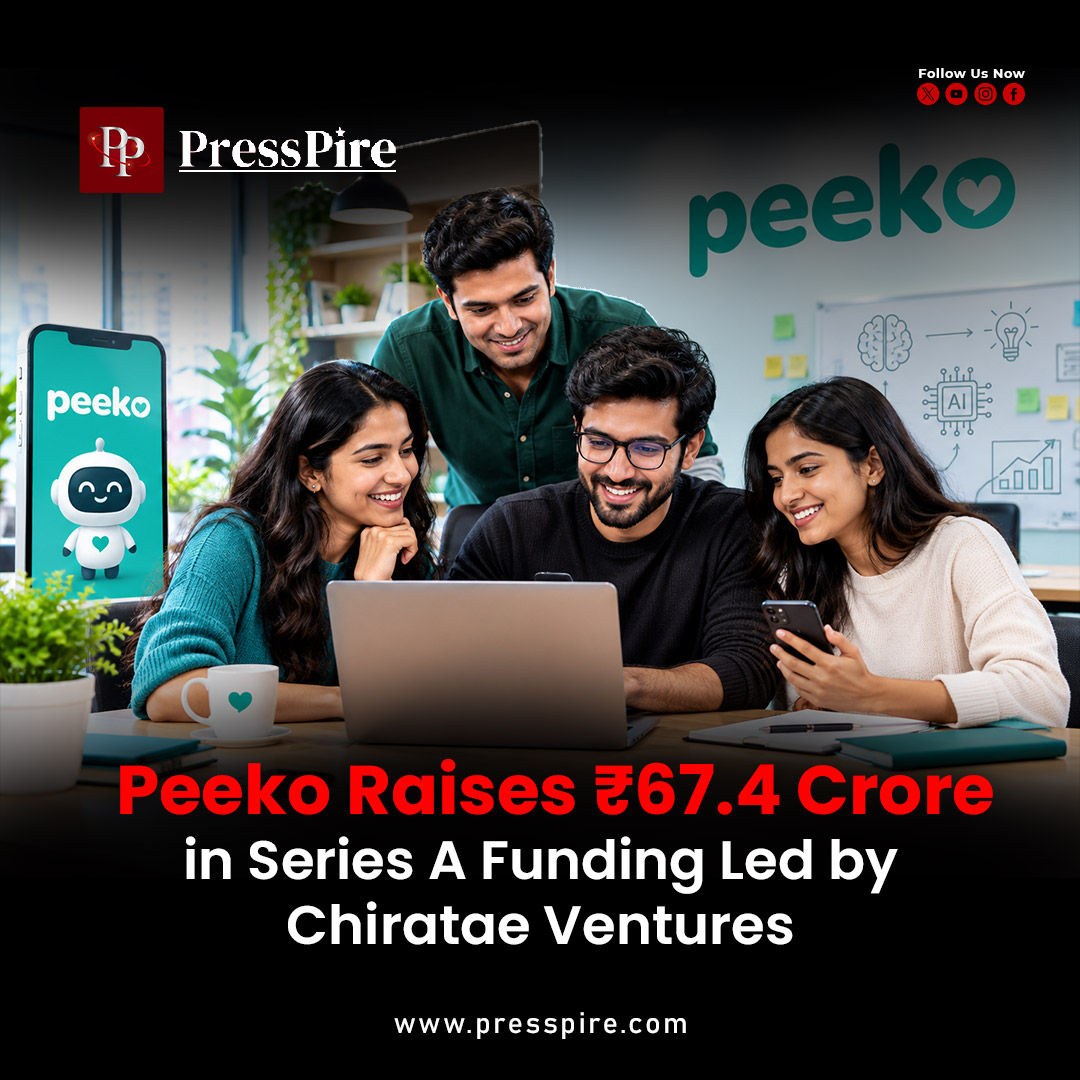
Peeko Raises ₹67.4 Crore in Series A Funding Led by Chiratae Ventures
Peeko has raised ₹67.4 crore in Series A funding led by Chiratae Ventures, with participation from Stellaris Venture Partners and angel investors. The Bengaluru-based babycare quick-commerce startup plans to use the fresh capital to expand its dark-store network, strengthen technology, widen its product assortment and build a broader parenting platform.
Table of Contents
Peeko Funding Marks a New Growth Phase
Peeko funding has entered a significant new chapter after the Bengaluru-based babycare quick-commerce startup raised ₹67.4 crore in its Series A round led by Chiratae Ventures. Existing investor Stellaris Venture Partners also participated, alongside angel investors including MakeMyTrip co-founder Deep Kalra. The latest investment takes Peeko’s total funding to roughly ₹95 crore since its launch in 2025.
For a startup operating in one of India’s most competitive consumer categories, the round represents more than fresh capital. It reflects growing investor interest in specialised quick-commerce models that solve specific consumer problems rather than trying to serve every category under one platform. Peeko has built its proposition around baby and kids-care products, where parents often value availability, trust, product choice and convenience as much as delivery speed.
The company says more than one lakh parents have shopped on its platform since launch and that its business has nearly doubled every quarter over the past six months. These figures are company-stated, but they point to the early demand Peeko is now attempting to convert into a larger and more durable business.
Peeko Series A Led by Chiratae Ventures
The latest Peeko Series A round is led by Chiratae Ventures, giving the young startup a major institutional backer as it moves from early validation towards expansion. Stellaris Venture Partners, which led Peeko’s earlier seed round, has continued its support, signalling confidence in the company’s specialised commerce strategy.
Peeko had previously raised $3.2 million, or approximately ₹28 crore, in August 2025. That round was led by Stellaris and included angel investors such as Maninder Gulati, Kunal Bahl, Rohit Bansal, Abhishek Goyal, Nitin Gupta and Arjun Vaidya. The company said the earlier funding would support product experience, supply expansion and hiring.
The latest Peeko funding round is substantially larger, providing the company with greater room to invest in fulfilment infrastructure, technology and talent. The startup has not disclosed its valuation or the precise equity dilution associated with the Series A.
Peeko Funding Builds on Strong Early Traction
Peeko funding comes at a time when the startup has rapidly expanded the breadth of its catalogue. The company’s assortment has reportedly grown from about 6,000 stock-keeping units at launch to between 27,000 and 30,000 products. Its categories include baby apparel, diapers, toys, baby food, personal care products and other essentials.
Peeko currently operates three dark stores in Bengaluru and covers approximately 55% of the city, according to company-reported figures. It plans to increase its dark-store footprint to six locations by the end of 2026 and enter two additional cities in 2027. The company has also reported an average order value of around ₹1,000.
This expansion strategy highlights the central bet behind the Peeko funding round: build enough local inventory and operational density to make specialised babycare commerce both fast and dependable. Unlike a general marketplace, Peeko is attempting to build depth within one high-frequency consumer category.
Peeko’s Babycare Quick Commerce Model
At the heart of Peeko’s business is a simple observation: buying for children can be very different from buying everyday groceries. Parents may need a particular diaper size, a specific baby-food product, clothing in the right fit or an urgently required care item. A delayed delivery or an incorrect product can create more frustration than it would in many other categories.
Peeko addresses this through a babycare-focused quick-commerce model promising delivery within about 60 minutes. Its platform combines curated inventory with dark-store fulfilment and a try-and-buy experience. Under the model, a delivery rider can wait while the parent checks the product and takes back unwanted items, with an instant refund process.
This approach gives Peeko a potentially meaningful point of differentiation. It is not simply competing on how quickly a package reaches a doorstep; it is trying to reduce uncertainty around product selection, fit and returns. That distinction could become increasingly important as India’s quick-commerce market becomes more crowded.
Peeko Funding to Expand Dark Stores
A major priority for the fresh Peeko funding will be expanding the company’s physical fulfilment network. Dark stores are central to quick commerce because inventory has to be positioned close enough to customers to make rapid delivery economically viable.
Peeko’s plan to move from three to six Bengaluru dark stores by the end of 2026 will therefore test whether its specialised model can achieve stronger operational efficiency as order volumes rise. The company is also expected to invest in hiring, logistics and supply-chain capabilities as it scales.
Expansion, however, brings its own challenges. More stores mean higher fixed costs, while a wider assortment requires better inventory forecasting and working-capital management. The success of Peeko funding will ultimately depend not just on adding locations, but on building sustainable unit economics across those locations.
Peeko Technology and Parenting Vision
Technology is another important part of Peeko’s growth strategy. The company plans to strengthen its technology stack and use the latest Peeko funding to improve the shopping experience. Its broader ambition is to become a “parenting partner” rather than remain simply a delivery platform.
That vision could take the company beyond transactions. A parenting-focused platform can potentially use purchase patterns, product preferences and customer behaviour to improve recommendations, discovery and retention. Earlier company information has also pointed towards technology-led personalisation and AI-based recommendations.
For Peeko, this creates an opportunity to build a stronger relationship with families over time. If the company can combine reliable delivery with useful product discovery and customer support, its competitive advantage could extend beyond speed.
The Founders Behind Peeko Funding
Peeko was founded in 2025 by Chetan Sharma, Abhijit Gairola and Vivek Khetan, who have professional backgrounds at Leap and OYO. The founders are IIT alumni and built Peeko around the everyday difficulties parents face while purchasing babycare products.
Their early approach has been strongly customer-focused. Chetan Sharma previously shared that Peeko reached 50,000 cumulative orders within 5.5 months of launch, attributing the progress to customer feedback, operational execution and close collaboration with supply partners.
That emphasis matters because babycare is fundamentally a trust-driven category. Parents are not simply looking for the cheapest product or the fastest delivery. They want confidence that the product is genuine, appropriate and available when they need it.
What Peeko Funding Means for Babycare
The significance of the Peeko funding round extends beyond one startup. It highlights the emergence of vertical quick commerce in India, where specialised platforms focus deeply on categories such as babycare, fashion or pharmacy rather than competing across the entire consumer basket. Business Standard has previously noted that vertical quick-commerce models can benefit from deeper assortment, category-specific curation and more specialised supply chains.
For babycare, the opportunity is particularly interesting because parents often purchase repeatedly as children grow. Diapers, wipes, food, clothing, toys and personal-care products can create recurring demand. A platform that earns customer trust early may therefore have opportunities to build long-term retention.
The challenge is equally clear. Generalist quick-commerce companies already have large customer bases, extensive delivery networks and significant purchasing power. Peeko must demonstrate that category depth and a better customer experience can justify a specialised model.
Challenges Ahead for Peeko
The Peeko funding round gives the company resources, but capital alone will not guarantee success. The startup must balance fast expansion with inventory efficiency, delivery economics, customer acquisition and repeat purchases. Scaling from one city to multiple markets can also expose differences in customer behaviour, supplier availability and operating costs.
The company’s current Bengaluru footprint provides an important testing ground. Moving from three to six dark stores will reveal whether higher density can improve delivery performance and order economics. Entering new cities in 2027 will then become a larger test of whether Peeko’s proposition is genuinely transferable.
Another challenge will be maintaining product quality and assortment as the catalogue grows. In babycare, trust can be damaged quickly by poor fulfilment, incorrect products or difficult returns. Peeko’s try-and-buy proposition could become a strength if executed consistently, but it also adds operational complexity.
The Road Ahead for Peeko Funding
Peeko funding marks an important moment for a startup attempting to redefine how Indian parents shop for baby and kids-care products. With ₹67.4 crore in fresh Series A capital, the company now has an opportunity to strengthen its technology, expand its dark-store network, deepen its assortment and build a broader parenting proposition.
The next phase will be less about proving that parents want convenience and more about proving that specialised convenience can become a sustainable business. Peeko has already built an early customer base, expanded its assortment and attracted follow-on institutional backing. The larger question is whether those advantages can translate into strong retention and efficient economics at scale.
India’s quick-commerce market is moving from a race for speed towards a race for relevance. For parents, relevance may mean having the right product, at the right time, with the right level of trust. If Peeko can deliver on that promise, the latest Peeko funding could become the foundation for a much larger babycare commerce story.
For more insights navigate: PressPire | Stories That Shape the Future
Read previous article here: https://presspire.com/new-age-parents/
Follow PressPire on Facebook | Instagram | LinkedIn | YouTube
PressPire | Stories That Shape the Future