
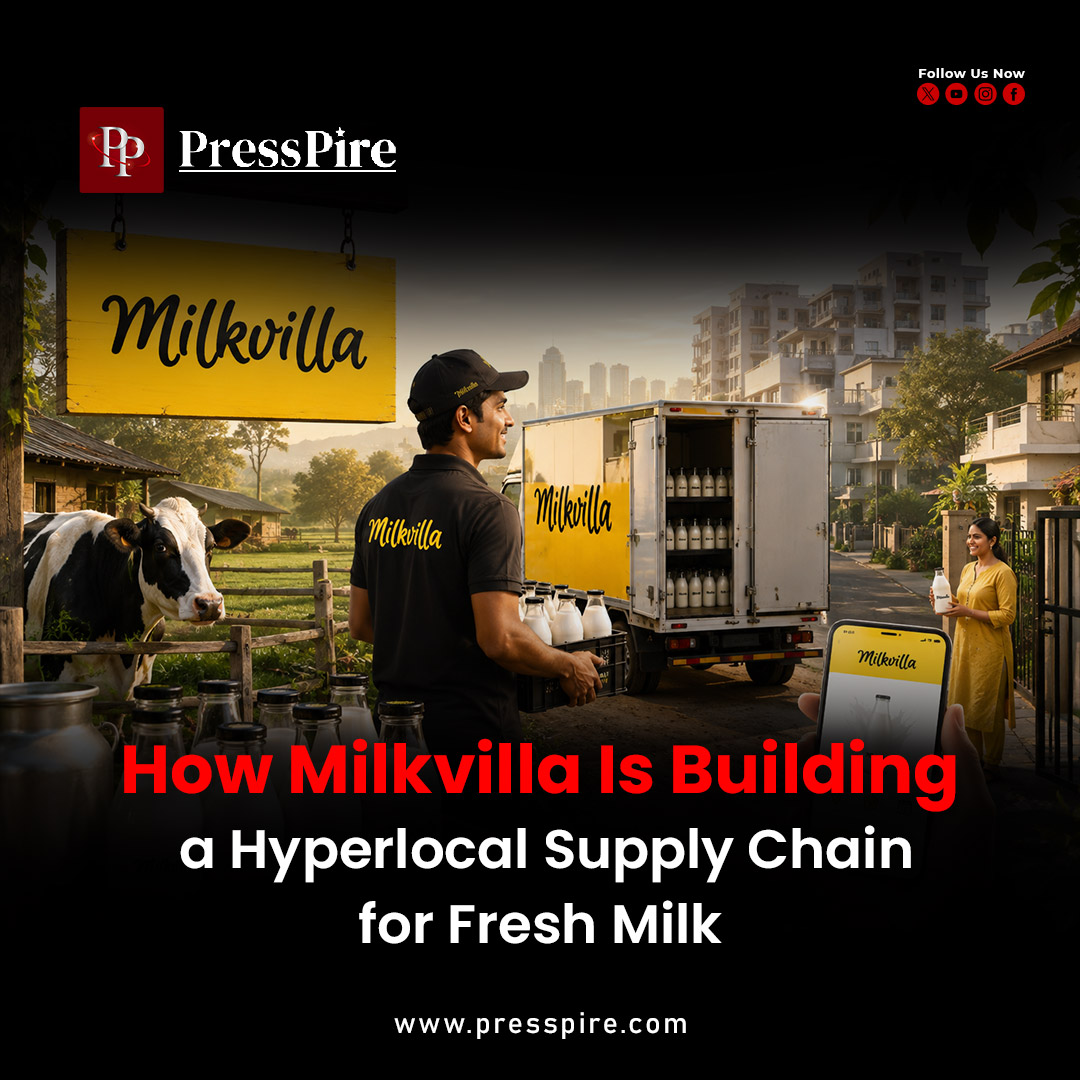
How Milkvilla Is Building a Hyperlocal Supply Chain for Fresh Milk
Milkvilla is taking a different approach to one of India’s most familiar daily essentials: fresh milk. While conventional dairy supply chains often involve multiple collection points, processing facilities, packaging centres, warehouses and retail channels, the Bengaluru-based dairytech startup is building a hyperlocal model designed to move milk from farmers to consumers within approximately 12 hours. By combining direct farmer sourcing, rapid cooling, quality testing, local distribution and technology-enabled subscriptions, Milkvilla is attempting to rethink what freshness can mean in India’s increasingly organised dairy market.
Milk is among the most time-sensitive products in the food industry. Unlike packaged goods that can remain in warehouses for weeks or months, fresh milk requires careful handling from the moment it leaves the farm. Temperature, transportation time, hygiene, testing and storage all influence the quality of the final product. For consumers, the expectation is simple: the milk delivered to the home should be fresh, safe and reliable.
For farmers, however, the equation is more complicated. Dairy production requires daily labour, livestock management, feed, veterinary care and disciplined collection practices. Small and independent dairy farmers can also face challenges related to spoilage, inconsistent demand and limited control over the route through which their milk reaches consumers.
Milkvilla’s model attempts to address both sides of this equation by shortening the distance between production and consumption.
Its approach is built around a straightforward principle: source milk close to the market, cool it rapidly, test it carefully and deliver it quickly.
That seemingly simple idea requires a highly coordinated supply chain.
Milkvilla Is Reimagining the Traditional Milk Supply Chain
The conventional journey of milk can involve several stages before it reaches a household. Milk may travel from individual farms to collection centres, then to processing facilities, packaging units, distribution warehouses and finally retailers or delivery networks. Every additional stage can increase the time and complexity involved in moving a highly perishable product.
Milkvilla is attempting to compress this journey.
The company’s model connects farmers directly with local demand. In Muzaffarpur, Bihar, where its founders grew up, the company works with dairy farmers in nearby villages. In Bengaluru, it sources milk from farmers in Ramanagara district, roughly 50 kilometres southwest of the city. This geographic proximity is central to the company’s hyperlocal strategy.
Instead of building a supply chain dependent on long-distance transportation, the company aims to establish relatively compact networks around the cities it serves.
The logic is important.
When the distance between farms and consumers is reduced, logistics can become more responsive. Fresh milk can be collected closer to the point of production, transported quickly into a controlled cold chain and delivered to customers without spending extended periods in transit.
This also gives the company greater visibility across the supply chain.
Milkvilla currently works with around 350 dairy farmers, according to recent company information, while serving more than 10,000 active customers. Its model includes a prepaid subscription system through its app, allowing consumers to add funds and manage their milk orders digitally.
The result is a business model that connects three traditionally separate elements: farmers, logistics and consumers.
Technology becomes the layer connecting them.
Instead of relying exclusively on conventional retail distribution, Milkvilla can use customer subscriptions and local demand information to better understand consumption patterns and organise deliveries accordingly.
For a product consumed daily, that predictability can be particularly valuable.
Milkvilla’s 12-Hour Fresh Milk Model
At the centre of Milkvilla’s proposition is its approximately 12-hour farm-to-home supply chain.
The process begins with milk collection from partner farmers. The company uses a specialised milk collection vehicle equipped with cooling and testing infrastructure. Milk collected at the farmer’s doorstep is rapidly cooled to around 4 degrees Celsius, which the company says helps extend its shelf life to approximately 24 hours without adding chemicals.
Rapid cooling is a critical part of the model because temperature control is fundamental to maintaining milk quality.
Once collected and cooled, the milk moves to a delivery hub. There, quality assessment takes place before the product is sent onward. Milk that meets the required quality parameters is then loaded into refrigerated vehicles for delivery to consumers.
This sequence creates a tightly connected chain:
Farmer → Collection and Testing → Rapid Cooling → Delivery Hub → Quality Assessment → Refrigerated Delivery → Consumer
The shorter the chain, the easier it can potentially be to manage time and temperature.
Milkvilla says its customers receive milk in two daily delivery batches, with each batch following the company’s 12-hour collection-to-delivery cycle.
The company’s own published explanation of the model places freshness at the centre of its operations. It describes a system designed to deliver milk within 12 hours of milking, while emphasising that the milk is unprocessed and unhomogenised and is not exposed to plastic packaging in its stated delivery model.
This positioning differentiates Milkvilla from the traditional packaged milk experience familiar to millions of Indian consumers.
However, freshness is not achieved through a single technology.
It is the result of coordination.
Collection timing must be aligned with transport. Cooling must happen quickly. Quality testing must be completed efficiently. Delivery hubs must be prepared to receive and dispatch the product. Refrigerated transportation must operate on schedule. Finally, household deliveries must be completed within the intended window.
In other words, the company’s competitive proposition is fundamentally a supply chain proposition.
Milkvilla Puts Farmers at the Centre of the Model
A major aspect of Milkvilla’s business strategy is its relationship with dairy farmers.
The founders, Mannu Jee and Aman Jee, grew up in Rampur village in Bihar’s Muzaffarpur district and saw the challenges faced by dairy farmers firsthand. Their family was involved in both agriculture and cattle rearing, giving the founders an early understanding of how much effort dairy production requires. They have spoken about problems such as milk spoilage and poor management affecting farmers’ income.
That background appears to have influenced Milkvilla’s emphasis on creating a more direct connection between farmers and consumers.
According to recent reporting, the company says approximately 60% to 70% of its revenue goes to its network of dairy farmers.
For a dairy business, farmer economics are crucial.
A supply chain cannot remain sustainable if the people producing its primary product do not receive adequate economic value. Farmers also need dependable collection mechanisms, timely payments and predictable demand.
A hyperlocal network can potentially help address some of these challenges by linking production more closely to a defined consumer market.
Rather than transporting milk across large distances to reach demand, local farmer networks can supply nearby urban communities.
This creates a more direct economic relationship.
The model also creates an opportunity for consumers to understand more about where their milk comes from. In an era when food provenance is becoming increasingly important, traceability and transparency can become meaningful differentiators.
Milkvilla’s expansion beyond milk also demonstrates how the same supply chain can support a wider dairy portfolio. The company has added products including paneer, ghee and peda, using the supply chain developed around its core milk business.
This is strategically important.
Once a company has built relationships with farmers, established collection infrastructure, developed cold-chain capabilities and acquired a recurring customer base, it can potentially introduce additional products without rebuilding its entire distribution system.
That can turn a single-product dairy business into a broader farm-to-consumer platform.
Milkvilla and the Growing Demand for Hyperlocal Food Distribution
The rise of Milkvilla comes at a time when Indian consumers are becoming increasingly accustomed to convenience-driven food delivery.
Consumers increasingly expect products to reach them quickly and reliably. At the same time, there is growing interest in freshness, provenance, ingredient quality and direct relationships with producers.
These expectations create an interesting opportunity for hyperlocal food businesses.
The traditional approach to scale often involves building large centralised processing and distribution systems. Such infrastructure can deliver efficiency, but it can also increase the distance between producers and consumers.
Hyperlocal models follow a different philosophy.
Instead of asking how far a product can be distributed, they ask how efficiently a product can be sourced and delivered within a defined geographic area.
For fresh milk, this distinction is particularly relevant.
Milk is consumed frequently and has a relatively short shelf life. Customers do not necessarily need a product that has travelled hundreds of kilometres. They need a reliable supply that arrives at the right time and meets their expectations for quality.
Milkvilla’s model therefore reflects a broader shift toward localised supply networks.
The company can build farmer clusters around individual cities, establish collection routes and connect them to neighbourhood-level delivery demand.
Such a model could also allow operational decisions to be made closer to the consumer.
Demand fluctuations, delivery density, farmer availability and local consumption patterns can all influence how efficiently a hyperlocal dairy network operates.
Technology can help coordinate these moving parts.
Milkvilla’s app-based subscription model gives customers a digital interface for managing orders and payments. At the operational level, such a system can also create valuable demand information for planning collection and delivery.
The combination of physical infrastructure and digital coordination is what gives the model its modern character.
It is not simply a milk delivery service.
It is an attempt to build a digitally coordinated local food network.
The Technology Behind Freshness
When consumers think about dairy technology, processing machinery and laboratory testing may be the first things that come to mind.
For a company such as Milkvilla, however, technology extends across the entire supply chain.
The collection vehicle itself becomes a mobile infrastructure unit. It brings together milk collection, cooling and testing at the point where milk enters the company’s network. That reduces the time between milking and temperature-controlled storage.
The delivery hub then becomes another quality-control checkpoint.
This approach is significant because food quality is not determined at only one point in the supply chain. It is affected by every stage of handling.
A temperature-controlled environment must be maintained. Testing needs to be systematic. Transportation must be coordinated. Delivery schedules need to be reliable.
The company has therefore built its proposition around operational precision.
Its stated goal of moving milk from farmer to customer within 12 hours leaves limited room for unnecessary delays.
That creates both an advantage and a challenge.
The advantage is a potentially fresher product and a more responsive supply chain.
The challenge is that the entire system must perform consistently.
A delayed collection can affect the next stage. A transport disruption can affect delivery. A refrigeration problem can compromise quality. A sudden change in demand can create inefficiencies.
Hyperlocal logistics are therefore not automatically simple.
They require strong planning, reliable infrastructure and disciplined execution.
Milkvilla’s model demonstrates that speed alone is not the objective. The real objective is controlled speed.
The milk must move quickly while maintaining quality standards throughout the journey.
Building a Consumer Brand Around Freshness
For Milkvilla, supply chain innovation also serves a branding purpose.
Freshness is easy for consumers to understand.
Instead of communicating a complex technical proposition, the company can explain its value through a simple question: how quickly did the milk travel from the farm to your home?
Its 12-hour model provides a clear answer.
That creates a narrative around the product.
The consumer is not simply buying milk. They are buying into a supply chain designed around proximity, speed and freshness.
This type of positioning can be particularly powerful in categories where products are otherwise perceived as commodities.
Milk is consumed every day, but consumers often have limited visibility into its journey.
A company that makes that journey part of its brand can create a stronger emotional connection with customers.
The farmer becomes part of the story. The local sourcing network becomes part of the story. The refrigerated delivery becomes part of the story.
Technology makes the experience convenient, but the underlying proposition remains human: connecting the people who produce food with the people who consume it.
The Road Ahead for Milkvilla
Milkvilla’s journey highlights a larger opportunity in India’s dairy sector.
The country’s dairy market is vast, but the next phase of innovation may not simply come from larger processing plants or wider distribution networks. It may come from companies finding smarter ways to connect local producers with urban consumers.
Milkvilla has built its strategy around this opportunity.
Its current network includes approximately 350 dairy farmers and more than 10,000 active customers, according to recent reporting. The company has established operations in Muzaffarpur and Bengaluru and is expanding its product portfolio beyond milk.
The challenge now is to determine whether the model can scale while preserving the qualities that make it distinctive.
Scaling a hyperlocal supply chain is different from scaling a conventional consumer brand.
Every new city requires a local farmer network, collection infrastructure, quality systems, delivery routes and sufficient customer density.
The company must therefore balance geographic expansion with operational discipline.
If it succeeds, the implications could extend beyond dairy.
The same principles could potentially be applied to other perishable food categories where freshness, traceability and speed are important.
That is what makes Milkvilla’s approach particularly interesting.
It is not simply attempting to deliver milk faster.
It is experimenting with a different architecture for the fresh-food supply chain.
Freshness as a Supply Chain Advantage
The story of Milkvilla is ultimately a story about shortening distance.
The company is bringing farmers closer to consumers, reducing the number of stages between production and delivery and using cold-chain infrastructure to protect freshness along the way.
Its 12-hour model provides a tangible expression of that strategy.
The company collects milk from local dairy farmers, rapidly cools it, conducts quality assessments, transports it through refrigerated logistics and delivers it to households through a digitally managed subscription model.
Behind that process is a broader vision of what a modern food supply chain can look like.
Instead of relying solely on centralised systems and long-distance distribution, hyperlocal networks can create shorter, more responsive connections between producers and consumers.
For farmers, the model can create a more direct route to the market. For consumers, it can offer greater visibility into freshness and sourcing. For the business, it creates an opportunity to build recurring relationships around a product that households purchase every day.
The real test will be scale.
Can Milkvilla replicate its model across more cities without losing control over quality, farmer relationships and delivery efficiency?
If it can, the company could become an important example of how technology and logistics can reshape India’s traditional dairy ecosystem.
The future of fresh milk may not depend solely on how efficiently it can be processed.
It may depend on how intelligently it can be connected.
And Milkvilla is betting that the strongest connection is one that brings the farm, the supply chain and the consumer closer together.
For more insights navigate: PressPire | Stories That Shape the Future
Read previous article here: https://presspire.com/new-age-parents/
Follow PressPire on Facebook | Instagram | LinkedIn | YouTube
PressPire | Stories That Shape the Future