
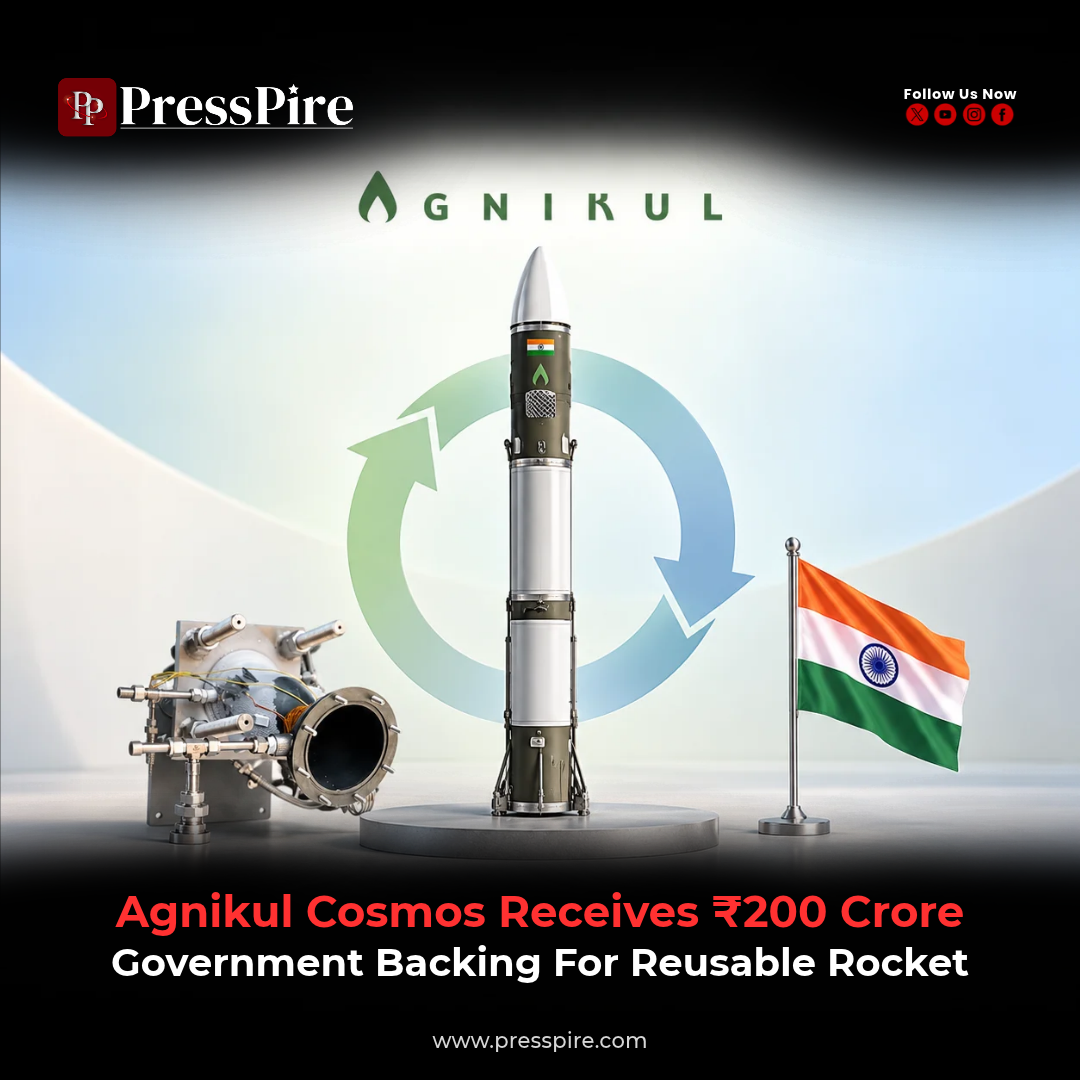
Agnikul Cosmos Secures ₹200 Crore Government Backing for Reusable Rocket Programme
The Chennai space startup has signed a financing agreement with the Technology Development Board to advance its Agnibaan reusable launch vehicle.
Agnikul Cosmos has secured an agreement for ₹200 crore in government financial support to develop its reusable rocket programme, marking a new stage in the Chennai startup’s work on space transportation.
The Technology Development Board (TDB), under the Department of Science & Technology (DST), announced the agreement on 25 September 2026. The support comes through the Research Development and Innovation (RDI) Fund and will support the development of the Agnibaan Reusable Launch Vehicle, or Agnibaan RLV.
The programme aims to develop a launch system capable of repeated use. Its commercial significance will depend on whether the company can combine reliable flight performance with economical recovery and preparation for subsequent missions.
Agnikul Cosmos Funding: The Key Details
| Detail | Announcement |
|---|---|
| Financial support | ₹200 crore |
| Government agency | Technology Development Board, under DST |
| Funding route | RDI Fund |
| Financial instrument | Optionally Convertible Debentures |
| Programme | Agnibaan Reusable Launch Vehicle |
The agreement provides backing for technology development. It does not establish that the entire amount has already been disbursed.
How the Financial Support Is Structured
The financing will use Optionally Convertible Debentures (OCDs). In simple terms, these are debt instruments that can be converted into equity under agreed conditions.
That structure matters when describing the announcement: the ₹200 crore is financing for the programme, with terms attached to the instrument.
The public announcement does not detail the repayment, interest or conversion conditions. It also does not provide a complete disbursement schedule, so the amount should be understood as the announced support under the agreement.
What the Agnibaan Reusable Rocket Programme Will Develop
According to TDB, the project targets full-system reusability, including work on a reusable upper-stage architecture.
The proposed design combines a lightweight upper stage with semi-cryogenic liquid propulsion, engine restart capability and deep throttling. Its development scope covers ascent, orbital insertion, descent and recovery.
These are connected engineering challenges. A vehicle must perform its launch mission and then manage the conditions needed for recovery. Reusability also requires engineers to understand how hardware behaves across repeated operations.
The programme therefore extends across propulsion, vehicle design and mission operations. A successful outcome would require these elements to work together consistently.
Understanding the Technology Readiness Target
The agreement aims to advance relevant technologies from Technology Readiness Level 4 and above towards TRL 8.
Technology Readiness Levels are a scale used to describe how mature a technology is. Earlier stages involve research and component testing, while later stages require increasingly representative demonstrations and qualification.
At TRL 4, components are tested together. TRL 8 generally indicates that a system has completed testing and qualification. The highest level, TRL 9, concerns technology proven through successful operation.
For readers, the distinction is useful: the funding supports a development journey towards a qualified system. The stated target does not mean that the reusable vehicle has already completed that journey.
The Founders and IIT Madras Connection
Agnikul Cosmos was incorporated in 2017 and incubated at the IIT Madras Incubation Cell.
Its co-founders include Srinath Ravichandran, the company’s chief executive, and Moin SPM, its chief operating officer. Ravichandran brings electrical and aerospace engineering experience, while Moin’s background includes aeronautical engineering, operations and manufacturing.
The company began operations at the National Centre for Combustion Research and Development at IIT Madras. Its subsequent development has included manufacturing facilities and launch infrastructure.
Agnikul’s business is centred on configurable launch vehicles for small satellites. The intended service gives satellite customers dedicated access to space, with vehicle configurations adapted to mission requirements.
Building on 3D-Printed Engines and the 2024 Flight
Agnikul’s earlier engineering work includes Agnilet, its single-piece, 3D-printed rocket engine developed and manufactured in-house.
The company’s approach brings engine development, vehicle systems and launch operations within the same organisation. Its published capabilities also include avionics, flight control and propulsion development.
A key demonstrated milestone came on 30 May 2024, when the Agnibaan SOrTeD Mission-01 launched from Agnikul’s launchpad at Sriharikota.
The mission was a suborbital technology demonstration. Agnikul’s mission record describes controlled ascent using an autopilot and a powered flight lasting approximately 66 seconds.
That flight provided experience in propulsion, vehicle control and coordinated launch operations. The new reusable programme adds further development requirements around recovery and repeated use.
A Continuing Relationship With the Technology Development Board
The September agreement builds on an earlier relationship between Agnikul and TDB.
In December 2024, the board announced support for the development and commercialisation of a modular, configurable launch vehicle for small-satellite missions.
That earlier project addressed the company’s launch capability. The newer programme focuses on extending its technology towards a reusable system.
Viewed together, the announcements show government support across successive development stages. They also illustrate why space hardware businesses need sustained engineering investment: a demonstrated component or initial flight is one step towards a dependable commercial service.
Why Reusability Matters to the Business
The commercial case for reusable rockets rests on using valuable hardware across multiple missions.
If recovered equipment can be inspected, prepared and flown again economically, an operator may spread manufacturing costs over more launches. A reusable fleet could also change how a company plans production and schedules missions.
However, the business calculation includes recovery operations, maintenance, replacement parts, testing and turnaround time. The number of times hardware can fly safely also matters.
For satellite customers, the useful outcome would be a launch service that combines competitive pricing with reliable delivery. Lower hardware expenditure alone would not establish that result.
Agnikul’s programme will therefore be judged on both engineering performance and operating economics. Repeatability must be demonstrated in practice, and the cost of returning a vehicle to service must support the proposed business model.
What Comes Next for Agnikul Cosmos?
The public announcement does not specify a firm date for the first reusable flight or commercial service.
Meaningful indicators of progress will include integrated testing, recovery demonstrations and evidence that recovered hardware can be prepared for another mission. Launch reliability and turnaround costs will become increasingly relevant as development progresses.
For Agnikul Cosmos, the ₹200 crore agreement provides financial backing for that work. Its long-term value will emerge through the systems the company qualifies and the missions it can perform repeatedly.
For more insights navigate: PressPire | Stories That Shape the Future
Read previous article here : vedanta-gamsberg-expansion-south-africa/
Follow PressPire on Facebook | Instagram | LinkedIn | YouTube
PressPire | Stories That Shape the Future