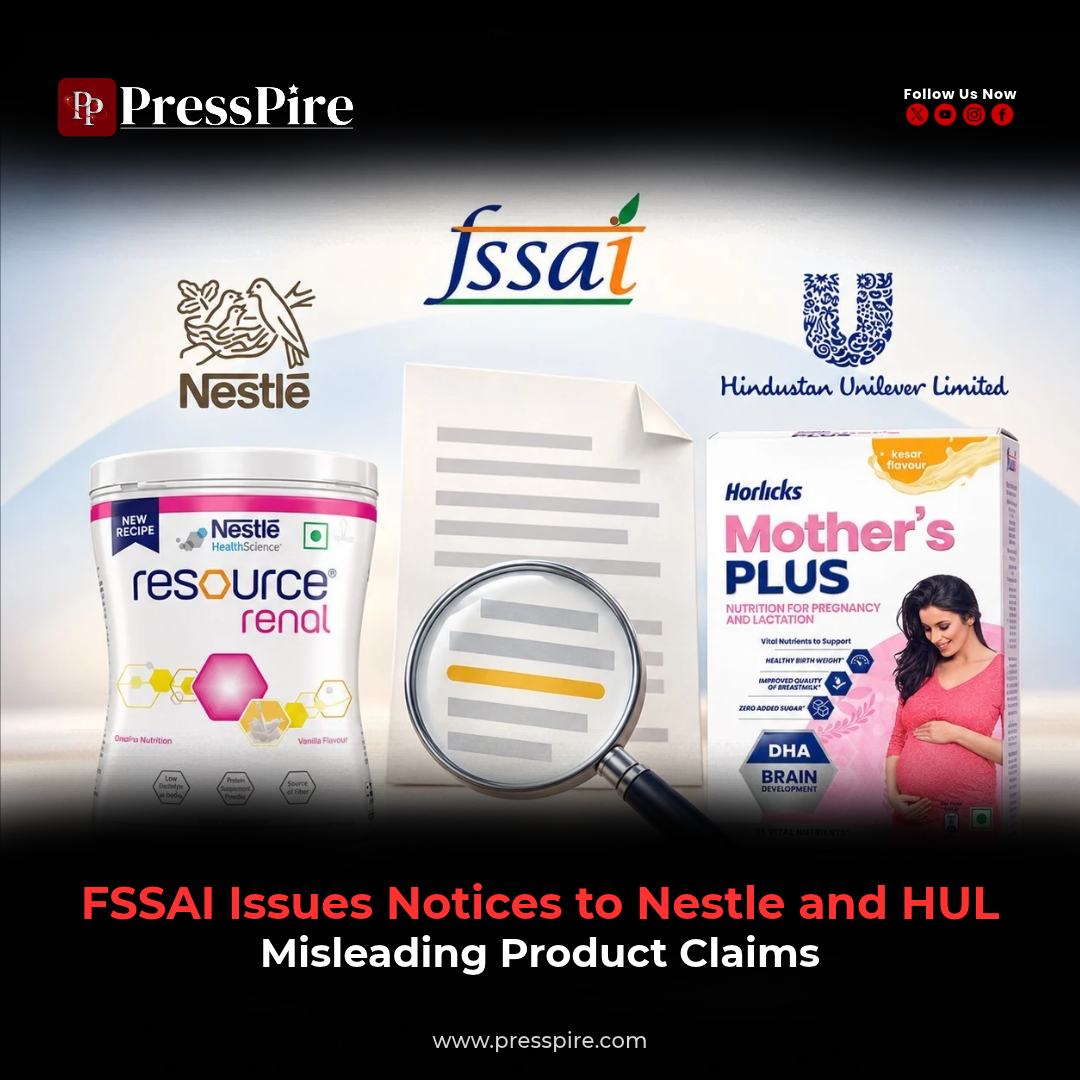
The regulator has questioned claims, labelling and approval compliance involving selected Horlicks, Nescafé and Resource Renal products.
The Food Safety and Standards Authority of India has issued notices to Nestlé India and Hindustan Unilever Limited (HUL) over allegedly misleading claims and regulatory non-compliance involving selected food and nutrition products.
Publicly announced on 17 October 2026, the FSSAI notices cover several distinct concerns. These include the promotion of health benefits, inconsistent product descriptions and requirements relating to a specialised nutrition product.
The companies have been asked to explain the observations. The proceedings bring attention to how manufacturers describe products across packaging, advertisements and online shopping platforms.
FSSAI Notices: Products and Concerns
| Company | Product or range | Main concerns reported |
|---|---|---|
| HUL | Horlicks Women’s Plus Chocolate Nutrition Drink, 400 g | Bone-health, muscle-health and nutrition claims |
| HUL | Horlicks Mother’s Plus Kesar, 400 g BIB | Birth-weight claims and online promotional descriptions |
| Nestlé India | Selected Nescafé ready-to-drink beverages | Inconsistent category descriptions on packaging and listings |
| Nestlé India | Resource Renal vanilla-flavoured powder | Required prior approval and mandatory labelling |
Each matter concerns specific products and regulatory observations. The notices should be understood within that scope.
Why Horlicks Women’s Plus Is Under Scrutiny
FSSAI Notices questioned several claims associated with Horlicks Women’s Plus Chocolate Nutrition Drink 400 g.
According to PTI’s reporting of the regulator’s statement, these included assertions about stronger bones, improved bone health and clinical evidence of improved bone strength within six months.
The regulator also objected to wording about healthy muscles and challenged the product’s “No Added Sugar” claim, citing the presence of maltodextrin in its formulation.
Another concern involved the claim that the product provided the full recommended dietary allowance of calcium, vitamin D and vitamin K2. FSSAI said this did not meet the applicable requirements.
The regulator also identified problems with the format of the nutritional information table. These observations concern how the product’s benefits and nutritional properties were presented.
What FSSAI Flagged in Horlicks Mother’s Plus
A separate notice concerns Horlicks Mother’s Plus Kesar 400 g BIB.
FSSAI questioned wording linking the product to a baby’s healthy birth weight, including “Healthy Birth Weight” on its label. The regulator considered the representations potentially misleading under the Food Safety and Standards (Advertising and Claims) Regulations, 2018.
It also flagged an online product name incorporating promotional statements about pregnancy, lactation, protein, birth weight and DHA-related brain development.
The issue therefore extends beyond the physical pack to the information shoppers encounter when browsing online.
Nescafé Drinks Face Questions Over Product Classification
The Nescafé matter involves Intense Café Cappuccino, Choco Mocha and Chilled Latte ready-to-drink beverages.
FSSAI said the packaging contained inconsistent descriptions: the front identified the beverages as flavoured milk, while the back categorised them as proprietary dairy-based food.
According to Business Standard’s reporting, the regulator considered the products to fall within the standardised flavoured-milk category and questioned the proprietary-food declaration.
The reported notices also named Schreiber Dynamix Dairies Private Limited and Lotus Dairy Products Private Limited, which manufacture the beverages.
This part of the action concerns consistency in product classification and presentation across manufacturing, branding and online sales.
Resource Renal Notice Concerns Approval and Labelling
Nestlé India’s Resource Renal vanilla-flavoured powder was flagged separately.
The product is intended for the dietary management of individuals with conservatively treated chronic kidney disease. According to the regulator’s observations reported by IANS, it required prior approval for the relevant category, which FSSAI said had not been obtained.
The regulator also reported that the label lacked the prescribed vegetarian or non-vegetarian symbol.
These allegations relate to approval and labelling requirements. The notice does not, by itself, establish a finding of contamination or a clinical assessment of the product’s effectiveness.
What India’s Food Advertising Rules Require
The Food Safety and Standards (Advertising and Claims) Regulations, 2018 set requirements for how food businesses communicate nutritional and health-related benefits.
The rules require claims to be clear, accurate and supported by appropriate evidence. They also require advertising claims to remain consistent with information on the product label.
The framework distinguishes between describing a nutrient’s function and attributing a health benefit directly to a finished product. Claims must meet the conditions applicable to the representation being made.
This helps explain why the precise wording matters. A statement about the presence of a nutrient and a statement promising a particular health outcome can convey different messages to a shopper.
Why Online Product Listings Matter
The reported observations repeatedly refer to e-commerce descriptions alongside packaging and advertisements.
Food advertising rules cover internet communications, so a product title or promotional description can form part of the material assessed by the regulator.
From a business perspective, this makes coordination between product, regulatory and marketing teams important. Information approved for a pack needs to remain accurate when adapted for marketplace titles, images and promotional campaigns.
That is a practical implication of the notices: reviewing a product’s presentation involves more than checking a single label.
What Happens Next?
Nestlé India and HUL have been asked to submit explanations within the periods specified in the notices. FSSAI has warned that unsatisfactory responses could lead to further action under applicable food safety laws.
Licensing authorities and e-commerce platforms have also been asked to take appropriate action in connection with the reported matters.
The reports reviewed for this article did not include substantive company responses addressing these specific notices.
A notice gives the recipient an opportunity to explain its position. The next developments to watch are the companies’ replies, any changes to product communication and subsequent decisions by the regulator.
For more insights navigate: PressPire | Stories That Shape the Future
Read previous article here : rapidcanvas-29-million-series-b-enterprise-ai/
Follow PressPire on Facebook | Instagram | LinkedIn | YouTube
PressPire | Stories That Shape the Future