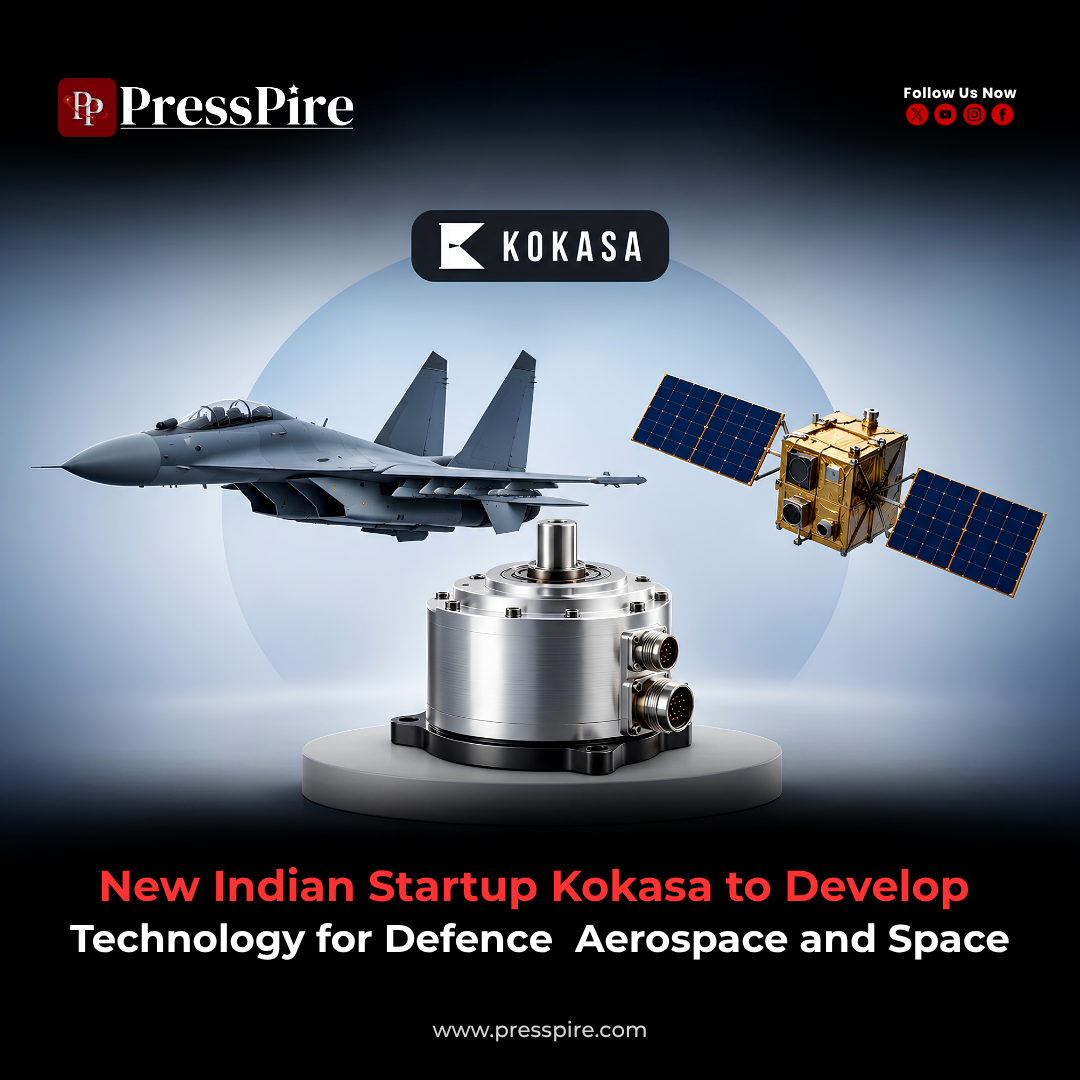
New Indian Startup Kokasa to Develop Technology for Defence, Aerospace and Space
Kokasa has announced its public launch with plans to develop critical hardware and autonomous technologies for defence, aerospace and space. Founded by Rahul Jain, Snehil Gautam and Vikalp Bagdi, the venture combines experience in building consumer businesses, digital platforms and aerospace systems.
Its focus is on the technologies that help advanced machines sense operating conditions, move precisely and coordinate their actions. The company aims to bring physical engineering, software development and manufacturing together to build these capabilities in India.
The launch announcement was issued on 30 September 2026. Its website dates the company’s establishment to February 2026, indicating that development activity began before its public introduction.
The Founders Behind Kokasa
The founding team brings different professional backgrounds to the venture.
| Founder | Previous experience |
|---|---|
| Rahul Jain | Co-founder of Epigamia |
| Snehil Gautam | Former executive at Housing.com |
| Vikalp Bagdi | Aerospace experience at HAL and Textron |
Jain and Gautam have known each other since their time at IIT Bombay, according to Jain’s public launch post. Their experience in building businesses sits alongside Bagdi’s work in aerospace engineering.
Bagdi has described more than 14 years in military and civil aerospace, covering system design, integration, testing and qualification. That experience is relevant to a business whose products must perform consistently in demanding environments.
For Kokasa, the task is to bring these skills into a single development and manufacturing operation. Commercial experience can help build the organisation, while engineering performance will determine whether its systems meet customer requirements.
Critical Technology for Defence, Aerospace and Space
The startup is developing equipment and software that connect digital instructions with physical action.
Its work includes electromechanical and electrohydraulic systems, sensing, instrumentation and embedded controls. These technologies manage movement, measure conditions and help machines respond to their surroundings.
| Technology area | What it does |
|---|---|
| Actuation and motion control | Turns commands into controlled movement |
| Sensing and instrumentation | Measures conditions such as position, pressure, speed and temperature |
| Autonomous systems | Helps a machine interpret information and carry out actions |
| Collaborative autonomous systems | Enables connected platforms and sensors to share information and coordinate activity |
The relationship between these technologies is central to the company’s approach. Software can decide that an action is needed, but physical hardware must carry it out. Sensors then provide information about what happened, allowing the system to respond.
Kokasa aims to develop more of the underlying technology within these systems. That could give its engineers greater control over how products are adapted to different applications and supported over time.
Indigenisation Work on Major Defence Platforms
According to the company’s launch statement, it is already executing indigenisation programmes associated with the Su-30MKI, MiG-29 and T-72.
The work involves developing domestic systems for existing defence platforms. Such programmes can create opportunities for Indian suppliers to address equipment requirements and provide local engineering support.
The company’s published capabilities include a T-72 turret traverse system, which its website identifies as being in development. Its reported programme activity should therefore be distinguished from confirmation that every product has completed qualification or entered operational service.
For customers, the potential benefit is access to an additional source of equipment and a domestic team that can support repairs, modifications and future requirements. Realising that benefit depends on successful testing and customer acceptance.
Kokasa Plans Systems That Can Work Together
Alongside its physical engineering work, the startup is developing a broader approach to autonomy.
Its vision for Collaborative Autonomous Systems involves multiple autonomous or semi-autonomous platforms operating through a common software architecture. The aim is to help compatible systems exchange information and coordinate their activity towards a shared objective.
This work includes perception, sensor fusion, guidance and control. In simpler terms, these capabilities help machines interpret information from their surroundings and use it to decide how to respond.
The launch material describes the company’s development direction but does not provide independent benchmarks for a fully deployed collaborative system. Testing and integration results will be important indicators of its progress.
Why Ownership of Technology Matters
In introducing Kokasa, Jain argued that India needs greater ownership of the critical technologies used inside advanced platforms. His concern includes intellectual property and influence over supply, upgrades and costs.
The commercial logic is that deeper design knowledge can make a supplier more capable of improving and maintaining its products. Engineers who understand a system’s underlying technology may be better placed to diagnose faults or adapt it when requirements change.
This also creates a long-term obligation. A customer buying critical equipment needs confidence that the supplier can continue supporting it after delivery.
For the startup, building that capability will involve retaining engineering knowledge, maintaining product quality and supporting systems throughout their use.
An Expanding Defence Manufacturing Market
Kokasa is entering the sector as India’s defence manufacturing base expands.
According to Ministry of Defence figures published in June 2026, annual defence production reached ₹1.78 lakh crore in FY2025–26, representing growth of 15.6% over the previous financial year.
The private sector contributed approximately 24% of production, compared with 22% a year earlier.
These figures describe the wider industry in which the company is operating. They provide context for the opportunity, while the startup’s own commercial progress will depend on specific customer programmes, product delivery and repeat orders.
Funding and the Next Stage of Development
The company’s website lists a seed funding round in May 2026, backed by Indian and global venture capital investors. The timeline does not disclose the amount raised or name the investors.
The Economic Times separately reported that the September launch announcement did not provide funding details, order values or customer names.
The next milestones for Kokasa will be the progress of individual products through testing, qualification and delivery. A working prototype establishes an initial capability; sustained business requires consistent performance and dependable support.
The founders have outlined an ambition to build critical technologies in India. Turning that ambition into a lasting business will depend on the systems the company delivers and the confidence it earns from customers.
For more insights navigate: PressPire | Stories That Shape the Future
Read previous article here : kaivalya-vohra-net-worth-hurun-rich-list-2026/
Follow PressPire on Facebook | Instagram | LinkedIn | YouTube
PressPire | Stories That Shape the Future