
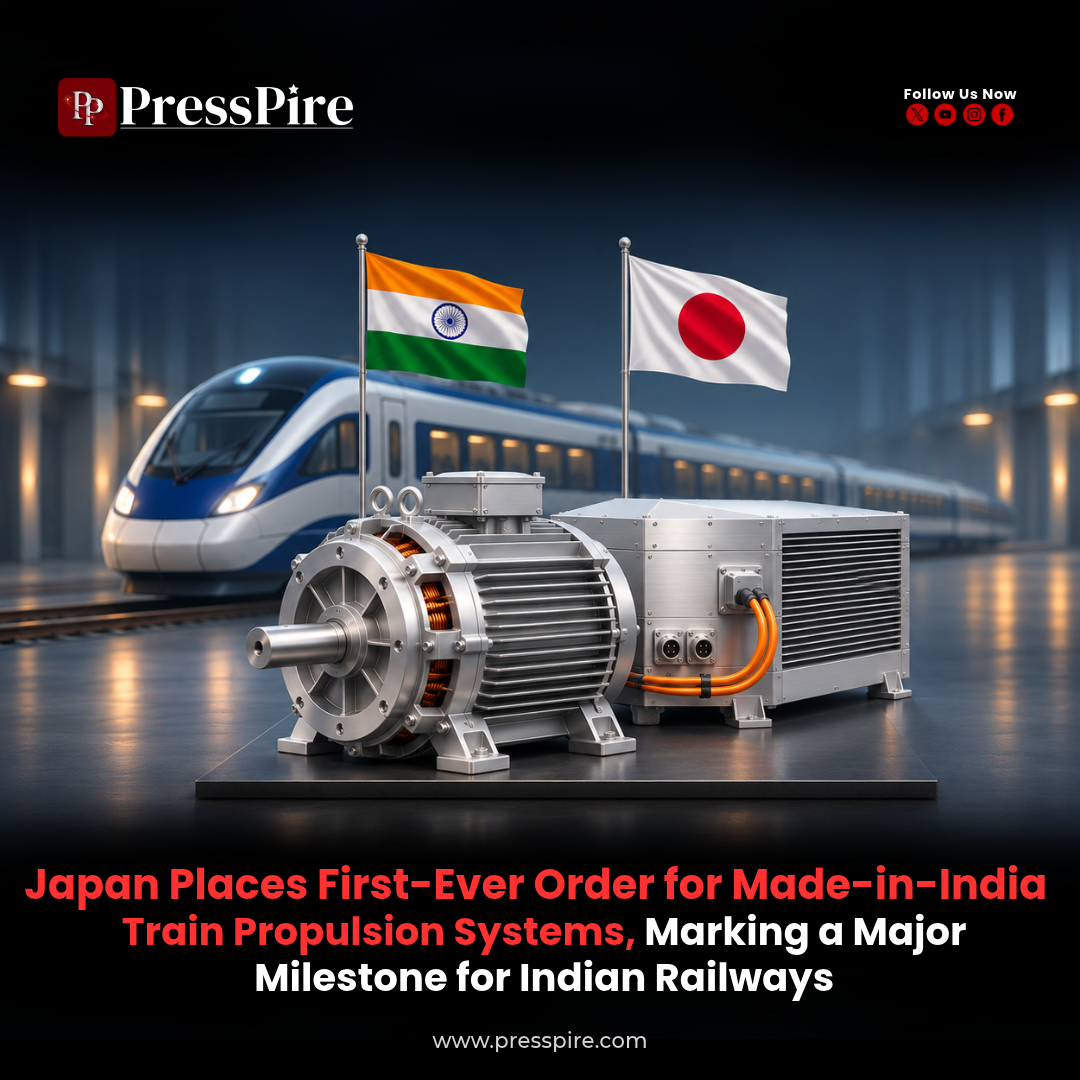
The reported order highlights India’s railway manufacturing capabilities, although the buyer, supplier and commercial terms remain undisclosed.
Japan has placed its first order for train propulsion systems manufactured in India, according to a November 10, 2026, report by The Economic Times. The development points to a new opportunity for India’s railway equipment industry in a country known for its advanced rail technology.
The report describes the equipment as indigenously manufactured electronic propulsion systems. However, it does not identify the Japanese buyer, the Indian supplier, the contract value, the number of systems ordered or the delivery schedule.
Those details will be necessary to assess the order’s commercial scale. Its reported significance lies in opening a market for a critical railway technology that Indian manufacturing facilities already supply internationally.
What Are Train Propulsion Systems?
Train propulsion systems provide and control the power that moves a train. In an electric train, they bring together electrical equipment, control electronics and traction motors to turn electrical energy into mechanical movement.
Their main functions include:
- Power conversion: Converters and inverters prepare electrical power in the form required by the traction motors.
- Controlled movement: Electronic controls regulate motor output to support acceleration and changes in speed.
- Efficient operation: Depending on the design, propulsion equipment can support regenerative braking, which recovers energy when a train slows down.
These systems must work with the train’s electrical supply, mechanical design and operating requirements. Equipment suitable for one railway network may need a different configuration for another.
The precise configuration of the systems reportedly ordered from India has not been disclosed.
Why the Japanese Order Matters
Japan’s established railway industry makes the reported order noteworthy. Supplying propulsion equipment to a Japanese customer could give an Indian manufacturing operation an opportunity to build a commercial relationship in a technically demanding market.
For manufacturers, the potential value extends beyond a single equipment sale. Successful delivery and reliable performance can help establish a supplier’s credentials for future tenders, replacement equipment and maintenance support.
Those opportunities remain potential outcomes. The available reporting does not establish that additional orders, investment or technology partnerships have been agreed.
The immediate development is therefore best understood as a reported export milestone whose longer-term importance will depend on the contract’s scope and execution.
India Already Exports Railway Propulsion Equipment
India’s railway export business predates the reported Japanese order.
In a July 27, 2025, release, the Ministry of Railways said that Alstom’s Maneja unit in Gujarat had exported more than 5,000 propulsion systems for international projects.
The same release described a broader manufacturing base supplying railway products overseas. These included bogies, metro coaches, passenger coaches and locomotives, alongside propulsion equipment.
A separate ministry release dated February 1, 2026, quoted Railway Minister Ashwini Vaishnaw saying that propulsion systems designed and developed in India were being delivered to markets including the United States, Germany, France, Switzerland and Spain.
This background helps explain the significance of the Japan report: it concerns the expansion of an existing export capability into another market.
The “first order” description applies to the reported Japanese purchase of this equipment category. India already has an established record of exporting railway components and vehicles.
Domestic Train Orders Support the Manufacturing Base
Indian Railways’ domestic procurement also illustrates the scale of demand for propulsion technology.
According to a February 2025 Ministry of Railways release, orders for propulsion electrics covering 50 sets of 24-car Vande Bharat Sleeper trains were placed on December 17, 2024.
The allocation covered:
- 33 trainsets for Medha
- 17 trainsets for Alstom
These were domestic procurement orders. Neither company has been identified in the reviewed reports as the supplier for the Japanese transaction.
From a manufacturing perspective, substantial domestic demand can help suppliers develop production capacity, engineering expertise and experience with equipment integration. An export order then creates a separate requirement to meet a customer’s specifications, acceptance procedures and service expectations.
Domestic scale and international sales can complement one another, but each overseas contract must be assessed on its own terms.
How This Relates to Vande Bharat Export Plans
The Economic Times report also referred to Ashwini Vaishnaw’s ambition to export complete, Made-in-India Vande Bharat trains by 2029–30.
That remains a stated export goal. The reported Japanese transaction concerns propulsion equipment and does not establish that Japan has ordered complete Vande Bharat trains or Indian-made bullet trains.
Supplying an important component can nevertheless contribute to the experience manufacturers need for larger international projects. It involves working with overseas customers on technical requirements, delivery and integration.
A complete train contract would involve a broader package of equipment, engineering, testing and support. Progress in component exports provides useful context for that ambition without confirming that complete-train sales have been secured.
Which Details Will Define the Order’s Impact?
The most useful next disclosures would identify the customer and supplier, explain the intended railway application, and provide the order quantity and delivery schedule.
The equipment’s destination also matters. A purchase by a Japanese company does not, by itself, establish which railway network or train fleet will ultimately use it.
For India’s railway manufacturing industry, the commercial opportunity will become clearer as those details emerge. Delivery, customer acceptance and performance in service will determine whether the reported first order develops into a lasting export relationship.
For more insights navigate: PressPire | Stories That Shape the Future
Read previous article here : sarvam-ai-sashikumar-sreedharan-president-cbo/
Follow PressPire on Facebook | Instagram | LinkedIn | YouTube
PressPire | Stories That Shape the Future