
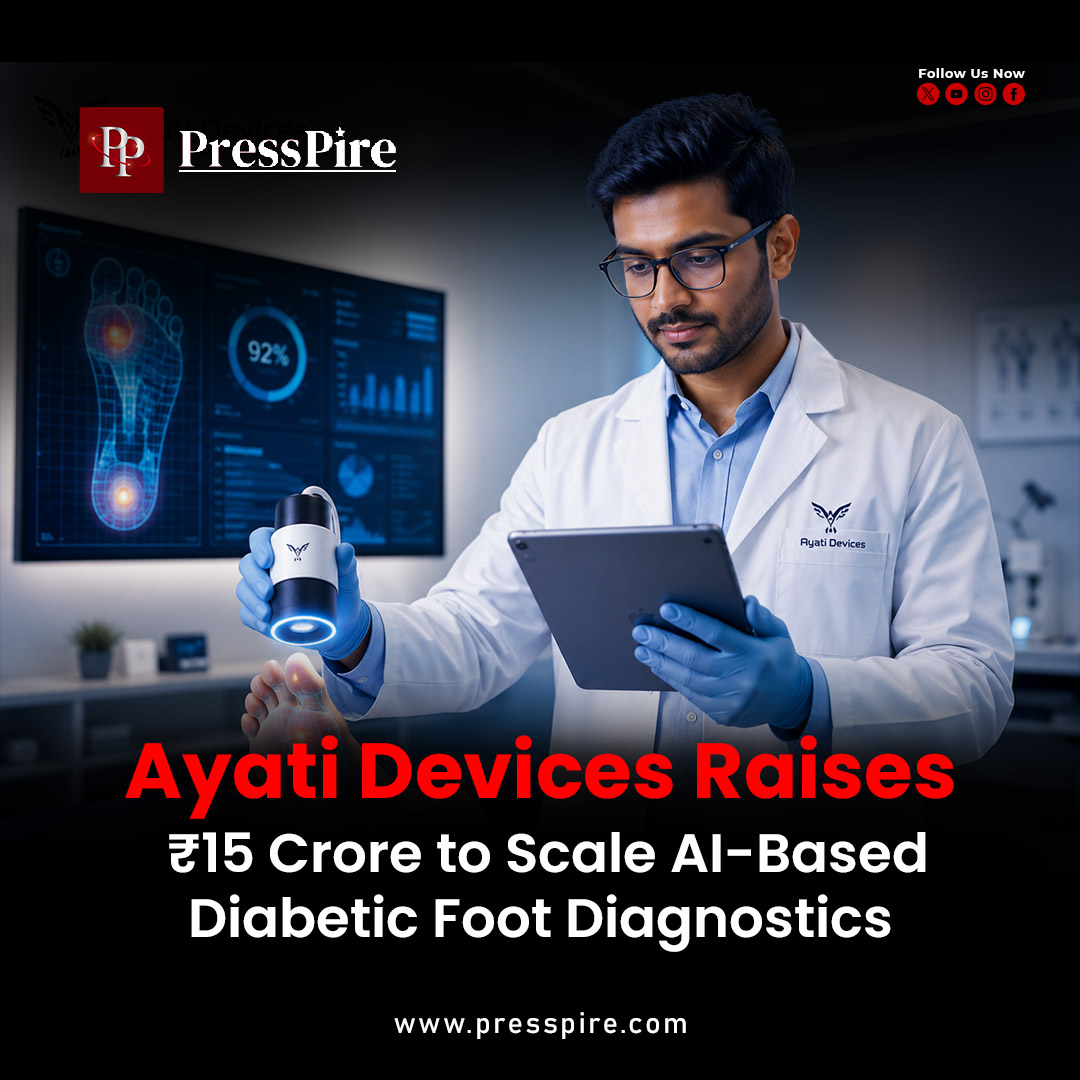
Ayati Devices Raises ₹15 Crore to Scale AI-Based Diabetic Foot Diagnostics
Ayati Devices has raised ₹15 crore in a Pre-Series A funding round led by Inflexor Ventures to scale AI-enabled diabetic foot diagnostics. The Bengaluru-based medtech startup plans to strengthen manufacturing, expand globally, commercialise its diagnostic portfolio and accelerate research into artificial intelligence-powered healthcare solutions.
Ayati Devices Raises ₹15 Crore in Funding
Ayati Devices has raised ₹15 crore in a Pre-Series A funding round led by Inflexor Ventures, marking a significant step in the Bengaluru-based medical technology company’s journey to make early diabetic foot screening more accessible. The investment is the company’s first institutional funding and arrives at a time when healthcare providers are increasingly looking for portable, objective and technology-driven diagnostic solutions. Founded in 2019 by Nishant Kathpal, Ayati Devices develops medical technologies focused on diabetic foot complications and peripheral vascular disease. The company has been incubated at IIT Bombay’s Society for Innovation and Entrepreneurship (SINE), giving its journey a strong foundation in engineering-led healthcare innovation. According to reports, the new capital will support commercialisation, manufacturing expansion, international market entry, research and development, regulatory approvals and further investment in artificial intelligence.
The funding is important not simply because of the amount involved, but because of what it represents for India’s medtech ecosystem. Medical devices often require years of product development, clinical validation, regulatory work and market-building before they can achieve meaningful scale. Ayati’s latest round provides the company with capital to move from product development and early commercial adoption towards a larger global expansion phase. For a healthcare problem that is frequently detected only after serious complications emerge, that shift could have considerable significance.
Why Diabetic Foot Screening Matters
Diabetic foot complications can develop quietly. Peripheral neuropathy can reduce sensation, while poor blood circulation can compromise tissue health and healing. A small wound that might otherwise be noticed quickly can therefore become a serious problem when protective sensation is reduced or blood flow is impaired. Research published in the Journal of Foot and Ankle Research notes that diabetic peripheral neuropathy is an important risk factor for diabetic foot ulcers and amputations, while also highlighting the need for regular screening.
This is where early diagnostic technology becomes particularly valuable. Instead of waiting until a patient develops an ulcer or requires specialist intervention, screening can help clinicians identify risk earlier. Ayati Devices has built its product strategy around this preventive approach. Its technologies are designed to bring assessments that traditionally required specialised equipment closer to primary-care centres, diabetes clinics, hospitals and community screening programmes. The company’s portfolio now addresses several dimensions of diabetic foot health, including neuropathy, vascular status, microcirculation and plantar pressure.
AI Diabetic Foot Diagnostics Gain Momentum
Artificial intelligence is becoming an increasingly important part of medical diagnostics, but its value depends on the quality of the underlying clinical data and the ability to translate technology into practical healthcare workflows. Ayati Devices’ latest funding is expected to accelerate research and development in AI-enabled diagnostics while supporting the company’s broader diagnostic platform. The company is not positioning AI as a replacement for clinicians; rather, its technology is aimed at generating objective measurements and helping healthcare professionals identify potential risks more efficiently.
Its existing products demonstrate this practical philosophy. Vibrasense, for example, measures vibration perception threshold to support quantitative assessment of large-fibre neuropathy. The portable device is designed for point-of-care use and can transfer data wirelessly for digital reporting. A published clinical study involving 562 people with type 2 diabetes found a strong positive correlation between Vibrasense measurements and standard biothesiometer values, supporting its potential as a screening tool for diabetic peripheral neuropathy.
The company’s newer AI-enabled direction could build on this foundation by combining diagnostic measurements, digital workflows and intelligent analysis. The goal is straightforward: make diabetic foot screening faster, more objective and easier to deploy at scale.
Ayati Devices Builds a Complete Diagnostic Platform
Ayati Devices is moving beyond a single-device approach. Its broader Ayati Foot Labs platform brings multiple areas of foot-health assessment into one ecosystem, including neuropathy assessment, blood-flow evaluation, microcirculation imaging and plantar-pressure analysis. This approach is important because diabetic foot risk rarely comes from one isolated factor. Nerve damage, vascular problems and tissue-level changes can interact, making a broader clinical picture useful for decision-making.
The company’s portfolio includes Vibrasense for quantitative vibration testing and Vibrasense+T, which adds warm and cold perception testing to assess both large- and small-fibre function. Vasosense is designed for peripheral artery disease assessment, while Angiocam provides real-time tissue-perfusion imaging. Ayati also offers the PODIA Trolley, built around a pay-per-test screening model that can reduce the upfront capital burden for healthcare providers.
The strategy reflects a larger shift in healthcare technology: advanced diagnostics do not necessarily need to remain confined to large tertiary hospitals. Portable equipment, digital reporting and flexible payment models can potentially bring specialised screening closer to patients.
Funding to Accelerate Global Expansion
The ₹15 crore funding gives Ayati Devices an opportunity to scale both its products and its international footprint. The company plans to strengthen manufacturing and supply-chain capabilities while expanding its go-to-market operations in India and overseas. It also intends to invest in additional regulatory approvals, intellectual property, engineering, clinical and regulatory teams, and global business development.
Ayati says its technologies have already been deployed across more than 30 countries, with more than 10,000 devices in the field. Its regulatory footprint includes clearances or approvals across markets such as India, the United States, Europe, Sri Lanka, Malaysia and the UAE. The company is now looking to deepen its presence across Europe, the US, the Middle East, Southeast Asia, Australia and Latin America.
The international ambition is significant for an Indian medical-device startup. Global healthcare markets demand more than good technology; they require regulatory compliance, manufacturing reliability, clinical evidence, distribution networks and local partnerships. The fresh capital is therefore likely to be as much about building organisational capacity as it is about developing new technology.
From IIT Bombay to Global Healthcare
The story of Ayati Devices began with an engineering-led attempt to solve a real healthcare problem. The company was incorporated in 2019, and its work has been linked closely with IIT Bombay’s innovation ecosystem. Its founder, Nishant Kathpal, developed the idea around diabetic foot screening after encountering the problem through an engineering programme and subsequently discovering its impact within his own family.
That origin story helps explain the company’s emphasis on practical medical devices rather than technology for technology’s sake. Ayati has focused on making diagnostic tools portable, quantitative and suitable for everyday clinical environments. Its Vibrasense platform, for instance, was developed to address some of the limitations associated with conventional biothesiometry, including portability and workflow convenience. A peer-reviewed study found a strong correlation between Vibrasense and standard biothesiometer measurements, adding clinical evidence to the product’s development journey.
The company has also moved into tissue-perfusion imaging through Angiocam. India’s Department of Biotechnology has highlighted Angiocam as a non-invasive laser-based medical device for early screening of diabetic foot complications, while noting its application at AIIMS Delhi.
The Road Ahead for Ayati Devices
The next phase for Ayati Devices will be about execution. Raising capital can accelerate a company’s ambitions, but healthcare startups must translate investment into clinical adoption, regulatory progress, manufacturing scale and sustainable distribution. Ayati’s immediate priorities include commercialising Angiocam, expanding its manufacturing base, increasing AI research and widening its international reach.
The company also plans to expand its pay-per-test screening model across hospitals, primary-care clinics and community healthcare programmes. This could prove especially important in markets where smaller healthcare facilities cannot justify substantial upfront spending on specialised diagnostic equipment. By shifting towards usage-based screening, Ayati can potentially make advanced diagnostics more accessible while creating a broader pathway for adoption.
Its challenge will be to maintain clinical quality while scaling rapidly. Medical diagnostics cannot be judged only by speed or convenience. Accuracy, evidence, regulatory compliance and clinician trust remain central to adoption. If Ayati can successfully balance those requirements with affordability and scale, its model could become an example of how Indian medtech companies can develop products for both domestic and international healthcare markets.
Why This Funding Matters for Indian MedTech
Ayati Devices’ ₹15 crore funding is more than another startup investment. It reflects the growing confidence in Indian medical-device innovation and in technologies designed to shift healthcare from late intervention towards earlier detection. Inflexor Ventures’ investment gives Ayati the resources to strengthen a product portfolio that already spans neuropathy, vascular assessment and tissue perfusion while accelerating its move into AI-enabled diagnostics.
For patients living with diabetes, the larger significance lies in accessibility. A sophisticated diagnostic tool matters only when it reaches the people who need it. By combining portable devices, digital reporting, broader diagnostic coverage and pay-per-test models, Ayati Devices is attempting to make diabetic foot screening part of routine preventive care rather than something that happens only after complications become visible.
As the company expands across India and international markets, the real measure of this ₹15 crore investment will be how many patients can be screened earlier, how effectively clinicians can act on the resulting information, and whether technology can help prevent avoidable complications. For India’s growing medtech sector, that is a meaningful ambition — and one worth watching closely.
For more insights navigate: PressPire | Stories That Shape the Future
Read previous article here: https://presspire.com/swiggy/
Follow PressPire on Facebook | Instagram | LinkedIn | YouTube
PressPire | Stories That Shape the Future