
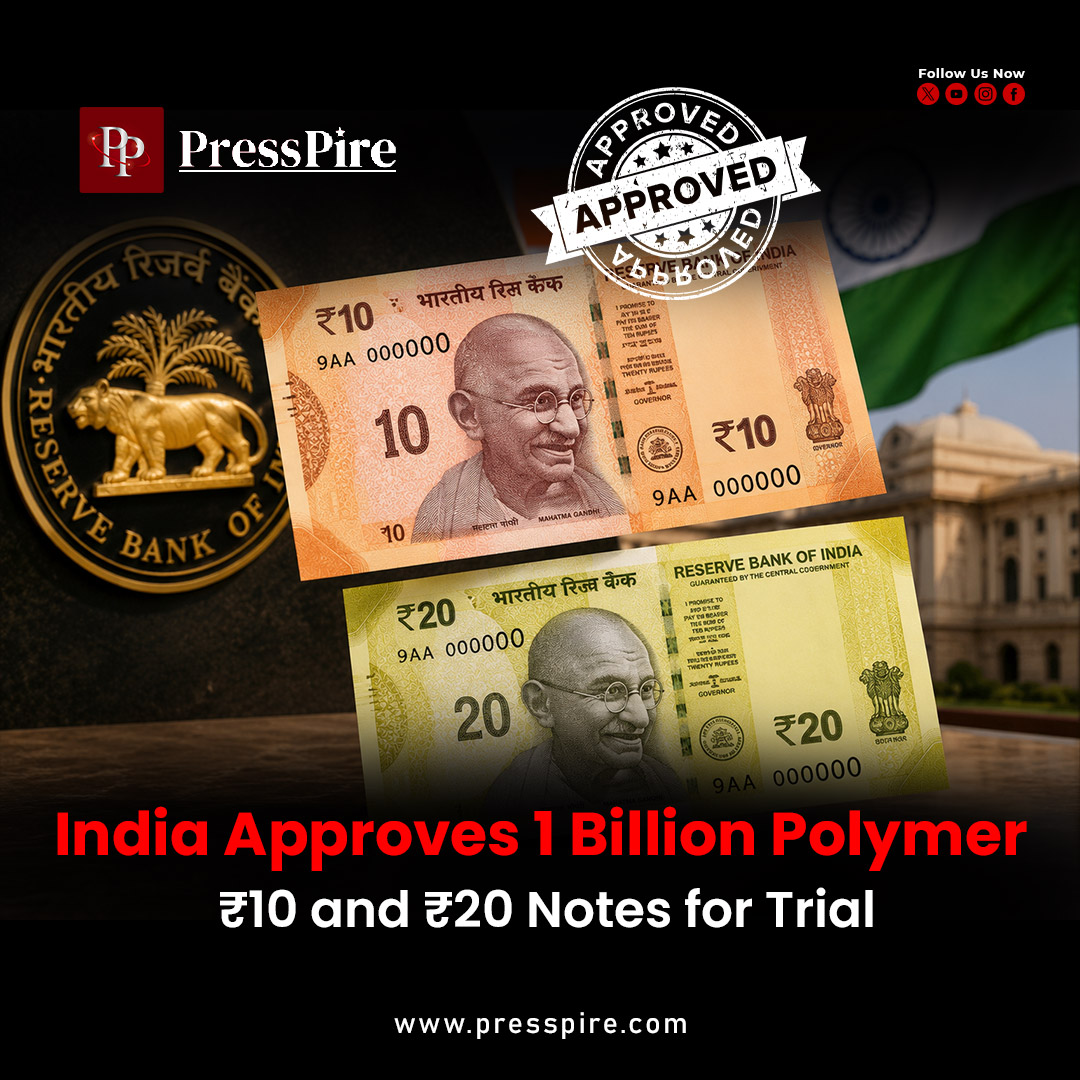
India Approves 1 Billion Polymer ₹10 and ₹20 Notes for Trial
India approves 2 billion polymer ₹10 and ₹20 notes for field trials. Know why RBI is testing polymer currency, its benefits, costs and future.
India Approves Polymer ₹10 and ₹20 Notes
India is taking another step toward modernising its physical currency system. The government has approved the Reserve Bank of India’s proposal to conduct field trials of polymer ₹10 and ₹20 notes, with one billion pieces of each denomination planned for the exercise. That means the trial could involve 2 billion polymer banknotes in total, representing a combined face value of ₹3,000 crore.
The announcement is significant because ₹10 and ₹20 notes are among the denominations that experience frequent handling in everyday transactions. They move through shops, public transport, small businesses, markets and households repeatedly, which can leave conventional paper notes worn, dirty or damaged relatively quickly. The RBI is therefore exploring whether polymer currency can provide a longer-lasting alternative.
However, this is not a decision to eliminate paper currency. The government has specifically clarified that there is no proposal to replace existing paper banknotes with polymer notes. Instead, polymer notes would initially be tested alongside paper currency, with wider issuance dependent on the outcome of the field trials.
Why RBI Is Testing Polymer Banknotes
The biggest reason behind the polymer ₹10 and ₹20 notes trial is durability. Unlike conventional Indian banknote paper, which is made from cotton, polymer banknotes use a synthetic substrate designed to withstand greater exposure to moisture, dirt and repeated handling. RBI information confirms that the paper currently used for Indian banknotes is made from 100% cotton.
For lower-value denominations, durability matters because these notes often change hands more frequently than higher-value currency. A ₹10 or ₹20 note may pass through dozens of transactions before eventually becoming too worn for circulation. Every damaged note must then be withdrawn, transported and replaced, creating an ongoing operational requirement for the currency management system.
Polymer currency is already used in several countries because of its longer usable life and resistance to everyday wear. The Indian trial will allow the RBI to examine whether those advantages can be achieved effectively within India’s enormous and diverse cash economy. It is also an opportunity to assess how polymer notes perform under different weather conditions and patterns of use.
Polymer ₹10 and ₹20 Notes Could Last Longer
One of the strongest arguments for polymer ₹10 and ₹20 notes is their potential to remain in circulation longer than traditional paper notes. International experience suggests polymer banknotes can have substantially longer lifespans, although the actual advantage depends on denomination, handling conditions, printing technology and circulation patterns. The government has cited international studies showing that polymer banknotes have a significantly higher lifespan than paper notes.
That longer lifespan could have practical consequences for India’s currency management system. If a note remains usable for longer, the frequency of replacement may decline. This could reduce the repeated costs associated with printing, sorting, transporting and destroying soiled banknotes.
The benefit could be particularly relevant for ₹10 and ₹20 notes because they are used heavily in everyday transactions. A durable note that survives longer could reduce the pressure on currency-printing operations while keeping small-denomination cash available for consumers who still depend on physical money.
Yet durability alone will not determine the success of the experiment. The RBI will need to examine production costs, compatibility with currency-processing machines, public acceptance, security performance and the practical experience of banks, retailers and consumers.
How Polymer Notes May Improve Security
The move toward polymer banknotes in India is also closely connected with the continuing need to strengthen currency security. Modern polymer notes can incorporate features such as transparent windows, specialised markings and other security elements that are difficult to reproduce using conventional printing techniques.
This does not mean polymer currency is automatically impossible to counterfeit. Security technology constantly evolves, and counterfeiters also adapt. However, polymer substrates can provide additional design possibilities that may make authentication easier for the public and financial institutions.
India already uses multiple security features in its current Mahatma Gandhi Series notes, including watermarks, security threads, micro-lettering and other elements. The polymer trial could therefore represent an additional layer in the country’s broader approach to currency security rather than a complete replacement of existing safeguards.
For consumers, the most important question will ultimately be simple: can an ordinary person quickly recognise whether a note is genuine? The success of any new currency design depends not only on sophisticated technology but also on practical usability.
India Has Tried Polymer Currency Before
India’s latest polymer ₹10 and ₹20 notes proposal is not the country’s first experiment with plastic currency. More than a decade ago, the government and RBI considered polymer notes as a way to extend the life of lower denominations.
In 2013, the government informed Parliament that a field trial involving one billion ₹10 polymer or plastic notes had been planned across Kochi, Mysore, Jaipur, Bhubaneswar and Shimla. These cities were selected to represent different geographical and climatic conditions.
The earlier initiative did not result in a nationwide rollout. The idea remained under consideration as India continued using cotton-based paper currency. The renewed proposal shows that the question of whether polymer notes are suitable for India has remained relevant despite the rapid growth of digital payments.
This time, however, the scale is much larger, with both ₹10 and ₹20 denominations included in the proposed trial. The RBI’s approach also reflects a more cautious strategy: test the notes in real-world conditions first and make decisions about regular issuance only after assessing the results.
Paper and Polymer Notes Will Coexist
A common misunderstanding surrounding the announcement is that India is preparing to make paper currency obsolete. That is not the government’s position. The approved plan is for polymer ₹10 and ₹20 notes to be introduced on a trial basis while paper-based banknotes continue to circulate.
The government has explicitly stated that there is currently no proposal to replace paper currency with polymer-based notes. If the field trials are successful, polymer notes could receive regular issuance in these denominations, but that would still mean coexistence rather than an immediate nationwide replacement of paper money.
This distinction matters because cash remains an important part of India’s economy even as digital payments continue to expand. Millions of people still use physical currency for small purchases, local transport, street commerce and everyday transactions.
The polymer experiment should therefore be viewed as an attempt to improve the physical cash system, not as a reversal of India’s digital-payment transformation. India can have a growing digital economy while continuing to improve the quality and efficiency of its physical currency.
What the Polymer Notes Trial Will Test
The field trial of polymer ₹10 and ₹20 notes will be about much more than simply putting plastic notes into circulation. The RBI will have to evaluate how the notes behave in real-world conditions and whether the expected benefits justify the changes required to produce and manage them.
Important areas will include durability, resistance to moisture and dirt, printing quality, security features, machine compatibility, public acceptance and the overall cost of production and circulation. The notes will also need to work efficiently with banking infrastructure that currently handles paper currency.
The procurement process has already moved forward. Bharatiya Reserve Bank Note Mudran Private Limited, the RBI’s currency-printing subsidiary, issued a global expression of interest in July for polymer substrate material. The proposed material includes specialised security elements and is intended for use in producing the trial currency.
This procurement stage is an important indication that the proposal has moved beyond a purely conceptual discussion. The actual field experience will ultimately determine whether polymer currency becomes a permanent part of India’s monetary landscape.
When Could Polymer Notes Reach India
The question now attracting public attention is when people might actually see polymer ₹10 and ₹20 notes in circulation. RBI Governor Sanjay Malhotra has indicated that polymer banknotes could enter circulation around the beginning of FY28, although the precise rollout schedule depends on preparations and the field-trial process.
That timeline should not be interpreted as a guaranteed nationwide launch. The approved proposal is primarily for field testing, and regular issuance is linked to successful completion of the trials. The RBI must first establish whether the notes work efficiently across India’s diverse cash environment.
The transition will also require coordination between currency printers, banks, cash-handling systems, retailers and the wider financial ecosystem. Even a seemingly simple change in the material used for a banknote can have significant logistical implications when billions of pieces are involved.
For consumers, the eventual arrival of polymer notes is likely to be gradual. Paper and polymer versions could circulate together, allowing the RBI to compare their performance before making broader decisions.
What Polymer ₹10 and ₹20 Notes Mean for Cash
The introduction of polymer ₹10 and ₹20 notes could become an important experiment in the future of physical cash in India. The country has rapidly embraced UPI, mobile banking and other digital payment systems, yet cash has not disappeared. Instead, both systems continue to serve different needs.
For small businesses and consumers, durable low-value notes could make everyday cash handling more convenient. For the banking system, longer-lasting notes could potentially reduce the frequency with which worn currency needs to be removed and replaced.
There is also a broader sustainability question. Polymer notes are not automatically environmentally superior in every circumstance because their production involves synthetic materials. Their overall environmental impact depends on manufacturing, transport, lifespan and end-of-life recycling. That means India’s trial will need to consider the complete lifecycle of the notes rather than focusing only on their durability.
The experiment could therefore provide useful evidence for future decisions about currency design, production and management.
The Future of Polymer Banknotes in India
The approval of polymer ₹10 and ₹20 notes marks a cautious but notable development in India’s currency journey. The government has authorised a large field trial, with one billion ₹10 notes and one billion ₹20 notes proposed, but it has stopped short of announcing a complete shift away from paper currency.
The real test will begin when these notes encounter everyday India — crowded markets, humid weather, busy cash counters, automated machines, small retailers and millions of ordinary transactions. That is where the theoretical advantages of polymer currency will meet reality.
If the notes prove durable, secure, practical and economically viable, the experiment could eventually influence how India produces its lower-denomination currency. If the challenges outweigh the benefits, the country may continue relying primarily on its existing paper-based system.
For now, the message is clear: India is testing polymer currency, not replacing paper money. The ₹10 and ₹20 trial will offer the RBI a valuable opportunity to determine whether plastic-based banknotes can become a durable part of India’s increasingly modern yet still cash-dependent economy.
For more insights navigate: PressPire | Stories That Shape the Future
Read previous article here: https://presspire.com/blinkit-mumbai-fda/
Follow PressPire on Facebook | Instagram | LinkedIn | YouTube
PressPire | Stories That Shape the Future