
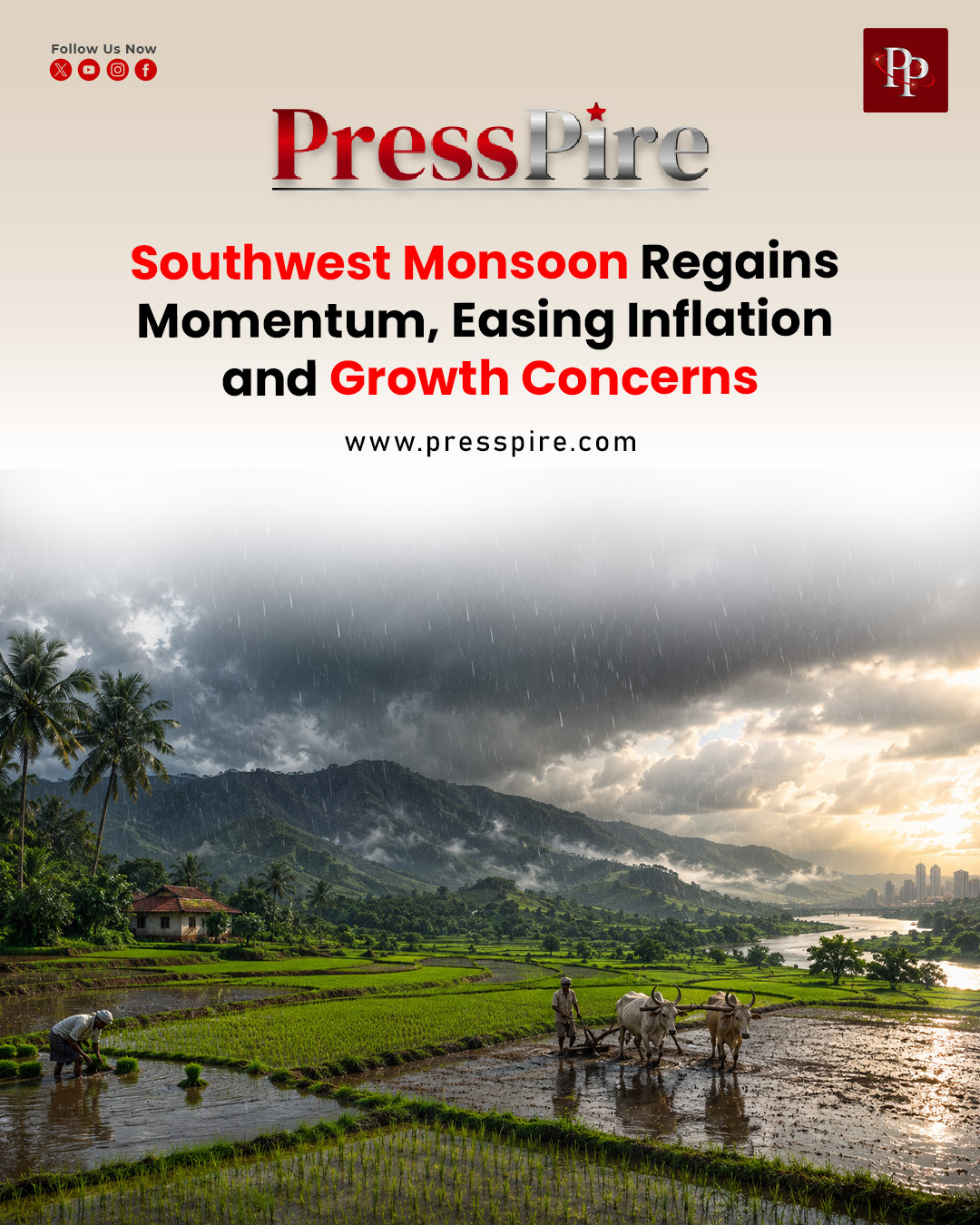
Southwest Monsoon Regains Momentum, Easing Inflation and Growth Concerns Across India
Southwest Monsoon regains momentum across India, improving kharif sowing, easing inflation concerns, and strengthening India’s economic growth outlook in 2026. The government has expanded the use of satellite monitoring, digital weather forecasting, and crop advisory services to help farmers make informed decisions. Mobile-based weather alerts and precision agriculture technologies are also becoming increasingly important in reducing weather-related risks and improving farm productivity.
Southwest Monsoon Regains Momentum, Bringing Relief to India’s Economy
After weeks of uncertainty over patchy rainfall and delayed precipitation across several regions, the Southwest Monsoon regains momentum, offering renewed optimism for India’s agriculture sector, inflation outlook, and overall economic growth. The revival comes at a crucial time when concerns over food prices, rural demand, and kharif sowing had begun weighing on policymakers and financial markets.
India’s southwest monsoon contributes nearly 70% of the country’s annual rainfall and remains one of the most influential drivers of the nation’s economy. More than half of India’s agricultural land depends directly on monsoon rains, making every phase of the season closely watched by farmers, businesses, economists, and the Reserve Bank of India (RBI).
Recent rainfall activity has significantly improved soil moisture levels in several agricultural states, helping farmers accelerate sowing operations after an earlier slowdown. While rainfall distribution continues to vary across regions, the revival has reduced immediate fears of widespread crop stress and supply shortages. Experts, however, caution that consistent rainfall through the remainder of the season will be essential to sustain agricultural productivity and stabilize food prices.
Southwest Monsoon Regains Momentum Boosting Kharif Crop Sowing
The renewed strength of the southwest monsoon has arrived during the critical sowing window for India’s kharif crops. Farmers cultivating rice, soybean, cotton, maize, pulses, and sugarcane have resumed planting activities across several states after waiting for sufficient rainfall.
Agricultural economists believe improved rainfall will help raise acreage under major food grains and oilseeds, supporting better production during the harvest season. Increased cultivation is expected to strengthen domestic food supplies and reduce the risk of shortages that often trigger inflation.
States including Madhya Pradesh, Maharashtra, Gujarat, Rajasthan, Uttar Pradesh, and parts of central India have witnessed improved rainfall, encouraging farmers to complete sowing before the optimum agricultural window closes.
A stronger monsoon also replenishes groundwater reserves, fills reservoirs, and improves irrigation availability for subsequent crop cycles. This creates a multiplier effect extending beyond agriculture into rural employment, farm incomes, and consumption demand.
The Indian Meteorological Department has continued monitoring rainfall distribution closely, noting that although overall monsoon activity has strengthened, regional disparities still exist. Some districts remain rainfall-deficient, highlighting the importance of sustained precipitation during the coming weeks.
Southwest Monsoon Regains Momentum, Helping Ease Food Inflation in India
One of the most significant economic implications as the Southwest Monsoon regains momentum is its potential to moderate food inflation, a key concern for both policymakers and consumers. Adequate rainfall directly supports higher agricultural output, increasing the supply of essential food commodities such as rice, pulses, vegetables, fruits, and oilseeds. As production improves, market availability rises, helping stabilize prices and reducing inflationary pressure.
Food inflation has remained one of the largest contributors to India’s retail inflation in recent years. Erratic weather patterns, heatwaves, and uneven rainfall have frequently disrupted crop production, resulting in supply shortages and volatile prices. A healthy monsoon can reverse this trend by ensuring better crop yields and smoother movement of agricultural produce through the supply chain.
Economists suggest that if rainfall remains close to the long-period average during the remainder of the season, the Reserve Bank of India (RBI) could find additional room to maintain an accommodative monetary stance. Lower food inflation also supports household purchasing power, enabling consumers to spend more on discretionary goods and services, which in turn stimulates broader economic activity.
The improved rainfall outlook is also expected to reduce dependence on irrigation-intensive farming in many regions, lowering cultivation costs for farmers. Better water availability decreases the need for expensive groundwater pumping and diesel-powered irrigation, improving farm profitability and strengthening rural incomes.
Additionally, healthy reservoir levels resulting from sustained rainfall support hydroelectric power generation and ensure sufficient water availability for industrial use and urban consumption. These indirect benefits contribute to greater macroeconomic stability, making the monsoon a critical driver of India’s overall economic performance.
Financial markets have responded positively to improving monsoon conditions. Investors generally view a normal or above-normal monsoon as supportive for sectors such as agriculture, fertilizers, rural banking, fast-moving consumer goods (FMCG), tractors, agrochemicals, and consumer durables. Stronger rural demand often translates into higher sales for companies serving India’s vast agricultural economy.
Southwest Monsoon Regains Momentum Strengthening India’s Economic Growth Outlook
As the Southwest Monsoon regains momentum, economists believe India’s growth prospects for the current financial year have become more resilient. Agriculture continues to employ a substantial portion of the country’s workforce, and higher farm incomes typically generate a ripple effect across multiple industries.
When farmers experience better harvests, rural households tend to increase spending on consumer goods, construction materials, farm machinery, automobiles, education, healthcare, and financial services. This rise in consumption supports manufacturing, retail, logistics, and service sectors, contributing to stronger GDP growth.
Improved agricultural production also enhances export opportunities for commodities such as rice, spices, sugar, and cotton, strengthening India’s trade position while supporting foreign exchange earnings. At the same time, reduced reliance on imports of edible oils and certain food commodities can help improve the country’s current account balance.
Government finances may also benefit from a productive monsoon season. Lower food inflation reduces the fiscal burden associated with food subsidies and emergency market interventions, while stronger rural incomes increase tax collections through higher economic activity.
Despite the encouraging outlook, experts caution that weather risks have not disappeared. Climate change continues to make rainfall patterns more unpredictable, with the possibility of localized floods, dry spells, or extreme weather events affecting crop quality and yields. Continuous monitoring of rainfall distribution and proactive policy measures will therefore remain essential to ensure that the monsoon’s revival translates into sustained agricultural and economic gains.
The coming weeks will be crucial in determining whether the renewed momentum of the southwest monsoon can deliver a strong harvest season and reinforce India’s position as one of the world’s fastest-growing major economies.
Southwest Monsoon Regains Momentum: Challenges That Still Need Close Monitoring
While the fact that the Southwest Monsoon regains momentum has significantly improved India’s agricultural and economic outlook, experts caution against assuming that the season is now free of risks. The distribution of rainfall over the next several weeks will determine whether the positive momentum translates into a bumper harvest or whether localized weather disruptions offset some of the gains.
Meteorologists point out that a “normal” monsoon at the national level does not necessarily guarantee adequate rainfall across every district. India has witnessed several monsoon seasons where overall rainfall remained near average, but uneven regional distribution led to drought-like conditions in some areas and floods in others. Such disparities can affect crop productivity, transportation, and food supply chains.
Climate scientists also continue to warn that rising global temperatures are increasing the frequency of extreme weather events. Heavy cloudbursts, prolonged dry spells, flash floods, and unusually intense rainfall can damage standing crops even during an otherwise healthy monsoon season. These climate-related challenges have reinforced the need for improved irrigation infrastructure, water conservation, crop diversification, and better weather forecasting systems.
The government has expanded the use of satellite monitoring, digital weather forecasting, and crop advisory services to help farmers make informed decisions. Mobile-based weather alerts and precision agriculture technologies are also becoming increasingly important in reducing weather-related risks and improving farm productivity.
In addition, sectors beyond agriculture including power generation, logistics, transportation, and water resource management—will continue monitoring reservoir levels and rainfall patterns. Healthy water storage not only benefits irrigation but also supports hydroelectric power production and ensures adequate drinking water supplies for urban and rural populations.
Southwest Monsoon Regains Momentum: A Positive Signal for India’s Economy
The revival of the southwest monsoon has arrived at a critical juncture for India’s economy. Stronger rainfall is expected to support kharif crop sowing, moderate food inflation, strengthen rural consumption, and improve the country’s overall growth trajectory during the current financial year.
If favourable weather conditions persist through the remainder of the season, India could witness improved agricultural output, higher farm incomes, stronger consumer spending, and greater macroeconomic stability. These developments would also provide policymakers with additional confidence in managing inflation while supporting economic expansion.
However, sustained vigilance remains essential. The ultimate success of this year’s monsoon will depend not only on the total rainfall received but also on its geographical distribution and timing during the crucial crop-growing months.
For businesses, investors, and policymakers alike, the renewed momentum of the southwest monsoon represents more than a weather event—it is a key economic indicator capable of influencing inflation, monetary policy, rural demand, corporate earnings, and India’s GDP growth.
As millions of farmers continue sowing operations across the country, the coming weeks will shape the agricultural season and determine how effectively the monsoon translates into stronger food security and long-term economic resilience. A well-distributed and sustained monsoon could ultimately become one of the strongest pillars supporting India’s growth story in 2026.
Southwest Monsoon Regains Momentum: Impact on Rural Consumption and Key Industries
As the Southwest Monsoon regains momentum, its impact extends well beyond agriculture, creating positive ripple effects across India’s rural economy and multiple industries. Higher farm incomes typically lead to increased spending on consumer goods, tractors, two-wheelers, fertilizers, seeds, agrochemicals, and household appliances. Companies in the fast-moving consumer goods (FMCG) sector also benefit from stronger rural demand, as improved purchasing power encourages higher consumption in villages and small towns. This cycle of increased agricultural income and consumer spending supports manufacturing, logistics, retail, and financial services, making the southwest monsoon a vital contributor to India’s broader economic growth.
Industry experts believe that a healthy monsoon season also strengthens investor confidence in sectors closely linked to rural markets. Banks and non-banking financial companies (NBFCs) often witness higher demand for agricultural and rural loans, while insurance companies benefit from increased crop insurance coverage. Better reservoir levels also improve water availability for industries and hydroelectric power generation, reducing operational risks during the year. As the Southwest Monsoon regains momentum, the positive sentiment across agriculture, industry, and financial markets reinforces expectations of stable economic expansion and sustainable rural development.
Southwest Monsoon Regains Momentum: Government Preparedness and Weather Outlook
The Indian government and weather agencies continue to closely monitor rainfall patterns as the Southwest Monsoon regains momentum across the country. The India Meteorological Department (IMD) has been issuing regular forecasts, district-level rainfall updates, and early weather warnings to help farmers plan sowing, irrigation, and harvesting activities more effectively. Alongside weather forecasting, state governments have enhanced crop advisory services, promoted water conservation initiatives, and strengthened disaster preparedness to minimize the impact of localized floods or prolonged dry spells. These measures aim to ensure that the benefits of improved rainfall translate into higher agricultural productivity and stronger food security.
Southwest Monsoon Regains Momentum: Why It Matters for India’s Agricultural Economy
The Southwest Monsoon regains momentum at a crucial stage for India’s agricultural economy, where timely rainfall determines crop productivity, farm incomes, and food security. Nearly half of India’s cultivated land remains dependent on monsoon rainfall, making the Southwest Monsoon in India one of the most important natural drivers of economic activity. Improved rainfall during the kharif sowing season enables farmers to cultivate major crops such as rice, maize, soybean, pulses, cotton, sugarcane, and oilseeds with greater confidence. A successful agricultural season not only increases crop production but also strengthens rural employment, boosts farm income, and enhances the overall resilience of India’s food supply chain. As the Southwest Monsoon regains momentum, expectations of a healthy harvest continue to improve, providing optimism for farmers, agribusinesses, and policymakers alike.
Southwest Monsoon Regains Momentum: Positive Outlook for Inflation, GDP Growth and Rural Demand
A sustained revival of the Southwest Monsoon regains momentum is expected to support India’s broader macroeconomic indicators by easing food price inflation, improving agricultural output, and stimulating rural demand. Better crop production increases the availability of food grains, vegetables, fruits, and pulses, helping stabilize retail prices and reducing inflationary pressure. This favourable inflation outlook also provides greater flexibility for monetary policymakers while supporting consumer spending across urban and rural markets. Higher agricultural incomes typically translate into increased demand for tractors, farm equipment, consumer goods, housing materials, automobiles, and financial services. Economists therefore view a healthy monsoon rainfall season as one of the strongest contributors to India’s GDP growth, strengthening both domestic consumption and long-term economic stability.
Southwest Monsoon Regains Momentum: IMD Forecast, Climate Resilience and Future Prospects
According to the latest IMD weather forecast, the strengthening of the Southwest Monsoon regains momentum is expected to bring further rainfall across several parts of the country, supporting reservoir replenishment and improving water availability for agriculture and industry. However, experts continue to monitor rainfall distribution, as uneven precipitation caused by climate change and monsoon variability can still impact crop yields in specific regions. Governments are increasingly investing in irrigation infrastructure, water conservation projects, digital weather forecasting, and climate-resilient farming techniques to reduce weather-related risks. If favourable weather conditions continue through the remainder of the season, the Southwest Monsoon in India could play a pivotal role in supporting agricultural growth, strengthening the rural economy, ensuring food security, and maintaining a positive economic outlook for the country.
For more insights navigate: PressPire | Stories That Shape the Future
Read previous article here: Strait Of Hormuz Tensions Ease: What It Means For India’s Energy Security
Follow PressPire on Facebook | Instagram | LinkedIn | YouTube
PressPire | Stories That Shape the Future