
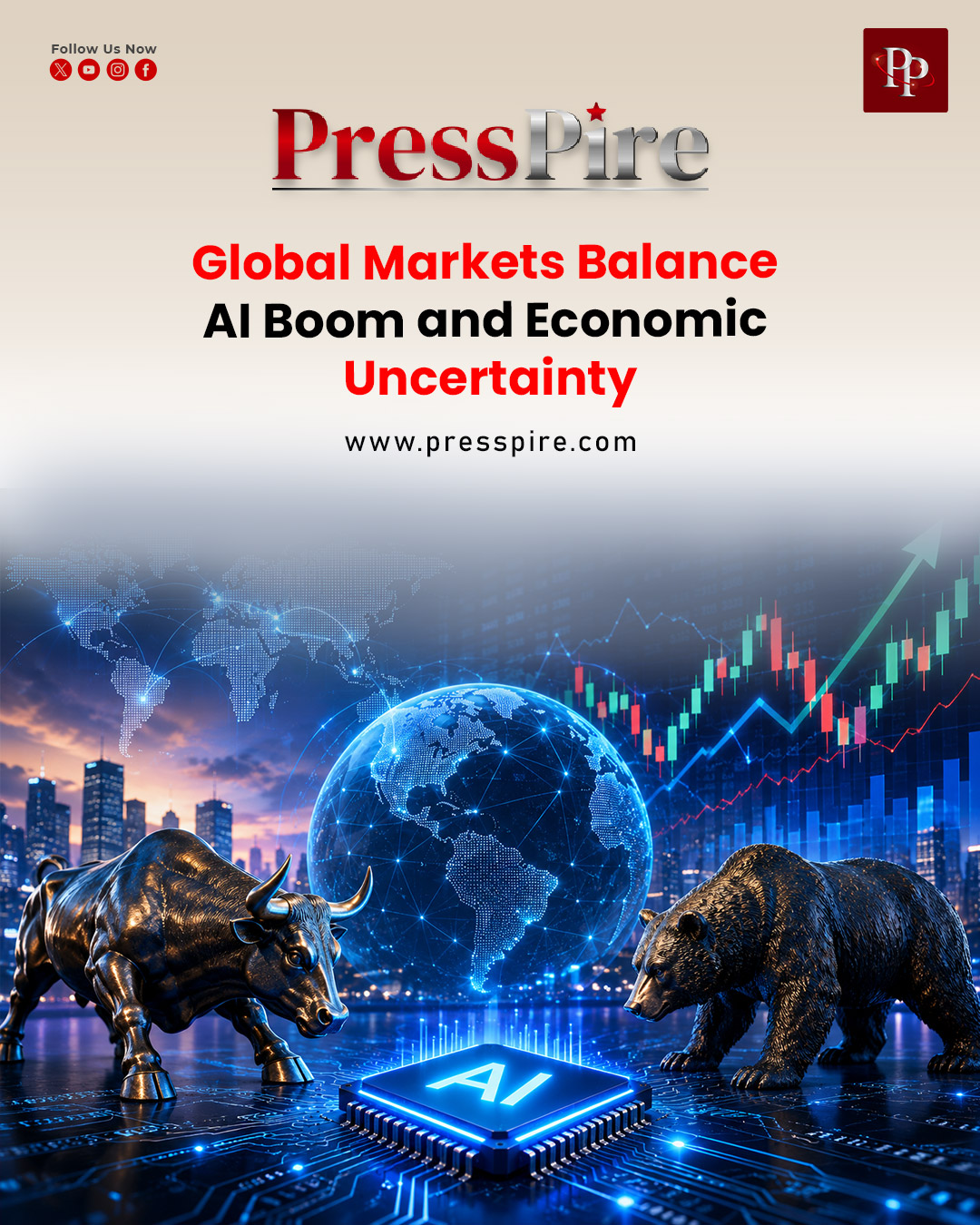
Global Markets Balance AI Boom and Economic Uncertainty
Global Markets Balance AI Boom and Economic Uncertainty as AI investments surge despite inflation, geopolitical tensions, and slowing global growth. Explore the latest market trends in 2026.
Global Markets Balance AI Boom and Economic Uncertainty
Artificial intelligence has become the defining force behind global financial markets in 2026. From Wall Street to Asian stock exchanges, investors are increasingly placing their confidence in AI-driven innovation while simultaneously navigating inflation, geopolitical tensions, interest rate uncertainty, and slowing economic growth. The phrase Global Markets Balance AI Boom and Economic Uncertainty perfectly captures the current investment landscape, where optimism surrounding AI is matched by caution over macroeconomic risks.
Technology companies continue to report strong earnings fueled by artificial intelligence investments, while governments and central banks remain focused on controlling inflation and maintaining financial stability. The result is a market environment where record-breaking valuations coexist with heightened volatility. Investors are no longer chasing growth blindly; instead, they are evaluating whether AI can deliver sustainable economic expansion without exposing portfolios to excessive risk.
As businesses accelerate digital transformation and governments prepare policies for responsible AI adoption, the global economy stands at a pivotal moment. The coming years will determine whether artificial intelligence can become the engine of long-term prosperity or whether economic headwinds will slow its momentum.
AI Boom Drives Global Markets Despite Economic Uncertainty
Artificial intelligence remains the biggest catalyst behind global equity markets in 2026. Companies involved in AI chips, cloud computing, cybersecurity, enterprise software, robotics, and digital infrastructure continue attracting billions of dollars in fresh investments. Major technology firms have announced record capital expenditure plans to build AI-ready infrastructure, reflecting strong confidence in the long-term commercial potential of artificial intelligence.
The AI ecosystem has expanded beyond technology companies. Banks now use AI for fraud detection and personalized financial services, healthcare providers rely on AI-powered diagnostics and drug discovery, manufacturers deploy intelligent automation to improve productivity, and retailers leverage AI to enhance customer experiences through predictive analytics. This widespread adoption demonstrates that AI has evolved into a core business strategy rather than a niche technological trend.
Financial analysts believe that artificial intelligence has become the world’s next general-purpose technology, comparable to the internet or electricity in terms of its long-term economic impact. As a result, institutional investors continue increasing their exposure to AI-related sectors despite ongoing macroeconomic uncertainties. This confidence has helped major stock indices remain resilient even during periods of heightened market volatility.
Why Investors Continue to Bet on Artificial Intelligence Amid Global Economic Uncertainty
One of the primary reasons why Global Markets Balance AI Boom and Economic Uncertainty is the extraordinary growth potential offered by artificial intelligence. Companies worldwide are investing heavily in generative AI, machine learning, cloud computing, and semiconductor manufacturing to improve operational efficiency and create new revenue streams.
The demand for AI infrastructure has created significant opportunities across multiple industries. Semiconductor manufacturers are witnessing unprecedented demand for advanced chips required to train and deploy large language models. Cloud service providers continue expanding data centres to support enterprise AI workloads, while cybersecurity firms are developing AI-powered security solutions to protect increasingly digital businesses.
Investors also recognize that AI has the potential to significantly improve productivity across sectors. By automating repetitive tasks, accelerating decision-making, and enhancing data analysis, artificial intelligence enables businesses to reduce operational costs while increasing profitability. These productivity gains are expected to contribute meaningfully to global economic growth over the next decade.
Another factor supporting investor optimism is the rapid commercialization of AI technologies. Businesses are no longer experimenting with artificial intelligence—they are integrating AI into customer service, supply chain management, financial planning, marketing, software development, and product innovation. This shift from experimentation to enterprise-wide adoption has strengthened confidence that AI investments will continue delivering long-term returns.
At the same time, venture capital firms remain highly active in funding AI startups, while established corporations pursue acquisitions to strengthen their AI capabilities. This sustained investment cycle continues fueling innovation and reinforces the belief that AI will remain one of the most influential drivers of global economic transformation.
Economic Uncertainty Challenges Global Market Growth Despite the AI Boom
While artificial intelligence continues driving optimism, economic uncertainty remains a major concern for investors. Inflation has moderated compared to previous years but continues to affect household spending and corporate profitability across several major economies. Central banks remain cautious, carefully balancing the need to support economic growth while ensuring inflation remains under control.
Higher borrowing costs have increased financing expenses for businesses, particularly in capital-intensive industries. Consumer spending has also shown signs of slowing in certain regions as households adjust to elevated interest rates and persistent cost-of-living pressures. These developments have prompted economists to revise growth forecasts for several advanced economies.
Geopolitical tensions further complicate the outlook. Ongoing conflicts, trade disputes, and disruptions in global supply chains continue influencing commodity prices, shipping costs, and investor sentiment. Energy markets remain particularly sensitive to geopolitical developments, adding another layer of uncertainty for businesses and financial markets.
Despite these challenges, global investors remain optimistic because AI-driven corporate earnings continue supporting broader market performance. However, market experts caution that sustainable growth will depend on maintaining a careful balance between technological innovation and macroeconomic stability.
Central Banks and Interest Rates Influence How Global Markets Balance AI Boom and Economic Uncertainty
One of the biggest factors influencing whether Global Markets Balance AI Boom and Economic Uncertainty successfully is the monetary policy adopted by central banks. While artificial intelligence continues to generate optimism among investors, decisions made by institutions such as the U.S. Federal Reserve, the European Central Bank, the Bank of England, and several Asian central banks continue to shape market direction.
Over the past few years, central banks have focused on containing inflation through higher interest rates. Although inflation has eased from its peak, policymakers remain cautious about reducing rates too quickly, fearing a resurgence in price pressures. As a result, borrowing costs remain elevated for businesses and consumers, impacting housing markets, corporate investments, and household spending.
For equity markets, this creates a mixed environment. High-growth technology companies, including AI firms, often rely on significant capital expenditure for research, infrastructure, and innovation. Higher interest rates can increase financing costs, affecting profitability. However, the exceptional revenue growth generated by AI-related businesses has allowed many technology companies to outperform broader market expectations.
Bond markets have also responded to changing monetary policy. Investors seeking lower risk are increasingly allocating funds toward government securities and investment-grade corporate bonds while maintaining exposure to AI-focused equities. This balanced investment approach reflects growing confidence in artificial intelligence while acknowledging broader economic risks.
Economists believe that if inflation continues to moderate and interest rates gradually decline, the combination of lower borrowing costs and expanding AI investments could provide a significant boost to global economic growth over the next several years. Until then, central bank decisions will remain one of the most closely watched factors influencing global financial markets.
Corporate Earnings Reflect Why Global Markets Balance AI Boom and Economic Uncertainty
Corporate earnings reports have become one of the strongest indicators of how businesses are adapting to the evolving economic landscape. Across industries, companies investing in artificial intelligence are reporting stronger productivity, improved operational efficiency, and enhanced profitability, helping explain why Global Markets Balance AI Boom and Economic Uncertainty despite persistent macroeconomic challenges.
The technology sector remains the primary beneficiary of AI-driven growth. Leading semiconductor manufacturers continue reporting record demand for advanced AI chips used in machine learning, cloud computing, autonomous systems, and data centres. Cloud service providers are expanding their infrastructure to support enterprise AI applications, while software companies are embedding generative AI into business solutions for customers across industries.
Beyond technology, healthcare organizations are increasingly using AI to improve diagnostic accuracy, accelerate drug discovery, optimize hospital operations, and enhance patient care. Financial institutions are leveraging AI for fraud detection, algorithmic trading, customer service automation, and risk management. Manufacturing companies are implementing intelligent robotics and predictive maintenance systems to improve production efficiency and reduce operational costs.
Retail businesses have also embraced AI-powered personalization, demand forecasting, and inventory optimization, enabling them to better understand consumer behaviour and improve profitability. Logistics companies are deploying AI to streamline supply chain operations, optimize delivery routes, and reduce transportation costs.
These developments demonstrate that AI is no longer limited to Silicon Valley. Instead, artificial intelligence has become a strategic business investment across virtually every major industry. Companies that effectively integrate AI into their operations are increasingly outperforming competitors, reinforcing investor confidence even during periods of broader economic uncertainty.
Corporate leaders are also shifting capital allocation strategies. Rather than reducing technology spending during uncertain economic conditions, many organizations are increasing investments in AI infrastructure, cybersecurity, cloud computing, and digital transformation. This long-term commitment reflects the growing belief that AI will become essential for maintaining competitiveness in the global economy.
Investment Strategies Help Global Markets Balance AI Boom and Economic Uncertainty
The evolving investment landscape has prompted both institutional and retail investors to rethink traditional portfolio strategies. Instead of relying solely on high-growth technology stocks, investors are adopting diversified approaches that balance the opportunities created by artificial intelligence with the risks associated with economic uncertainty.
Portfolio diversification has become increasingly important as markets experience periodic volatility. While AI-related companies continue to generate attractive returns, investors are also allocating capital to defensive sectors such as healthcare, utilities, consumer staples, infrastructure, and financial services. These sectors often provide greater stability during periods of economic slowdown while still benefiting from AI adoption.
Infrastructure has emerged as one of the most attractive long-term investment themes supporting the AI revolution. Massive investments in semiconductor manufacturing, renewable energy, electricity grids, data centres, fibre-optic networks, and cloud infrastructure are expected to continue for years as AI applications require increasingly sophisticated computing resources.
Environmental, Social, and Governance (ESG) considerations are also influencing investment decisions. Investors are paying closer attention to the energy consumption of AI data centres, responsible AI governance, data privacy, and ethical use of artificial intelligence. Companies demonstrating sustainable AI practices are likely to attract stronger long-term investor interest.
Meanwhile, alternative investments such as private equity, venture capital, and AI-focused exchange-traded funds (ETFs) continue gaining popularity among investors seeking exposure to emerging technologies. Venture capital firms remain highly active in funding startups specializing in generative AI, robotics, autonomous systems, and enterprise software, further accelerating innovation across the global economy.
Despite continued optimism, financial experts advise investors to avoid concentrating portfolios exclusively in AI-related stocks. Instead, they recommend balancing exposure to high-growth technology companies with sectors capable of delivering consistent earnings during periods of economic uncertainty.
Future Outlook: How Global Markets Balance AI Boom and Economic Uncertainty in the Years Ahead
Looking ahead, the ability of Global Markets Balance AI Boom and Economic Uncertainty will largely depend on how governments, businesses, and investors respond to evolving economic conditions. Artificial intelligence is expected to remain one of the most influential drivers of productivity and innovation, but its long-term success will require supportive policies, strategic investments, and responsible governance.
Economists believe AI could contribute trillions of dollars to the global economy over the next decade by improving efficiency across manufacturing, healthcare, finance, education, logistics, and public services. Businesses that successfully integrate AI into their operations are likely to experience stronger productivity, reduced operational costs, and faster innovation cycles. This transformation is expected to create new markets, generate employment in high-skilled sectors, and enhance global competitiveness.
However, opportunities are accompanied by significant challenges. Governments must address concerns surrounding data privacy, cybersecurity, AI regulation, intellectual property, workforce displacement, and ethical AI deployment. At the same time, businesses must invest in employee reskilling to ensure workers can adapt to rapidly changing job requirements. Countries that combine technological innovation with sound economic policies are expected to attract greater foreign investment and strengthen their position in the global economy.
For investors, the outlook remains cautiously optimistic. While short-term market corrections are inevitable due to geopolitical events, inflation concerns, or policy changes, the structural growth story surrounding artificial intelligence remains intact. Analysts expect continued investments in semiconductor manufacturing, cloud computing, AI software, robotics, digital infrastructure, and clean energy to support long-term market expansion.
Key Risks That Could Impact Global Markets Balance AI Boom and Economic Uncertainty
Although artificial intelligence continues to power global equity markets, several risks could influence future market performance.
One of the biggest concerns is inflation, which continues to affect consumer purchasing power and business operating costs. Persistent inflation could force central banks to maintain higher interest rates for longer, reducing liquidity and slowing economic growth.
Geopolitical tensions remain another major challenge. Ongoing conflicts, trade restrictions, and disruptions to global supply chains can increase commodity prices, affect energy security, and weaken investor confidence. Businesses operating across multiple regions must continue building resilient supply chains to mitigate these risks.
Another emerging concern is the high valuation of AI-related stocks. While leading technology companies continue to report strong earnings, analysts caution that excessive market enthusiasm could result in temporary corrections if growth expectations are not met. Investors are therefore encouraged to focus on companies with strong fundamentals, sustainable profitability, and long-term AI strategies rather than speculative investments.
Cybersecurity threats are also becoming increasingly important as AI adoption expands. Organizations must strengthen digital security frameworks to protect sensitive data, maintain customer trust, and ensure regulatory compliance. Responsible AI governance will play a crucial role in sustaining long-term investor confidence.
Despite these challenges, experts believe the combination of technological innovation, resilient corporate earnings, and increasing AI adoption will continue supporting global markets over the coming decade.
For more insights navigate: PressPire | Stories That Shape the Future
Read previous article here: https://presspire.com/southwest-monsoon/
Follow PressPire on Facebook | Instagram | LinkedIn | YouTube
PressPire | Stories That Shape the Future