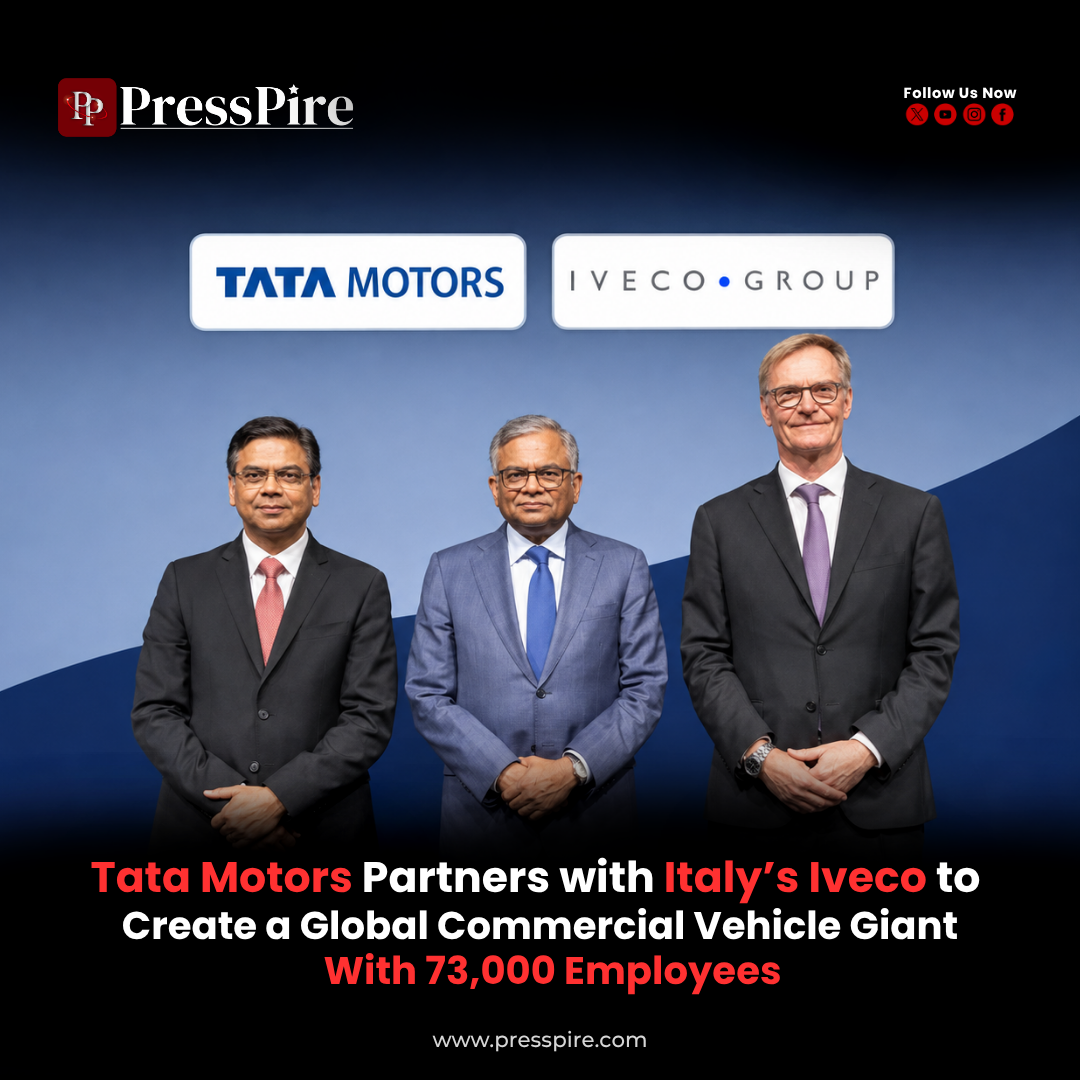
Tata Motors and Iveco Group have outlined a combined commercial vehicle business with more than 73,000 employees, operations across over 130 countries and approximately €21 billion in revenue.
The Tata Motors Iveco deal has brought together two major commercial vehicle manufacturers, creating a business with a wider international presence across trucks, buses and powertrain technologies.
At a global press conference in Turin, Italy, on 3 November 2026, the companies presented their plans for the combined enterprise. The announcement followed Tata Motors’ acquisition of an 89.42% controlling stake in Iveco Group through the initial settlement of its tender offer on 30 October.
The combination connects Tata Motors’ established position in India and other emerging markets with Iveco’s operations in Europe and Latin America. Together, the businesses employ more than 73,000 people across six continents.
Tata Motors Iveco Deal: The Key Figures
The companies described a substantial manufacturing, engineering and customer-service network that they intend to use for international expansion.
| Business measure | Announced figure |
|---|---|
| Combined workforce | More than 73,000 employees |
| Geographic presence | Over 130 countries |
| Combined revenue | Approximately €21 billion |
| Revenue equivalent cited by the companies | More than ₹2.28 lakh crore |
| Combined vehicle sales volume | Approximately 590,000 units |
| Manufacturing sites | 27 |
| Research and development centres | 25 |
| Sales and service centres | Approximately 9,300 |
| Tata Motors’ stake after initial settlement | 89.42%, excluding treasury shares from the calculation |
According to the companies, the combination ranks fourth globally by truck sales volumes in the above-six-tonne segment. That qualification is important: the ranking concerns a defined truck category.
How Tata Motors Acquired Control of Iveco
The transaction moved into its ownership phase on 30 October 2026, when Tata Motors completed the initial settlement of its recommended tender offer.
Through its indirect subsidiary TML CV Holdings B.V., the company acquired approximately 238.16 million Iveco common shares at an offer price of €14.40 per share.
The resulting controlling stake made Iveco part of Tata Motors. The process for acquiring additional shares continued, with the offer reopened from 2 to 6 November and settlement for shares tendered during that window scheduled for 13 November 2026.
The acquired business excludes Iveco’s former defence operations. Those operations, including the IDV and ASTRA brands, were transferred separately to Leonardo on 18 March 2026.
Why the Two Businesses Fit Together
The strategic case rests partly on the companies’ different geographic strengths.
Tata Motors has extensive experience serving India and other emerging markets. Iveco contributes established operations, customer relationships and distribution networks in Europe and Latin America.
This creates opportunities to introduce suitable products through an existing local network. Entering a market becomes more practical when a manufacturer can draw on dealers, service facilities and customer knowledge already present there.
Their product ranges also cover different commercial transport requirements, from smaller delivery vehicles to heavy trucks and passenger buses.
The opportunity is therefore broader than selling more of the same vehicles. It includes deciding which products, technologies and components can serve customers in additional markets—and adapting them to local requirements.
What the 73,000-Employee Workforce Represents
The 73,000-plus figure describes the combined workforce across Tata Motors and Iveco Group.
These employees bring experience in manufacturing, engineering, software, sales, distribution and customer support. The companies have identified the exchange of technical expertise and market knowledge as an important part of their plans.
For a business operating across many countries, that knowledge can be as valuable as manufacturing capacity. Engineers need to understand different operating conditions, while sales and service teams need to understand how local customers buy, finance and maintain their vehicles.
The practical challenge will be to make collaboration useful: transferring relevant knowledge between teams, coordinating development work and bringing suitable products to market.
Could Iveco Vehicles Be Assembled in India?
Local assembly is one of the opportunities being explored.
Speaking at the Turin event, N Chandrasekaran, chairman of Tata Sons, Tata Motors and Iveco Group, said the companies were identifying Iveco products that could be relevant to Indian customers.
Management discussed beginning with semi-knocked-down assembly, under which partially assembled vehicle kits are brought into a market for further assembly.
The companies are also examining opportunities involving components, batteries and the introduction of Tata Motors products through Iveco’s international operations.
These discussions describe areas under evaluation. Commercial decisions will depend on product suitability, demand, costs and the level of localisation required.
For India’s automotive suppliers, successful localisation could create opportunities to participate in a broader international production network.
Powertrain Technology Adds Another Dimension
The deal also brings access to FPT, Iveco Group’s powertrain business.
FPT’s activities extend beyond road vehicles to applications such as agricultural machinery, construction equipment, marine engines and power generation. That gives the combination opportunities outside the sale of complete trucks and buses.
At the Turin event, Tata Motors Managing Director and CEO Girish Wagh highlighted FPT’s engineering capabilities and customer relationships.
The combined technology portfolio includes conventional combustion engines, natural gas, battery-electric systems and hydrogen-related technologies.
For commercial transport, different applications can require different solutions. A city bus operating on a predictable route has different needs from a long-distance truck carrying heavy loads. Vehicle cost, range, charging or refuelling access, payload and maintenance all influence what customers can use effectively.
The breadth of the companies’ capabilities gives them more options to address those requirements.
Iveco’s Headquarters Will Remain in Turin
The companies have said that Iveco Group will remain headquartered in Turin, retaining its brands, teams and industrial identity.
Tata Motors has also committed to supporting Iveco’s existing strategy and investment plans.
For a cross-border acquisition, this approach makes local management and engineering knowledge important to the wider business. Established brands carry customer relationships and expectations that take years to build.
The leadership task is to create useful cooperation while maintaining clear responsibility for product quality, investment and customer service.
What Customers, Dealers and Suppliers Can Expect
The companies have emphasised continuity during the transition.
Their announcement states that existing customer contracts, warranties, dealer and supplier relationships, aftermarket commitments and financing arrangements will continue through the established teams and networks.
For fleet operators, the value of a vehicle extends well beyond its purchase price. Parts availability, repair times, fuel or energy costs and access to service support influence the cost of keeping it on the road.
A larger international network could support a broader product offering and stronger service coverage over time. Those benefits will depend on how the companies connect their operations and implement their plans.
Suppliers and dealers may also gain access to additional markets, although individual opportunities will depend on future sourcing and distribution decisions.
What Will Determine the Deal’s Long-Term Success?
The Tata Motors Iveco deal establishes substantial global scale. Its commercial results will depend on how effectively the businesses use it.
The main developments to watch include new product introductions, progress on Indian assembly plans, cooperation in powertrain development and expansion through each other’s distribution networks.
Management has expressed an ambition to increase vehicle volumes, revenue and profitability over the next five years. Detailed business plans will be important for assessing that ambition.
For customers, the clearest evidence of progress will be competitive vehicles, dependable service and technologies that work economically in their daily operations. For the combined business, those outcomes will determine how successfully its international reach translates into sustained growth.
For more insights navigate: PressPire | Stories That Shape the Future
Read previous article here : pune-metro-pink-line/
Follow PressPire on Facebook | Instagram | LinkedIn | YouTube
PressPire | Stories That Shape the Future