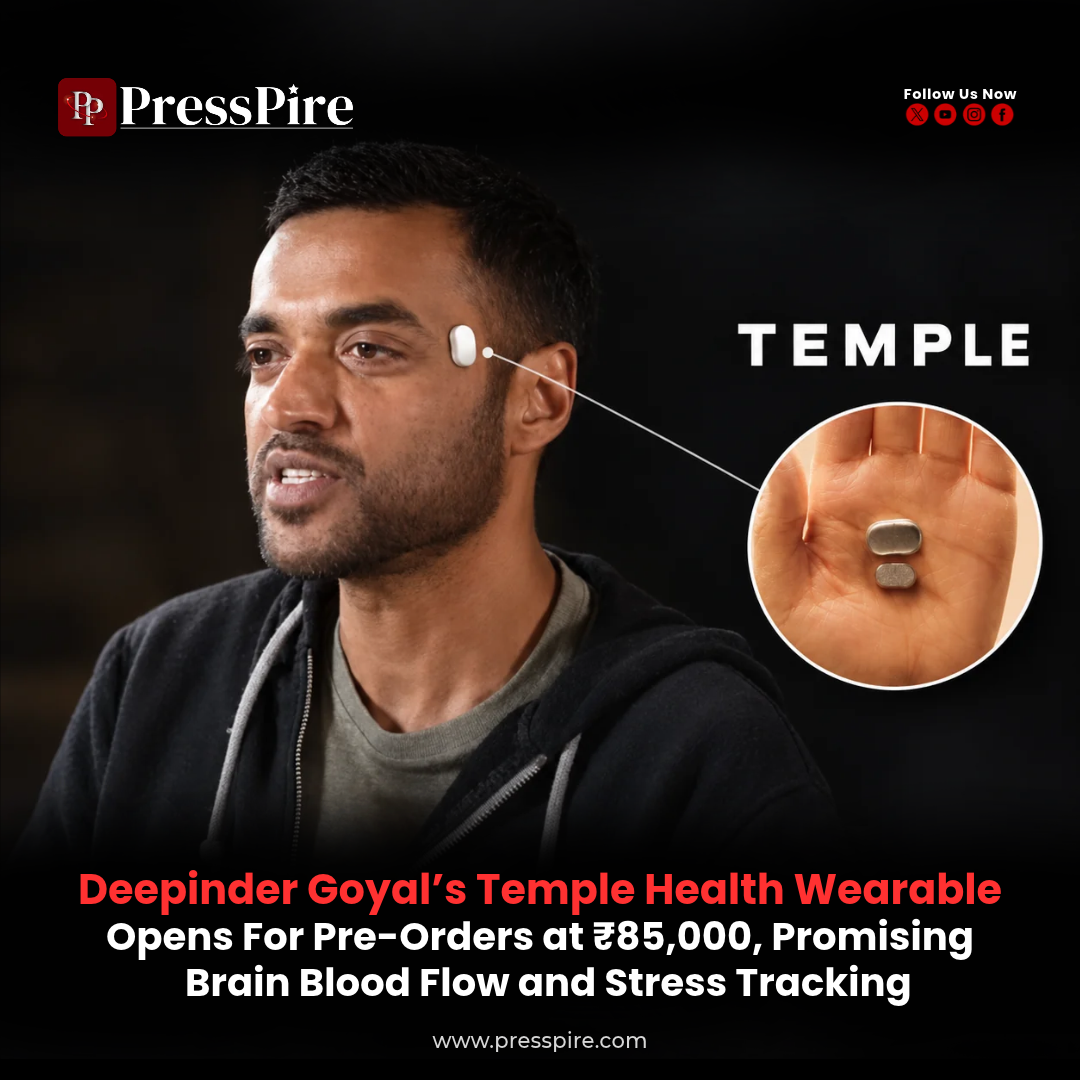
Deepinder Goyal’s Temple Wearable Opens ₹85,000 Pre-Orders
The Zomato founder’s health technology venture is accepting orders for a device designed to track signals associated with brain blood flow and physiological strain, with deliveries expected in approximately three months.
Updated: 2 November 2026
The Temple wearable, developed by Zomato founder Deepinder Goyal’s health technology venture, has opened for pre-orders in India. Reports covering the booking process list the device at ₹85,000, placing it in the premium consumer wellness market.
The Indian pre-order window opened on 1 November 2026. Temple’s official website now confirms that bookings are available, with orders accessible through its website and mobile application.
Worn against the side of the head, the device uses optical sensors to collect physiological signals. Its central features include a proprietary BrainFlow index and an Entropy metric, which the company positions around understanding the body’s response to different demands.
The launch introduces an unusual approach to wearable technology. However, its commercial availability and its scientific validation are separate developments: Temple describes the product as a wellness device, and the research supporting its BrainFlow measurements remains preliminary.
Temple Wearable Price, Pre-Orders and Delivery
The ₹85,000 figure has appeared in reports describing Temple’s app listings and early-access invitations. The publicly accessible homepage confirms that pre-orders are open but does not display a detailed Indian price breakdown.
The first commercial batch, referred to as Batch 01, follows a made-to-order production model. Goyal has said that each device will be made after an order is placed, with delivery expected within approximately three months.
| Detail | What has been announced or reported |
|---|---|
| Indian pre-order opening | 1 November 2026 |
| Reported listed price | ₹85,000 |
| Initial release | Batch 01 |
| Production approach | Made to order |
| Expected delivery | Approximately three months after purchase |
| Product positioning | Consumer wellness and physiological tracking |
For orders placed in November, that delivery estimate points towards early 2027. It remains an estimate rather than a guaranteed arrival date.
Pre-order coverage also reports that buyers can request refunds until their device ships. Reports describe lifetime platform access as part of the initial offer, although the precise scope of that access should be read alongside the purchase terms.
How the Temple Wearable Works
Temple attaches near the temple using adhesive strips called Grips. Its placement gives the product a different physical design from wrist-based fitness trackers and smart rings.
The device uses light-based sensing, including a technique called photoplethysmography, or PPG. In simple terms, optical sensors observe changes in reflected light that are associated with blood-volume fluctuations in tissue.
Temple’s software processes these signals into its own measurements. The important scientific question is how closely those measurements reflect changes originating within the brain, rather than signals from the scalp or other influences.
That distinction is central to understanding both the product’s appeal and the limits of its current evidence.
What BrainFlow and Entropy Mean
BrainFlow: A Relative Index
BrainFlow is Temple’s proprietary index intended to track changes associated with cerebral circulation.
It should not be interpreted as a direct clinical measurement of the exact volume of blood reaching the brain. The published research examines whether changes in the index correspond with changes recorded by reference instruments under controlled conditions.
A relative index can show a signal rising or falling. Establishing what a particular reading means for an individual’s health requires additional evidence.
Entropy: The Company’s Wellness Metric
Temple describes Entropy in terms of the body’s effort to dissipate heat. Its explanation connects the measurement with physiological load at rest and during activity.
The company’s broader pitch includes helping users understand responses to stress, exercise and recovery. However, a proprietary wellness score does not automatically establish a medically validated measure of psychological stress.
The BrainFlow studies also should not be treated as validation of every separate feature or interpretation offered through the platform.
What the Early Research Shows
Temple’s research page highlights two studies comparing its BrainFlow index with reference measurements. Both are available as preprints and remain listed by the company as being under peer review.
One study recruited 23 healthy adults, with 20 included in the per-protocol analysis. Researchers compared the wearable’s signal with transcranial Doppler measurements during exercise and changes in posture.
The study reported correlations of approximately 0.8 between changes in the wearable’s index and the reference measurements. This describes how the signals varied together; it does not mean that the device demonstrated “80% accuracy” or can replace the reference equipment.
A second study analysed 60 recording sessions involving 44 healthy young men. It compared BrainFlow with measurements from depth-resolved near-infrared spectroscopy during controlled changes in body position.
The findings supported an association with model-derived brain-related haemodynamic changes. However, the researchers could not exclude contributions from superficial tissue or wider changes in the circulation.
The second study was designed, funded and conducted by Temple, with company affiliations disclosed. Broader testing and independent replication would help establish how reliably the findings apply to everyday use.
Is Temple a Medical Device?
Temple’s terms state that the product is not a medical device and is not intended to diagnose, treat, cure or prevent disease.
The terms also distinguish its data from measurements produced by professional medical or scientific equipment.
This matters because phrases such as “brain blood flow tracking” can suggest capabilities beyond what the current research establishes. An association with a reference signal does not, by itself, demonstrate that a consumer device can detect a neurological condition.
Similarly, the available studies do not show that wearing Temple reduces stress, prevents cognitive decline or extends lifespan.
Its present proposition is to provide wellness information that users can observe over time, while further research determines the reliability and practical significance of its measurements.
The Business Challenge Behind the ₹85,000 Price
Temple’s reported price places considerable importance on the usefulness of its data. Buyers will need more than an unfamiliar metric: they will need clear explanations of what changes in that metric mean.
Everyday comfort, consistent readings, dependable adhesive attachment and a usable app will also influence whether customers continue wearing the device after the initial novelty fades.
The made-to-order approach gives the company a more controlled first production phase. Its next commercial milestones will include delivering those orders, supporting customers and demonstrating that the product works consistently outside research settings.
The opening of pre-orders moves Temple into its first consumer delivery phase. Its longer-term prospects will depend on how effectively it connects its engineering and research with information that customers can understand and use.
For more insights navigate: PressPire | Stories That Shape the Future
Read previous article here : manisha-bhanwala-world-wrestling-gold/
Follow PressPire on Facebook | Instagram | LinkedIn | YouTube
PressPire | Stories That Shape the Future