
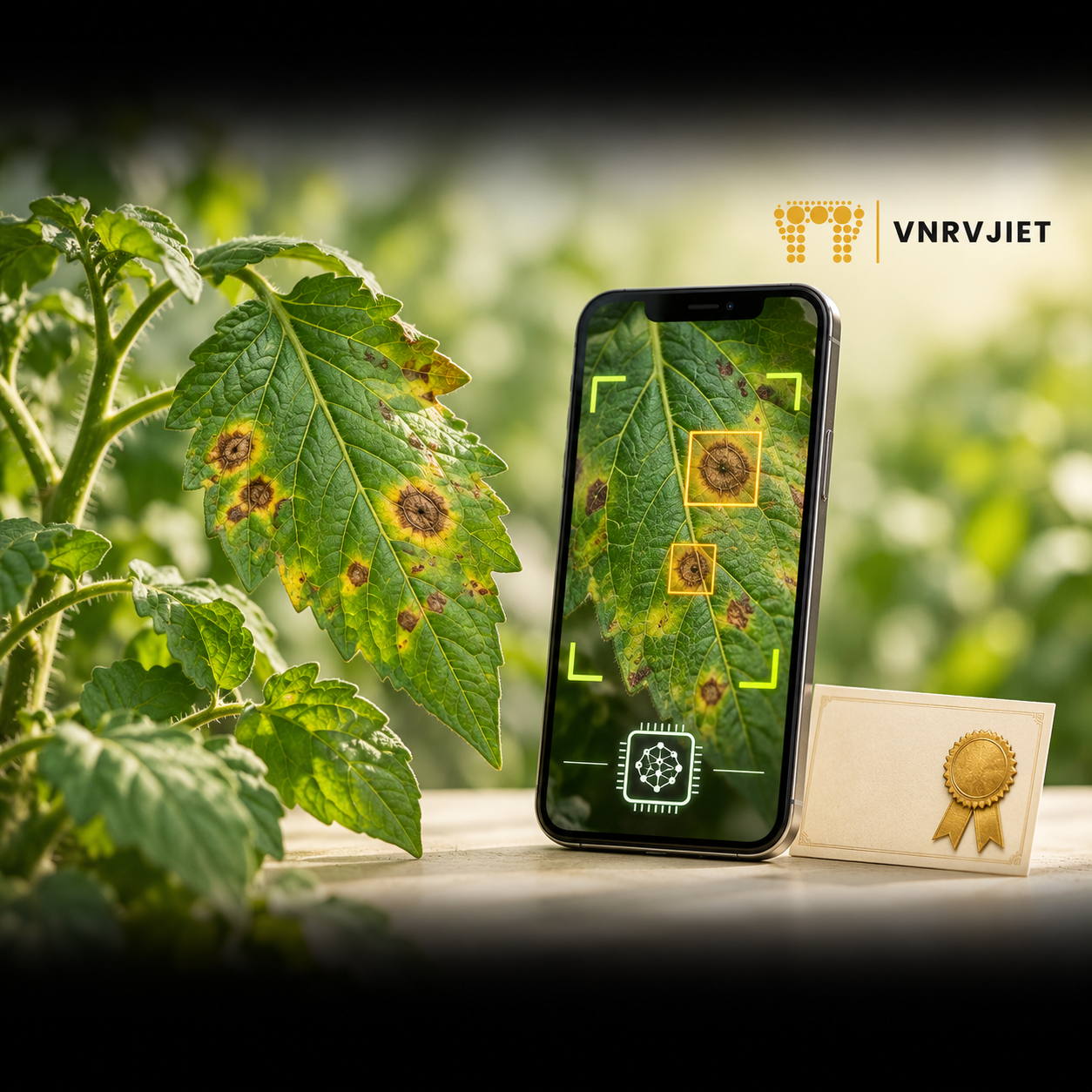
VNR VJIET Secures Patent for AI Leaf Disease Detection
Researchers at the Hyderabad engineering institute are developing image-based tools to identify crop diseases, with a mobile app planned to bring the technology closer to farmers.
Researchers at Hyderabad’s VNR Vignana Jyothi Institute of Engineering and Technology, known as VNR VJIET, have secured an Indian patent for an AI leaf disease detection system.
The institute records the patent grant date as 5 May 2026, under Patent No. 588346. The research uses convolutional neural networks, a type of artificial intelligence suited to analysing images, to identify signs of disease in crop leaves.
According to the institute’s July announcement, the system was trained using nearly 20,000 images of tomato, potato and pepper plants. It reported approximately 96% accuracy in identifying ten common leaf diseases.
The project combines an agricultural problem with computer vision: helping farmers interpret visible changes in leaves and seek an appropriate response.
VNR VJIET Secure AI Leaf Disease Detection: Key Details
| Detail | Information |
|---|---|
| Institution | VNR VJIET, Hyderabad |
| Patent number | 588346 |
| Patent grant date | 5 May 2026 |
| Core technology | Convolutional neural networks |
| Crops covered in the reported research | Tomato, potato and pepper |
| Reported training images | Nearly 20,000 |
| Institute-reported accuracy | Approximately 96% |
| Mobile application | Described as planned in July 2026 |
The accuracy figure relates to the research reported by the institute. It should not be read as a guarantee of identical results across every farm, camera or growing condition.
The Research Team Behind the Patent Of VNR VJIET
The project was led by Dr. R. Vijaya Saraswathi from the institute’s Computer Science and Engineering department.
The institute’s announcement also names R. Vasavi, M. Gangappa, G. Laxmi Deepthi, B. V. Seshu Kumari, B. Ganesh Babu, A. Giri Prasad, K. Aruna Kumari, N. Sravani and K. Jaya Jones.
The collaboration spans computer science, information technology, electrical engineering, and electronics and communication engineering. In a July interview, the lead researcher described contributions ranging from algorithms and data processing to image acquisition and hardware integration.
That combination reflects the practical demands of the project. A useful agricultural tool needs both a capable model and a reliable way to collect and process images.
A Family’s Crop Loss Inspired the Research
The work has a personal connection to farming.
The Times of India reported that Vijaya Saraswathi grew up in a farming family and experienced a major crop loss when she was around 13. Her family had planted tomatoes on three acres of its five-acre holding when disease destroyed the tomato crop.
The experience later helped shape her interest in using technology to address crop disease. It gives the project a practical motivation: making useful information available while farmers still have an opportunity to respond.
How the AI System Analyses Leaves
Convolutional neural networks learn visual patterns from examples. For plant disease identification, a model learns relationships between leaf images and their associated disease labels, then uses those patterns to classify new images.
In the VNR VJIET project, the researchers describe an image-processing workflow that includes resizing, augmentation and noise reduction.
Resizing prepares images for consistent processing. Augmentation creates variations of training images to expose the model to a broader range of appearances. Noise reduction aims to limit visual interference that could affect analysis.
The lead researcher has also described a recommendation component intended to suggest remedies after a disease is identified. Any such recommendation would need to match the crop and diagnosis and be suitable for local growing conditions.
Why Field Performance Matters
Photographs taken on farms can vary considerably. Shadows, lighting, background clutter, leaf movement and camera quality can change what the system sees.
The researcher identified these issues as development challenges. They explain why a headline accuracy figure provides only part of the picture.
Published plant-disease research has also shown that image classifiers can perform differently when tested on photographs that differ from their training data. For a farmer-facing tool, testing across varied locations and image conditions is therefore important.
The approximately 96% figure reported by VNR VJIET is a research result. The reviewed announcements do not provide enough detail to establish equivalent performance across different regions, crop varieties and seasons.
A Mobile App Is Part of the Development Plan
In July 2026, Vijaya Saraswathi said the team was preparing a mobile application to make the technology accessible to farmers.
The intended approach is straightforward: use a photograph of a leaf as the starting point for an assessment. If implemented reliably, this could help a farmer decide when to seek further advice.
However, the July interview described commercialisation as unfinished. The reviewed announcements do not establish a public app launch, subscription price or large-scale farmer deployment.
The team has also discussed extending coverage to more crops and exploring drone-based assessment and offline processing. These are development ambitions rather than confirmed features of an available product.
From Patent to Practical Agricultural Use
The patent is a milestone for the research team. The next challenge is turning the work into a tool that farmers can use consistently.
Useful measures of progress would include published field-test results, clear limits on supported diseases, and evidence that users can capture suitable images. A tool should also communicate when an image is unclear or a condition falls outside its capabilities.
The potential benefit is easier access to an initial assessment. Demonstrating reduced crop losses, better yields or lower pesticide use would require additional evidence.
For VNR VJIET, the opportunity now lies in connecting its patented research with dependable performance under everyday farming conditions.
For more insights navigate: PressPire | Stories That Shape the Future
Read previous article here : hdfc-bank-probe-confidential-information-leak/
Follow PressPire on Facebook | Instagram | LinkedIn | YouTube
PressPire | Stories That Shape the Future