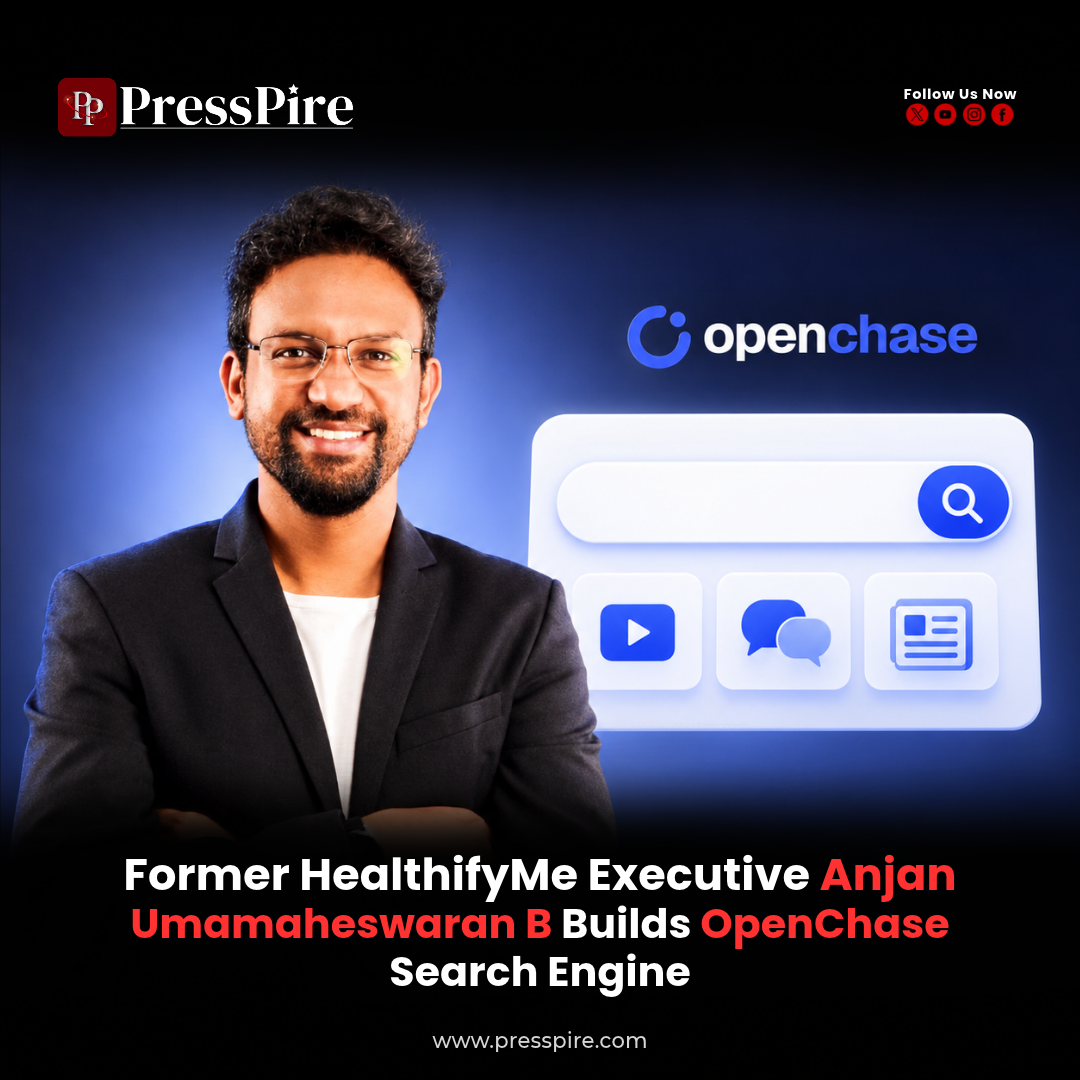
Former HealthifyMe Executive Anjan Umamaheswaran B Builds OpenChase Search Engine
The OpenChase search engine brings social media discussions, videos, forums and news into a single search experience. Built by Anjan Umamaheswaran B, founder of CuriousCats and former Chief Business Officer and Chief Product Officer at HealthifyMe, the platform aims to help people discover what is being discussed across the internet.
According to Indian Startup Times, OpenChase launched in public beta on 19 October 2026. Its central proposition is straightforward: make it easier to explore a subject through both published reporting and the conversations surrounding it.
That could be useful when a news article explains an announcement, while community discussions reveal the questions, concerns and experiences it has generated.
What Is the OpenChase Search Engine?
OpenChase describes itself as a search service for social media, video, forums and news, with an emphasis on current information.
Its official website lists support for X, Reddit, YouTube, TikTok, Instagram, Facebook, Threads, LinkedIn, Substack and Medium, alongside news sites. The aim is to make content from these different sources discoverable through one query.
For users, that means the service is positioned around a particular discovery task: finding relevant conversations and reporting without beginning a separate search on every platform.
Anjan Umamaheswaran B: From HealthifyMe to CuriousCats
Before building CuriousCats and OpenChase, Anjan held senior product and business roles at HealthifyMe.
In an earlier interview with Indian Startup Times, he described the frustration of moving between newsletters, news services, videos and social feeds to follow his interests. He initially developed CuriousCats as a personal solution and subsequently left Healthify in 2025 to work on it full-time.
CuriousCats focuses on gathering information and delivering personalised briefings. The OpenChase search engine extends the team’s work into a service where users actively search for a subject.
In his launch announcement, Anjan explained that a standalone search engine had not been the original objective. The team was developing ways to understand online conversations for CuriousCats. That capability eventually appeared useful enough to become a separate product.
OpenChase Search Engine: 5 Key Features
The launch materials describe five aspects of the service.
1. Search Across Multiple Content Platforms
OpenChase combines results from social networks, discussion communities, video services and publishers. For someone investigating a topic, the potential benefit is having fewer separate searches to organise and compare.
2. Explore Recent Discussions
Launch coverage describes access to material from the previous 24 hours, with results organised by platform and story. It also reports options to search across individual countries or several countries.
3. Review AI-Generated Themes
The platform is described as producing AI overviews that identify themes in the retrieved material. These can include labels such as factual, speculative, critical or celebratory.
Such labels should be treated as the system’s interpretation of the material, rather than independent verification.
4. Inspect the Original Sources
Launch coverage says users can open themes to inspect the original posts behind them. This could help readers check wording, attribution and context before relying on a summary.
5. Try the Public Beta for Free
The OpenChase search engine launched with free access, without an invitation code or waitlist, according to its founder. He also acknowledged that the product was at an early stage and asked users to report problems.
How Journalists, Marketers and Researchers Could Use It
The announced capabilities suggest several practical uses for the OpenChase search engine.
For a journalist covering a product launch, a combined search could help locate questions from customers, reactions from industry professionals and discussions about availability. Those results could provide leads for interviews or further reporting. Any factual claim would still require checking.
A marketing team could use a similar approach to explore how a campaign is being received. Repeated complaints might identify an issue worth investigating, while positive reactions could suggest which messages are resonating. A useful assessment would distinguish recurring feedback from duplicated posts or coordinated promotion.
Researchers could compare how different communities frame the same subject. For example, a professional discussion might focus on commercial implications, while a consumer forum highlights practical problems. Viewing both could help identify questions that a single source would miss.
Creators could also use the results to find unanswered questions around a topic. The value would come from understanding those questions and producing a useful response.
Developer Tools Are on the Roadmap
Anjan’s announcement says a Search API and Model Context Protocol support are coming, with a separate waitlist for developer and agent integrations.
These are planned capabilities. They should not be confused with the public search service already announced.
If delivered, such tools could allow developers to incorporate retrieved material into research assistants or other applications. Their usefulness would depend on the eventual documentation, access conditions, reliability and quality of the returned sources.
Why Social Media Search Matters
A published article and a community discussion can answer different questions about the same event. Reporting may explain what a company announced. Discussion threads may show which details people find confusing, how they interpret the announcement or what they want clarified.
Bringing those perspectives together could help users build a fuller picture. A product researcher, for example, might find that the feature receiving the most publicity is different from the issue customers keep asking about.
The opportunity for the OpenChase search engine is to make those connections easier to discover. Its usefulness will depend on how consistently it returns relevant, recent material and preserves the context of each source.
There is also an important distinction between finding a conversation and establishing a fact. Popularity alone does not prove accuracy. Access to original posts therefore matters: it lets users inspect the evidence and decide what needs further investigation.
For more insights navigate: PressPire | Stories That Shape the Future
Read previous article here : vedanta-gamsberg-expansion-south-africa/
Follow PressPire on Facebook | Instagram | LinkedIn | YouTube
PressPire | Stories That Shape the Future