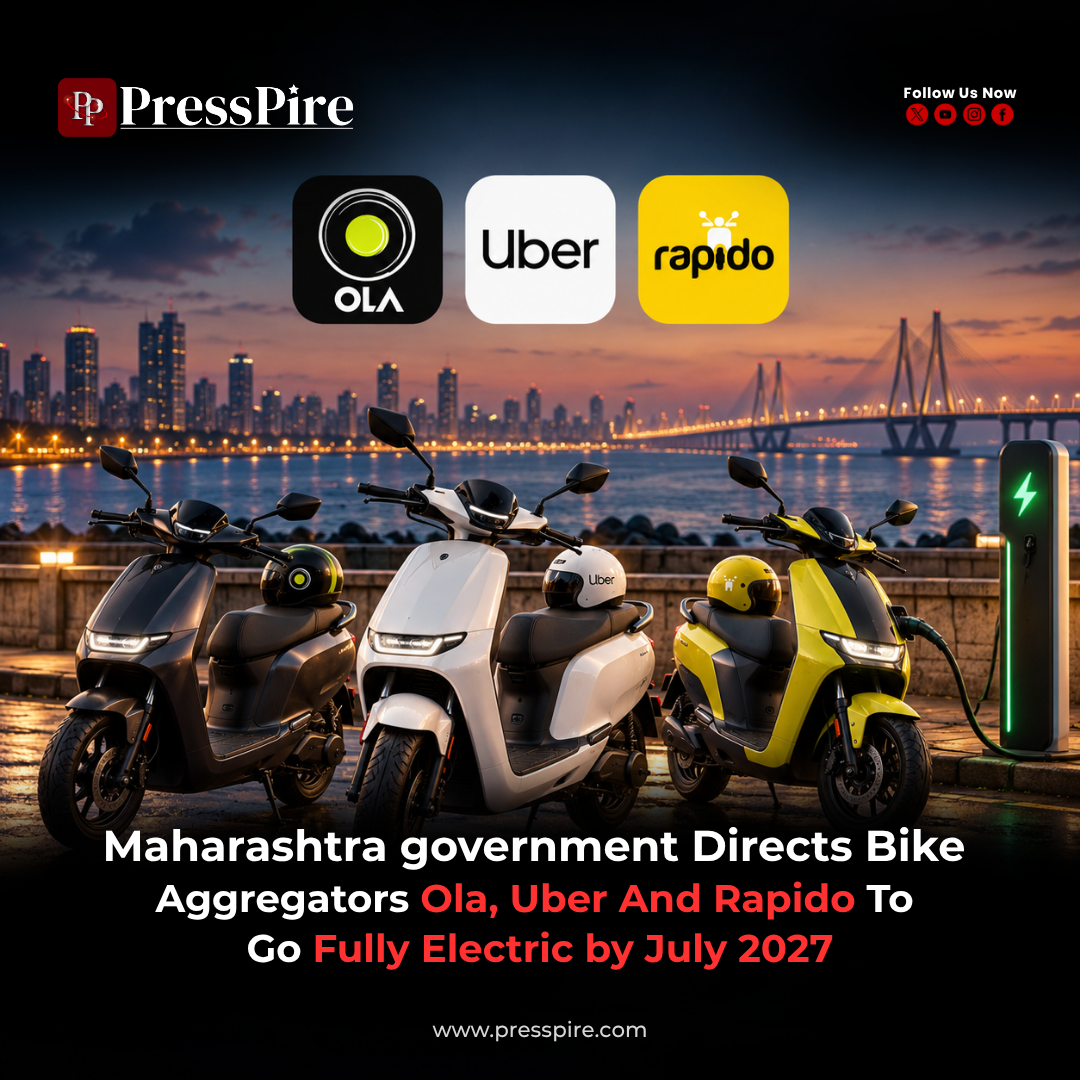
Maharashtra government Directs Bike Taxi Aggregators Ola, Uber and Rapido to Go Fully Electric by July 2027
PressPire 9 October 2026
Maharashtra bike taxi operators, including Ola, Uber and Rapido, have been directed to move to fully electric fleets by July 2027, according to reporting by The Indian Express. The State Transport Department communicated a phased transition to aggregators and Regional Transport Offices in October.
The decision puts a timetable on the replacement of petrol-powered bike taxis. For passengers, its success will depend on whether services remain accessible. For drivers and platforms, the immediate challenge is arranging suitable vehicles, affordable financing and reliable charging.
How the Maharashtra bike taxi transition will work
The reported timetable provides six months initially, followed by an additional three months for eligible operators connected to the provisional or temporary licensing process under the Maharashtra Bike Taxi Rules, 2025. The Economic Times describes the extension as possible, rather than an unconditional allowance for every operator.
The July 2027 date is therefore the reported endpoint of a transition lasting up to nine months. Individual operators will need to establish which licensing conditions and extension requirements apply to them. The directive concerns the platforms’ bike-taxi operations in Maharashtra.
Why platforms and riders asked for more time
The Maharashtra Bike Taxi Welfare Association had sought 18 months for the switch. Its concerns included the purchase cost of electric vehicles and access to charging. Aggregators reportedly requested an extension until 2030, but the government retained the shorter timetable.
A proposal to permit an equal mix of petrol and electric motorcycles was also considered earlier. According to The Indian Express, Transport Minister Pratap Sarnaik said the Cabinet rejected it amid concerns that operators might continue favouring petrol vehicles.
These requests highlight a practical tension. A fixed deadline gives businesses a planning target, while drivers need to understand how the change will affect their daily earnings and existing vehicle commitments.
What the Maharashtra Bike Taxi Rules already require
The state’s published July 2025 rules establish a licensing framework for bike-taxi services. They require an applicant to have at least 50 electric bike taxis, either through ownership or agreements with their owners, before beginning services.
The rules also address vehicle registration, insurance, fitness certification, maintenance and battery-charging facilities. Operators must provide arrangements for customer grievances and maintain a round-the-clock control room.
Electrification therefore sits within a wider set of operating obligations. Replacing a petrol motorcycle with an electric model is only one part of preparing a compliant service. The Maharashtra bike taxi transition will also require coordination between platforms, vehicle owners and transport authorities.
What the switch could mean for driver earnings
For a driver, the relevant comparison is the total cost of staying on the road. A vehicle’s purchase price or monthly instalment must be considered alongside charging charges, insurance, maintenance, battery terms and time spent away from paid trips.
A driver still repaying a petrol motorcycle could face overlapping commitments when moving to another vehicle. Leasing may reduce the initial payment, but a fixed rental can remain difficult to cover during periods of low demand. These are potential effects of the transition, not announced terms of a government assistance programme.
Platforms could make the switch easier by publishing clear vehicle-access options and explaining who bears maintenance and battery replacement costs. Any financing or leasing arrangement would need to be judged against the driver’s expected income, rather than a headline promise of lower running costs.
Charging access will shape daily operations
The International Energy Agency notes that removable batteries can allow some electric two-wheelers to charge at home. It also identifies battery swapping as useful for taxi and delivery applications, where a quick return to service matters.
For Maharashtra bike taxi fleets, that points to the importance of matching the vehicle to the work. A motorcycle that suits occasional personal travel may have different charging needs when used for repeated passenger trips.
Charging locations, opening hours, queues and compatibility could all affect how much time a rider spends earning. Swapping can help only where suitable batteries and dependable stations are available. Procurement and infrastructure planning will therefore need to progress together.
How the policy fits into the Indian electric two wheeler market
The IEA’s Global EV Outlook 2026 identifies India as the world’s second-largest electric two-wheeler market. Electric models represented around 6% of the country’s two-wheeler sales in 2025.
That gives the Maharashtra bike taxi mandate an established vehicle market to draw on, although national sales figures do not show whether enough suitable commercial vehicles are immediately available in every operating area.
The transition could create opportunities for manufacturers, leasing businesses and charging providers. Realising them would depend on purchase orders, service support and workable operating costs. A regulatory deadline alone does not establish the size of that opportunity.
Battery-electric two-wheelers produce no exhaust emissions while being ridden. The IEA identifies electrifying this vehicle category as a way to improve urban air quality. The scale of the benefit in Maharashtra would depend on how many petrol trips are replaced.
What passengers should watch
For commuters, the most useful measures will be ride availability, waiting times, fare transparency and service reliability. A gradual switch could allow platforms to introduce vehicles while maintaining coverage. If financing or vehicle delivery falls behind, some areas could instead experience temporary shortages.
Neither outcome can be assumed from the deadline alone. The reports reviewed do not establish a new passenger fare or quantify the effect on driver income. Those questions will become clearer as operators announce their transition arrangements.
For the Maharashtra bike taxi sector, the next developments to watch are vehicle-access plans, charging partnerships and clearer implementation instructions for eligible operators. These will show how the reported timetable translates into a service that drivers can afford to provide and passengers can continue to use.
For more insights navigate: PressPire | Stories That Shape the Future
Read previous article here : sunfox-funding-series-a-cardiac-diagnostics-2/
Follow PressPire on Facebook | Instagram | LinkedIn | YouTube
PressPire | Stories That Shape the Future